
The Fed's Dilemma: Navigating Inflation Stickiness and Rate Cut Expectations in 2025
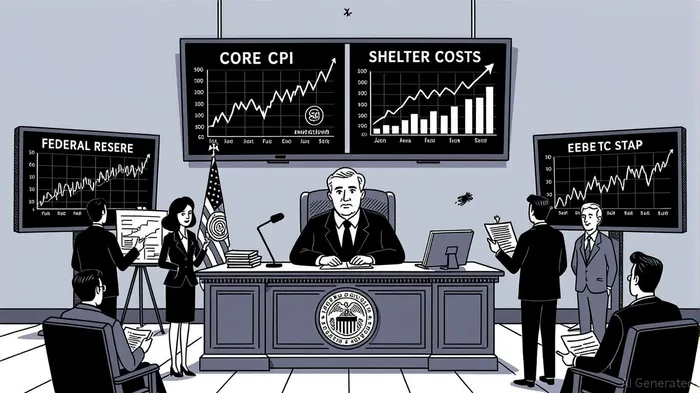
The Federal Reserve faces a complex balancing act in 2025, caught between persistent inflationary pressures and mounting expectations for rate cuts to stimulate a slowing economy. For bond investors, this policy uncertainty demands a nuanced approach to portfolio positioning, as central bank decisions and market dynamics intertwine to shape yield curves and credit spreads.
Inflation Stickiness: A Persistent Headwind
Despite a slight easing in short-term inflation expectations—median consumer forecasts fell to 3.0% for the one-year horizon in Q2 2025—core inflation remains stubbornly above the Fed’s 2% target. The July 2025 Consumer Price Index (CPI) revealed a 3.1% annual increase in core prices, driven by shelter costs (up 0.2% for the second consecutive month), medical care, and transportation services [1]. According to a report by the New York Fed, median home price growth expectations remain unchanged at 3.0%, underscoring the entrenched nature of housing-related inflation [1].
President Trump’s tariff policies further complicate the inflation landscape. Recent trade measures have pushed up prices in core goods categories, raising concerns that these pressures could become embedded in inflation expectations. As noted by the Peterson Institute for International Economics, such embedding risks a self-fulfilling cycle of wage and price increases, complicating the Fed’s mandate [3].
Rate Cut Expectations: A Market-Driven Narrative
Financial markets are pricing in aggressive Fed easing, with futures contracts indicating an 87% probability of a 25-basis-point rate cut at the September 2025 meeting [5]. This expectation is fueled by a cooling labor market: average monthly job gains since May 2025 have plummeted to 35,000, a fraction of the 168,000 monthly average in 2024 [4]. While the unemployment rate remains low at 4.2%, metrics like the quits rate and vacancy-to-unemployment ratio signal fragility [4].
However, internal Fed debates highlight diverging views. Some policymakers advocate for cuts to support growth, while others caution against inflation risks from tariffs and sticky service-sector prices [3]. Treasury Secretary Scott Bessent has amplified calls for deeper cuts, arguing the federal funds rate should be at least 1.5 percentage points lower than its current 4.25%-4.50% range [3].
Bond Market Reactions: Range-Bound Yields and Strategic Opportunities
The bond market has responded to this policy uncertainty with range-bound yields. The 10-year U.S. Treasury yield fluctuated between 4.08% and 4.6% from April through August 2025, stabilizing at 4.045% by early September as rate cut expectations solidified [2]. Morningstar’s 2025 bond market outlook anticipates yields remaining between 3.5% and 5.0%, with investors prioritizing income generation amid moderate inflation [4].
Yet risks persist. Tariff-driven inflationary spikes and geopolitical tensions—such as the Israeli-Iran conflict—have triggered periodic volatility, with yields initially rising on inflation fears rather than the traditional “flight-to-quality” dynamic [4]. For investors, this environment underscores the need for diversified fixed-income portfolios.
Strategic Portfolio Positioning: Navigating the Fed’s Dilemma
Given the Fed’s constrained policy path, bond investors should adopt a dual strategy:
1. Quality and Diversification: Focus on high-grade corporate bonds and non-Treasury securities to capitalize on attractive spreads while mitigating duration risk. NuveenSPXX-- highlights that “historically attractive yield levels across fixed-income sectors” justify a tilt toward diversified credit [3].
2. Duration Management: Short- to intermediate-duration bonds may offer better protection against potential rate hikes if inflation proves more persistent than anticipated. The flattening yield curve suggests limited rewards for long-duration assets [1].
3. Sector Selection: Prioritize sectors insulated from tariff impacts, such as utilities or consumer staples, while avoiding cyclical industries vulnerable to trade policy shifts [4].
Conclusion
The Fed’s September 2025 meeting will be a litmus test for its ability to reconcile inflation control with growth support. For bond investors, the path forward requires agility—leveraging yield curve positioning, credit diversification, and sectoral insights to navigate a landscape where policy outcomes remain far from certain.
Source:
[1] United States Inflation Rate [https://tradingeconomics.com/united-states/inflation-cpi]
[2] Weekly fixed income commentary | 09/08/2025 [https://www.nuveen.com/en-us/insights/investment-outlook/fixed-income-weekly-commentary]
[3] The Fed's September dilemma [https://www.piie.com/blogs/realtime-economics/2025/feds-september-dilemma]
[4] 2025 Bond Market Outlook: Yields Range-Bound but Volatile [https://www.morningstarMORN--.com/bonds/2025-bond-market-outlook-yields-range-bound-volatile]
[5] Federal Reserve Calibrates Policy to Keep Inflation in Check [https://www.usbank.com/investing/financial-perspectives/market-news/federal-reserve-tapering-asset-purchases.html]







Comentarios
Aún no hay comentarios