
The Fed's Dilemma: Jobs Weakness vs. Inflation Persistence – What It Means for 2026 Rate Paths and Asset Allocation
The U.S. Federal Reserve faces a growing conundrum as it navigates a fragile labor market and stubborn inflation. With nonfarm payrolls adding just 64,000 jobs in November 2025-the weakest print since April of that year-and the unemployment rate climbing to 4.6%, the labor market shows clear signs of deterioration. Meanwhile, inflation, though easing from its 2022 peak, remains above the Fed's 2% target, with core PCE inflation projected at 2.5% for 2026. This divergence between employment and price pressures has created a policy crossroads, forcing investors to reassess risk exposure and asset allocation strategies.
A Labor Market in Retreat
The November jobs report underscored the fragility of the labor market. Hiring has slowed to a crawl, with downward revisions to prior months' data compounding concerns. August's payrolls were revised down by 22,000 to -26,000, while September's were adjusted by 11,000 to 108,000. Annual wage growth of 3.5% is the slowest since May 2021, reflecting a cooling in labor demand. Sector performance was mixed, with healthcare and construction adding jobs but manufacturing, leisure, and hospitality shedding positions. These trends suggest a labor market that is not only weakening but also unevenly distributed, raising risks of a broader slowdown.
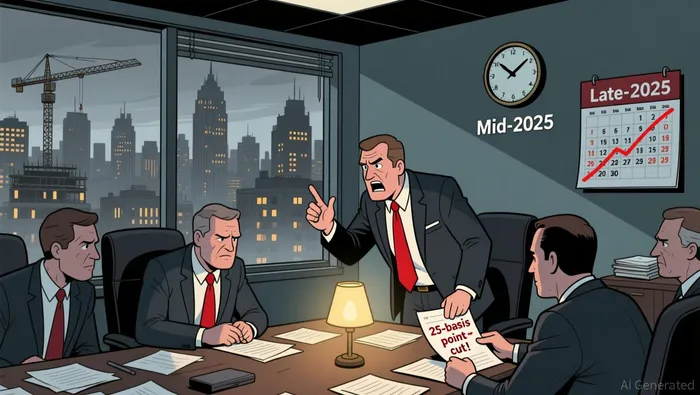
The Fed's December 2025 rate cut-its first in over two years-was partly a response to these labor market headwinds. Chair Jerome Powell acknowledged the "downside risks to employment" had increased, signaling a shift in policy focus. However, the 25-basis-point cut was met with dissent, as three FOMC members opposed the move. Austan Goolsbee and Jeff Schmid argued inflation remained too high, while Stephen Miran advocated for a larger 50-basis-point cut. This internal division highlights the Fed's struggle to balance employment and inflation priorities.
Inflation: Persistent but Easing
Inflation data for late 2025 paints a mixed picture. The Cleveland Fed's nowcasting model estimates November PCE inflation at 0.25% and CPI at 0.32%, indicating a modest uptick from October. Annual inflation accelerated to 3.1% in September, driven by tariffs on goods and sticky service-sector prices, particularly in housing. While goods inflation is expected to peak in Q1 2026, services inflation remains a drag, complicating the Fed's disinflation narrative.
The FOMC's December statement acknowledged inflation as "somewhat elevated" and emphasized the need for "patience" in assessing progress toward the 2% target. Projections for core PCE inflation in 2026 at 2.5% suggest a gradual path to normalization, but risks remain. Tariff policies and potential supply shocks could reignite price pressures, particularly in goods. Meanwhile, the government shutdown in October disrupted data collection, creating uncertainty around November's inflation trajectory.
Policy Divergence and 2026 Outlook
The Fed's internal debate over 2026 policy is intensifying. Goolsbee, a non-voting member in 2026, has called for more rate cuts but stressed the need for "more data" on inflation. In contrast, incoming FOMC voter Beth Hammack has advocated for a "modestly restrictive" stance to maintain downward pressure on prices. This tension reflects broader uncertainty: while labor market weakness could force the Fed to prioritize employment, inflation persistence may compel a hawkish bias.
The December rate cut, though a step toward easing, was framed as a "mid-cycle adjustment" rather than a full pivot. Powell emphasized that the policy rate is now near neutral and that future moves will remain data-dependent. However, the FOMC's forward guidance-highlighting the "extent and timing" of rate adjustments-leaves room for both further cuts and potential hikes if inflation resurges. This ambiguity is a red flag for investors, as policy uncertainty often amplifies market volatility.
Implications for Asset Allocation
Given the Fed's dilemma, a cautiously bearish stance on equities is warranted. Cyclical sectors like industrials and consumer discretionary, which rely on strong labor demand, face headwinds as hiring slows. Defensive assets-utilities, consumer staples, and healthcare-offer resilience in a weak labor market. Rate-sensitive sectors such as financials and real estate could benefit from a clearer path to rate cuts, but their performance will hinge on the Fed's ability to credibly anchor inflation expectations.
Fixed income remains a strategic consideration. While the Fed's hawkish lean increases short-term bond volatility, long-term yields may stabilize if inflation trends toward 2.5% in 2026. Investors should prioritize high-quality bonds and inflation-linked securities to hedge against residual inflation risks. Gold and other commodities, which have historically performed in inflationary environments, may also warrant a small allocation.
Conclusion
The Fed's 2026 policy path will be defined by its ability to reconcile a weakening labor market with persistent inflation. While the December rate cut signals a tentative shift toward easing, the FOMC's internal divisions and data-dependent approach suggest a cautious, measured response. For investors, this means prioritizing defensive assets, hedging against inflation, and avoiding overexposure to cyclical equities. The Fed's dilemma is not a short-term anomaly-it is a structural challenge that will shape markets for years to come.







Comentarios
Aún no hay comentarios