
The Fed's Dilemma: August Payrolls and the Path to Rate Cuts
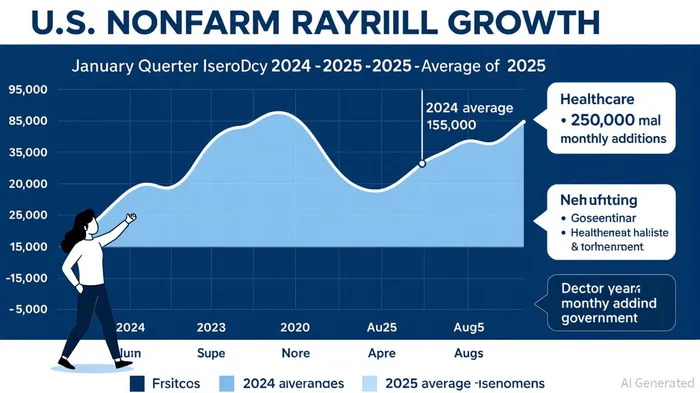
The U.S. labor market’s fragility has crystallized in August 2025’s nonfarm payrolls report, which revealed a mere 22,000 job additions—a stark contrast to the robust 168,000 monthly average in 2024 [1]. This slowdown, coupled with a 4.3% unemployment rate and politically sensitive job losses in manufacturing and government sectors, has thrust the Federal Reserve into a policy crossroads. The central bank now faces the dual challenge of balancing inflationary pressures against the risk of a deteriorating labor market, with markets increasingly pricing in aggressive rate cuts.
Labor Market: A House of Cards?
The August data underscores a labor market teetering on the edge of stagnation. While healthcare added 31,000 jobs, these gains were offset by losses in federal government (-15,000) and mining (-6,000) [1]. Revisions to prior months’ data further eroded confidence: June’s employment figure was downgraded by 27,000, while July’s was upgraded by 6,000, resulting in a net loss of 21,000 jobs [1]. Such volatility highlights the fragility of the current recovery, particularly in sectors like manufacturing, which lost 12,000 jobs—a red flag for policymakers [4].
Average hourly earnings, though rising 0.3% month-over-month to $36.53, remain a double-edged sword. A 3.7% year-over-year increase suggests persistent wage inflation, complicating the Fed’s mandate to achieve price stability [1]. This tension is exacerbated by the fact that a historically low unemployment rate of 4.2% (pre-August) does not necessarily reflect a healthy labor market if job quality and sectoral imbalances are deteriorating.
The Fed’s Tightrope: Dual Mandate Under Strain
The Federal Reserve’s August 2025 policy statement acknowledged a labor market “near maximum employment” but one increasingly vulnerable to “downside risks” [1]. Payroll growth over the last three months averaged just 35,000 per month, a fraction of the 2024 pace. This divergence between headline unemployment and underlying weakness has forced the Fed to recalibrate its approach. Governor Christopher Waller’s recent speech emphasized the need to “ease policy and move toward a more neutral stance” to avert further employment deterioration [3].
The central bank’s dual mandate—price stability and maximum employment—is now in direct conflict. Inflation remains stubbornly above target, yet the labor market’s fragility risks triggering a self-fulfilling prophecy of recession. The Fed’s dilemma is further compounded by market expectations: traders have priced in a 90% probability of a 50-basis-point rate cut at the September 16-17 meeting, with additional cuts anticipated in 2026 [2]. This shift reflects not just the August payroll data but also a broader loss of confidence in the labor market’s durability.
Market Positioning: Navigating Uncertainty
For investors, the path forward requires a nuanced understanding of sectoral dynamics and policy risks. Equities in labor-intensive sectors like healthcare and consumer discretionary may benefit from a rate-cut cycle, which typically boosts valuations. Conversely, manufacturing and government-contracted industries face headwinds, as evidenced by August’s 12,000 job losses in manufacturing [4]. Bonds, meanwhile, are poised to outperform as the yield curve steepens in anticipation of aggressive Fed easing.
The dollar’s trajectory also hinges on the Fed’s actions. A dovish pivot could weaken the U.S. dollar against peers like the euro and yen, which are less constrained by domestic labor market pressures. Commodity investors, however, may find opportunities in gold and silver, which often act as hedges against inflation and monetary uncertainty.
Conclusion: A Delicate Balancing Act
The Fed’s September meeting will be a litmus test for its ability to navigate the labor market’s fragility without exacerbating inflation. While rate cuts are likely, their efficacy will depend on whether the August payroll data marks a cyclical slowdown or the beginning of a deeper downturn. For now, investors must remain agile, hedging against both a prolonged high-rate environment and a rapid policy reversal.
**Source:[1] Employment Situation News Release - 2025 M08 Results, [https://www.bls.gov/news.release/archives/empsit_09052025.htm][2] US Jobs Report August 2025, [https://www.bloomberg.com/news/articles/2025-09-05/us-employers-add-just-22-000-jobs-unemployment-rate-rises][3] Speech by Governor Waller on the economic outlook, [https://www.federalreserve.gov/newsevents/speech/waller20250828a.htm][4] US Jobs Market Stalls in August While Unemployment Rises, [https://www.bloomberg.com/news/live-blog/2025-09-05/us-employment-report-for-august]







Comentarios
Aún no hay comentarios