
The Fed's Delay of the October Industrial Production Report and Its Implications for Market Sentiment
The Federal Reserve's delayed release of the October 2025 Industrial Production Report, compounded by a government shutdown halting critical economic data collection, has ignited fresh concerns about central bank transparency and its ripple effects on financial markets. According to a Reuters report, the shutdown has paralyzed the Bureau of Labor Statistics (BLS) and other federal agencies, delaying key metrics like the jobs report and Consumer Price Index (CPI). While the Fed will still publish its industrial production data on October 17, the absence of broader labor and inflation data has left policymakers reliant on private-sector indicators, such as ADP employment reports, which lack the granularity of official statistics, Reuters noted. This "data blackout" has forced investors into a fog of uncertainty, amplifying short-term asset volatility and reshaping market sentiment.
Central Bank Transparency and the Volatility Paradox
Central bank transparency is a cornerstone of modern monetary policy, designed to anchor expectations and reduce market turbulence. However, the current delay underscores a paradox: when transparency falters, volatility often follows. Research from the Journal of Financial Stability highlights that transparency and stock market volatility share a non-linear relationship, with the most pronounced benefits observed when transparency transitions from low to moderate levels. In the current environment, the Fed's inability to provide timely, comprehensive data has eroded this buffer.
Historical precedents reinforce this dynamic. A Capstone & Co. study found that major economic data releases-such as Non-Farm Payrolls-typically suppress VIX volatility, with the fear index closing lower 70% of the time on such days. Conversely, delayed or incomplete data creates a vacuum for speculation, forcing markets to price in a wider range of outcomes. For instance, the September ADP report, which showed a contraction of 32,000 private-sector jobs, triggered a sharp selloff in risk assets, even though it was a proxy for the missing BLS data, illustrating how fragmented transparency can amplify short-term swings, even if the underlying economic story remains unclear.
The 2025 Shutdown: A Case Study in Uncertainty
The current government shutdown offers a real-time case study in how delayed data disrupts market calculus. A Journal of Financial Stability paper noted that the Fed's September meeting minutes revealed deep divisions among FOMC participants about the path of future rate cuts, reflecting the lack of consensus driven by incomplete data. This uncertainty has translated into erratic investor behavior: while the S&P 500 has shown resilience, sector rotation has accelerated, with defensive stocks outperforming cyclicals.
Moreover, the absence of the October jobs report-a key inflation and labor market barometer-has forced the Fed to rely on high-frequency indicators like initial jobless claims and corporate earnings guidance. Yet these proxies are inherently noisy. For example, a Federal Reserve Board analysis warned that rising uncertainty, whether from policy shifts or data gaps, often leads to delayed investment and reduced consumption, further destabilizing markets. This creates a self-reinforcing cycle: delayed data → heightened uncertainty → volatile asset prices → prolonged decision-making delays.
Historical Context: When Delays Spur Volatility
While the 2025 shutdown is a recent example, history shows that delayed central bank data can exacerbate volatility, though not always as the primary driver. During the 2008 financial crisis and the 2020 pandemic, VIX spikes were largely attributable to systemic shocks rather than data delays, according to Macroption's VIX history. However, subtler instances-such as the 2015 taper tantrum-demonstrate how incomplete communication about policy timelines can destabilize markets. In the current context, the Fed's reliance on private data sources (e.g., ISM surveys, regional Fed indexes) mirrors these past episodes, where mixed signals led to divergent market interpretations.
Implications for Investors
For investors, the lesson is clear: in an era of fragmented transparency, hedging strategies and sector rotation become critical. The VIX's recent fluctuations-spiking to 38.57 in August 2024 amid BoJ rate surprises-highlight how liquidity gaps and delayed data can amplify leveraged positions, as shown in a Cassini analysis. Similarly, the current environment favors assets with intrinsic value (e.g., utilities, bonds) over speculative growth plays.
Conclusion
The Fed's delayed October Industrial Production Report is more than a technical hiccup-it is a stress test for central bank transparency in an age of rising geopolitical and fiscal risks. While the Fed's industrial production data offers some clarity, the broader data blackout has exposed markets to heightened volatility and fragmented expectations. As the October 28-29 policy meeting approaches, investors must brace for a scenario where policy decisions are made with one hand tied behind the Fed's back. In such an environment, adaptability-not just for central banks but for market participants-will be the ultimate determinant of resilience.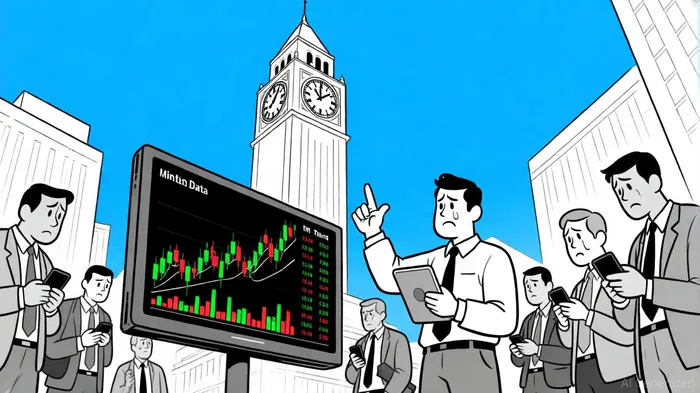







Comentarios
Aún no hay comentarios