
The Fed's Deepening Divisions and What It Means for 2026 Rate Policy
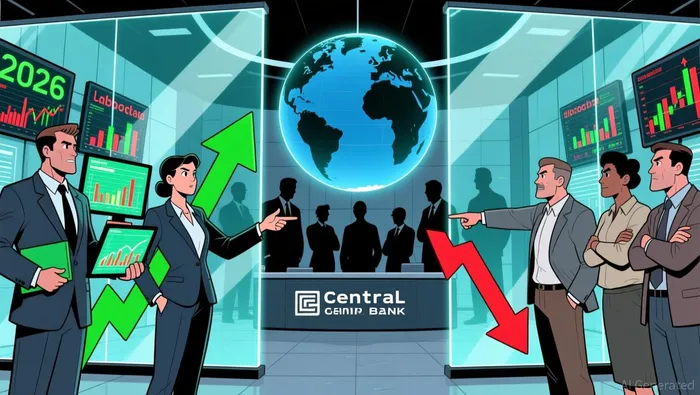
The Federal Reserve's internal divisions have reached a critical juncture, with policymakers sharply split on the trajectory of interest rates in 2026. This fragmentation, evident in the Fed's "dot plot" and recent voting records, underscores the central bank's struggle to balance inflation risks against labor market vulnerabilities. For investors, the implications are profound: a fractured Fed introduces uncertainty into monetary policy, complicating forecasts and reshaping asset allocation strategies.
The Current Policy Landscape
As of late 2025, the Fed's 19 policymakers are divided on the appropriate path for rate adjustments in 2026. While a median forecast projects one quarter-point rate cut by year-end, the dispersion of views is stark. Seven members argue no cuts are warranted, while eight anticipate at least two, with one outlier suggesting a potential drop toward 2%. This divergence was starkly reflected in the December 2025 rate cut, which passed with a 9-3 split, as three officials dissented-two opposing the cut entirely and one advocating for a larger 50-basis-point reduction. The Fed's updated economic projections, which maintain a median target range of 3.25%–3.5% for 2026, mask underlying tensions. Policymakers remain cautious, with inflation still above the 2% target and labor market risks looming.
Implications for 2026 Rate Policy
The Fed's 2026 rate path is likely to remain data-dependent, with policymakers prioritizing price stability over aggressive easing. Market participants, however, anticipate more aggressive cuts than the Fed's official projections. J.P. Morgan Research, for instance, forecasts one rate cut in 2026, while the Fed's own "dot plot" suggests a median of one. This disconnect highlights the central bank's credibility challenges. Chair Jerome Powell has emphasized the need to avoid overreacting to short-term economic fluctuations, yet the political appointment of a new Fed chair by President Trump-a figure favoring more aggressive rate cuts-could further complicate the policy outlook.
Investment Opportunities Amid Uncertainty
The Fed's cautious approach has already triggered shifts in asset allocation strategies. Sectors benefiting from lower interest rates, such as Real Estate Investment Trusts (REITs), small-cap equities, and Industrials, are poised to outperform. U.S. REITs, for example, historically deliver strong returns following rate cuts, with an annualized return of 9.48% in the 12 months post-cut. Small-cap stocks, as evidenced by the Russell 2000's recent surge, also gain from reduced borrowing costs and leverage advantages.
Technology and AI-driven sectors remain central to 2026's investment landscape. Hyperscalers like Microsoft and Amazon are capitalizing on AI infrastructure, with lower interest rates reducing the financial hurdles for large-scale projects. Utilities, too, benefit from growing power demands from AI data centers and reduced debt servicing costs.
 In fixed income, high-quality U.S. bonds and intermediate-term portfolios are gaining traction as real yields remain attractive. Vanguard and PIMCO highlight the role of fixed income as a stabilizer in multi-asset portfolios, particularly if AI-driven growth disappoints. Alternative assets, including private credit and preferred stocks, are also gaining appeal for their income-producing potential and risk-adjusted returns.
Risks and Strategic Considerations
The Fed's divided stance introduces volatility into markets, as seen historically during periods of policy uncertainty. The 2013 "Taper Tantrum," for instance, saw the VIX® Index spike by 3.9 points due to concerns over Fed tapering. Investors must remain vigilant against over-reliance on short-term rate forecasts, as the Fed's dual mandate-balancing inflation and employment-creates inherent unpredictability. Morningstar's Dan Lefkovitz cautions that tactical adjustments based on near-term rate predictions can lead to costly mistakes, advocating instead for long-term, risk-managed approaches.
Diversification across asset classes and geographies is critical. With global central banks like the ECB and BoC potentially hiking rates in 2026, divergent monetary policies could affect capital flows and currency valuations. A weaker U.S. dollar, for example, may benefit U.S. exporters but pose challenges for foreign investors. Hedged equities and alternative strategies are increasingly favored to mitigate downside risks in a volatile environment.
Historical Context and Lessons
Past Fed divisions, such as the July 2015 FOMC meeting debates over policy language, demonstrate that even unanimous decisions can mask internal disagreements. Over the past decade, rate-cutting cycles have often lagged equity market peaks, underscoring the delayed nature of monetary policy. Investors must recognize that the Fed is just one of many drivers of market dynamics, with structural trends like AI adoption and fiscal policy playing equally significant roles.
Conclusion
The Fed's deepening divisions in 2026 present both risks and opportunities for investors. While the central bank's cautious approach may limit rate cuts, the broader economic environment-marked by AI-driven growth and fiscal tailwinds-supports a strategic shift toward sectors and asset classes poised to benefit from lower rates. However, the uncertainty surrounding policy direction necessitates a diversified, adaptive strategy. By balancing income-seeking fixed income, high-quality equities, and alternative assets, investors can navigate the fractured Fed landscape while positioning for long-term resilience.







Comentarios
Aún no hay comentarios