
The Fed's Deepening Divide and Its Implications for 2026 Rate Cuts
The Federal Reserve's internal policy divergence has reached a critical juncture, with far-reaching implications for 2026 rate decisions and global market dynamics. As of late 2025, the Fed's struggle to reconcile divergent views on inflation, labor market fragility, and political pressures has created a policy environment marked by uncertainty. This divergence not only complicates the central bank's ability to project a coherent path forward but also forces investors to recalibrate their strategies in anticipation of a fragmented monetary policy landscape.
The 2025 Policy Divergence: A Microcosm of 2026 Challenges
The December 2025 FOMC meeting underscored the Fed's deepening divide. While the central bank cut rates by 25 basis points for the third consecutive meeting, bringing the federal funds target range to 3.50%-3.75%, three officials dissented. Some argued for a larger cut to address a weakening labor market, while others preferred to hold rates steady to guard against inflation risks according to reports. This split reflects a broader tension: the Fed must balance a stubbornly high inflation rate (still above 2%) with a labor market that is losing steam, with unemployment projected to peak at 4.5% in 2025.
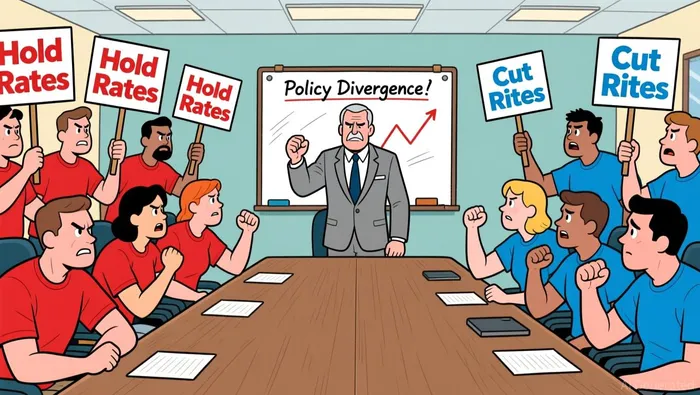 Governor Christopher Waller's advocacy for risk management in a fragile labor market contrasted sharply with Boston Fed President Susan Collins' caution, highlighting the lack of consensus on the appropriate policy response. Such disagreements are not merely academic-they signal a central bank struggling to unify its messaging, which could erode market confidence.
2026 Projections: A Median Path Amid Warring Factions
Looking ahead, the Fed's 2026 rate projections reveal further fragmentation. The median estimate among officials calls for one rate cut, but seven members favor no cuts, while eight support at least two. This lack of alignment raises questions about the effectiveness of the incoming Fed chair, Kevin Hassett, who is expected to prioritize rate cuts under pressure from the Trump administration according to financial analysts. Trump's explicit demands for aggressive easing-such as a 50-basis-point cut-contrast with the concerns of regional Fed presidents about inflation persistence according to Reuters.
Market expectations, meanwhile, outpace the Fed's median projection. Financial markets currently price in 70-80 basis points of easing in 2026, far exceeding the central bank's cautious outlook. This disconnect has already triggered volatility in rate options and long-term yields, as investors grapple with the likelihood of a hawkish pivot or a more aggressive easing cycle.
Market Preparedness: Navigating a Policy Uncertainty Landscape
Investors are increasingly advised to adopt strategies that account for the Fed's policy uncertainty. According to a Bloomberg report, behavioral discipline-such as avoiding overreactions to headlines and maintaining diversified portfolios-is critical in a market environment shaped by divergent central bank policies. Bank of AmericaBAC-- forecasts two additional rate cuts in 2026 (June and July), suggesting a continuation of the easing cycle. However, this optimism is tempered by risks such as trade tensions and potential corrections in AI-driven sectors according to Moody's analysis.
JP Morgan's analysis highlights the transformative role of artificial intelligence in bolstering market resilience. The bank projects the S&P 500 could reach 7,500 points by year-end 2026, driven by AI-fueled capital expenditure and global economic growth. Yet, this optimism is not without caveats. Moody's warns of systemic risks from stretched AI equity valuations, while trade realignments-such as the EU's partnerships with Indonesia and India-add complexity to global supply chains according to Moody's analysis.
Strategic Implications for Investors
The Fed's deepening divide necessitates a nuanced approach to asset allocation. JP Morgan's bearish stance on oil and yen, coupled with its bullish outlook on gold (targeting $5,000/ounce) and high-yield currencies like the Brazilian Real and Mexican Peso, reflects the broader trend of capital flows driven by divergent interest rates according to market analysis. Investors should also monitor the Fed's December 2025 meeting for clues about the 2026 policy trajectory, particularly the updated "dot plot" and economic projections.
Conclusion
The Federal Reserve's internal policy divergence in 2025 has set the stage for a contentious 2026. With political pressures, inflation risks, and labor market fragility all at play, the central bank faces a delicate balancing act. For investors, the key lies in preparing for a range of outcomes-whether the Fed adopts a cautious median path or yields to political and market pressures for more aggressive easing. As the global economy navigates multidimensional polarization, resilience will depend on strategic adaptability and a keen eye on the Fed's evolving narrative.





Comentarios
Aún no hay comentarios