
The Fed's December Dilemma: Why Kalshi Traders Are Underestimating 2025 Rate Cut Odds
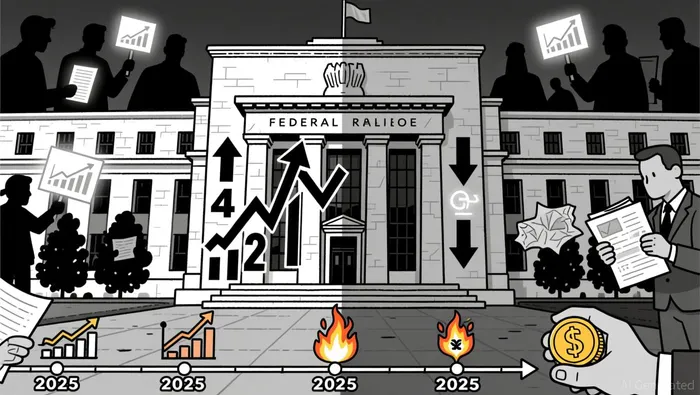
The Federal Reserve's 2025 rate-cut trajectory has become a battleground between market expectations and structural economic realities. While prediction markets like Kalshi suggest traders are pricing in exactly three 25-basis-point cuts for 2025, a closer examination of macroeconomic data, FOMC dissent, and institutional forecasts reveals a compelling case for underestimation. This analysis argues that the Fed may be forced to act more aggressively than current market odds imply, creating a contrarian opportunity for investors who recognize the growing asymmetry between inflation persistence and labor-market fragility.
Market Expectations vs. Structural Weaknesses
Kalshi traders currently assign a 67% probability to three rate cuts in 2025, with the first cut already priced in for October 2025 at 79% odds according to Kalshi markets. However, this consensus overlooks critical structural weaknesses in the U.S. economy. The IMF's 2025 World Economic Outlook highlights a slowdown in U.S. growth to 1.5% in 2025, downgraded from 2.7% in January 2025, due to the drag from tariffs and immigration restrictions. Similarly, the World Bank cut its U.S. growth forecast to 1.4% for 2025, citing trade barriers and policy uncertainty. These downgrades suggest the Fed may face mounting pressure to ease policy more aggressively than the market anticipates.
Inflation, though slightly below the 4% peak of 2024, remains stubbornly near 3%, with the services sector-particularly shelter costs-acting as a persistent drag according to recent analysis. Meanwhile, the labor market is showing signs of deterioration: October 2025 job creation slowed to 50,000, and the unemployment rate is projected to rise to 4.5% by year-end. Such data points indicate a Fed that may prioritize employment over inflation in its next moves, a stance that could lead to more aggressive cuts than the 25-basis-point increments currently priced in.
FOMC Dissent and Policy Divergence
The Federal Reserve's internal divisions further complicate the narrative. At the September 2025 FOMC meeting, one member-Stephen Miran-dissented in favor of a 50-basis-point cut, arguing that the labor market's weakening warranted a stronger response. Miran repeated his dissent in October 2025, while Kansas City Fed President Jeffrey Schmid advocated for rate stability due to inflation concerns. These splits reflect a broader tension within the FOMC between "hawks" focused on inflation and "doves" prioritizing employment.
Kalshi markets, however, have largely ignored the possibility of larger-than-expected cuts. The "Cut >25bps" contract trades at only 3¢, implying near-zero confidence in a 50-basis-point move. This disconnect is problematic. If the Fed's dovish faction gains influence-particularly as Chair Jerome Powell's term nears its end in May 2026-traders may be caught off guard by a more aggressive easing cycle.
The December Dilemma: A Contrarian Case
The December 2025 rate decision epitomizes this dilemma. While Kalshi traders price a 65% chance of a rate hold, other prediction markets like Polymarket signal an 89% probability of a 25-basis-point cut. This divergence underscores the uncertainty surrounding the Fed's next move. The September 2025 rate cut-its first in nine months-was framed as a "risk management" decision to prevent a deeper slowdown. If Q4 2025 GDP growth falls below the projected 1.1% according to Philadelphia Fed data, the Fed may feel compelled to act more decisively.
Moreover, the IMF warns that inflation could peak at 3.5% in late 2025 due to tariff-driven cost pressures and labor shortages. If inflation remains sticky while the labor market weakens further, the Fed's dual mandate will force it into a precarious position: either tolerate higher inflation or accelerate rate cuts. Given the Fed's recent emphasis on "employment as a buffer," the latter seems more likely.
Conclusion: A Case for Rebalancing Bets
The current market consensus underestimates the Fed's potential to act more aggressively in 2025. Structural weaknesses in the U.S. economy-compounded by FOMC dissent and divergent policy signals-create a scenario where rate cuts could exceed the three 25-basis-point moves priced in by Kalshi. Investors who position for a more aggressive Fed easing cycle, particularly in December 2025 and early 2026, may find themselves ahead of the curve as the market recalibrates to these realities.







Comentarios
Aún no hay comentarios