
The Fed's December 2025 Rate Cut and Its Implications for Fixed-Income Markets
The Federal Reserve's December 2025 rate cut, , marked a pivotal moment in its ongoing balancing act between cooling inflation and supporting a slowing labor market. This decision, the third consecutive rate cut of the year, was met with a divided (FOMC), underscoring the central bank's struggle to navigate a fragile economic landscape. For bond investors, the move signals a shift in monetary policy and raises critical questions about strategic reallocation in fixed-income portfolios.
The Fed's Dilemma and Market Reactions
The December 2025 rate cut followed a pattern of cautious easing, with the Fed lowering rates in October and December to address a moderation in economic activity and a slowdown in job gains.
As stated by the FOMC in its official statement, the central bank remains committed to its dual mandate of maximum employment and price stability, though inflation remains stubbornly above its 2% target. The decision to cut rates was supported by concerns over a weakening labor market but faced dissent from officials like Stephen Miran, who advocated for a larger 50-basis-point cut, and , who preferred maintaining rates unchanged
according to Reuters reports.
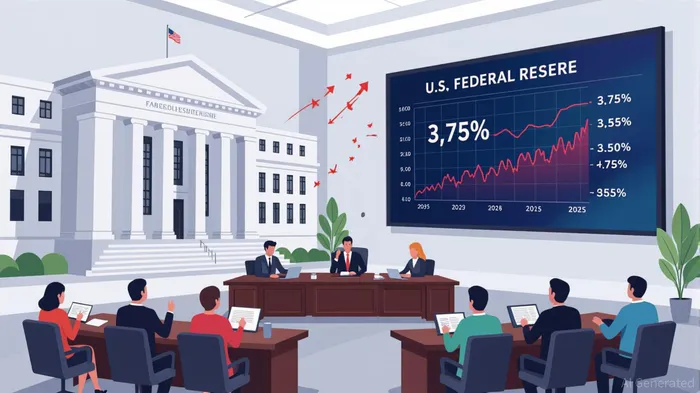 The market's immediate reaction was muted, . This tepid response reflects investor skepticism about the Fed's ability to engineer a soft landing, as well as uncertainty over the trajectory of future rate cuts.
According to a report by The New York Times, the Fed's press conference emphasized the absence of a "risk-free path" in its policy decisions, further complicating market expectations.
Historical Context and Bond Market Dynamics
Historically, Fed rate cuts have driven bond prices higher, particularly for longer-duration instruments. However, the December 2025 decision occurs in a unique context.
Analysts at BlackRock note that long-dated bonds may underperform in this cycle due to a benign economic outlook and reduced demand from foreign investors. Instead, the "belly" of the yield curve-bonds with maturities of less than 10 years-is expected to outperform.
This aligns with broader trends observed in 2025, where investors have increasingly favored intermediate-term maturities as a hedge against inflation and policy uncertainty.
The Fed's projected easing cycle also suggests a limited number of rate cuts in 2026,
according to Morgan Stanley analysis. This shallow easing path, combined with a higher neutral rate (estimated near 3%), . As a result, , .
Strategic Reallocation for Bond Investors
For bond investors, . Key considerations include:
Intermediate-Term Focus, , can mitigate inflation risk while capturing yield.
This approach is supported .Credit Investing Opportunities: In a low-rate environment, investment-grade and high-yield corporate bonds are likely to outperform Treasuries.
BlackRock highlights , .Diversification Across Asset Classes: While bonds remain a core holding, .
Lower U.S. , .Duration Management: Given the Fed's projected path, .
Instead, .
Conclusion
. For bond investors, the decision underscores the importance of strategic reallocation, . While the path forward remains uncertain, . , investors must remain agile, adjusting portfolios to align with both short-term opportunities and long-term objectives.







Comentarios
Aún no hay comentarios