
The Fed's Beige Book and the Two-Tiered U.S. Economy: Implications for Sectoral Performance and Rate-Cut Expectations
The Two-Tiered Economy: Resilience and Weakness in Tandem
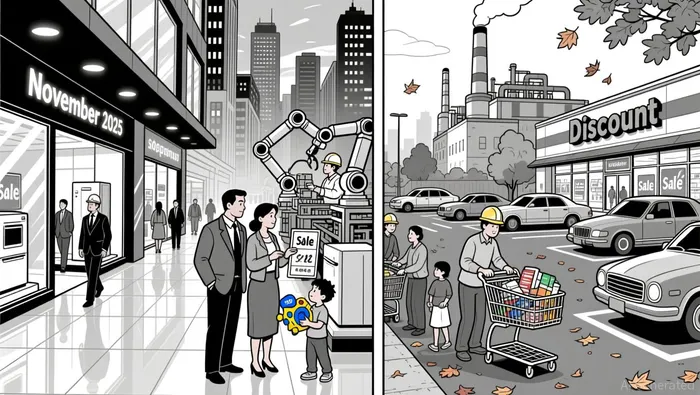
The November 2025 Beige Book highlights a stark contrast in economic activity. While manufacturing activity increased "somewhat" across most districts, consumer spending declined, particularly among middle-income households. High-end retail, however, remained resilient, suggesting that wealthier consumers are insulating certain sectors from broader weakness. This bifurcation is compounded by labor market trends: employers are managing headcounts through attrition and AI-driven efficiency gains, with wage pressures concentrated in sectors like healthcare and manufacturing.
The report also underscores the role of tariffs and input cost pressures. Tariffs have become a double-edged sword, driving up costs for manufacturers and retailers while simultaneously creating opportunities for domestic producers. This duality is emblematic of a two-tiered economy where policy-driven distortions amplify sectoral imbalances.
Rate-Cut Expectations: A 50-50 Proposition
With the Fed's dual mandate of maximum employment and price stability in focus, policymakers are navigating a delicate balancing act. As of late November 2025, the probability of a December rate cut stands at 50-50, with officials signaling a need for "more clarity" before acting. Analysts project two rate cuts in 2025 and two more in 2026, reflecting growing expectations that the Fed will pivot toward easing as inflationary pressures moderate.
This uncertainty has already influenced market behavior. Equity investors are rotating into sectors perceived to benefit from lower interest rates, such as financials and real estate, while energy and healthcare have gained strength due to their exposure to inflation-linked demand. Conversely, technology and AI stocks-once darlings of the growth narrative-are underperforming, as companies grapple with margin compression from input cost pressures.
Strategic Sector Rotation: Navigating the Two-Tiered Landscape
Given the Fed's cautious stance and the economy's bifurcation, strategic sector rotation must prioritize resilience and adaptability. Here's how to position for the next phase:
Defensive Sectors for a Weak Consumer:
As middle-income households tighten their belts, investors should overweight sectors insulated from discretionary spending. Utilities and consumer staples, which provide essential goods and services, are natural hedges against consumer caution. Additionally, healthcare-where demand is inelastic and wage pressures persist-offers a buffer against broader economic weakness. The Federal Reserve's latest Beige Book highlights these trends.Capital-Intensive Sectors for a Manufacturing Rebound:
Manufacturing activity, though constrained by tariffs, shows signs of growth. Sectors like industrial machinery and logistics stand to benefit from increased capital expenditures and supply chain reshoring. However, investors must balance exposure to these sectors with hedging strategies to mitigate input cost risks. The Federal Reserve's latest Beige Book notes these dynamics.Financials and Real Estate for a Rate-Cut Cycle:
With rate cuts increasingly priced into markets, financials and real estate are prime beneficiaries. Lower borrowing costs boost mortgage refinancing activity and commercial real estate valuations, while banks profit from narrowing credit spreads. However, regional banks remain vulnerable to credit risk, necessitating a focus on well-capitalized institutions. The Boston Fed's analysis supports this view.AI and Tech: A Cautionary Tale:
While AI adoption is reshaping labor markets, its impact on earnings is mixed. Firms leveraging AI for productivity gains (e.g., manufacturing, logistics) may outperform, but pure-play tech stocks face headwinds from margin compression and regulatory scrutiny. A selective approach-favoring AI-driven infrastructure over speculative growth is advisable.
Risk Mitigation: Diversification and Dynamic Hedging
In a two-tiered economy, diversification is no longer enough. Investors must adopt dynamic hedging strategies to counteract sector-specific risks:
- Inflation Hedges: Gold and commodities remain attractive during periods of monetary easing, offering protection against residual inflation and currency devaluation. The Boston Fed's analysis supports this view.
- Short-Term Treasuries: As rate-cut expectations rise, short-term fixed-income instruments provide liquidity and reduce duration risk. Reuters reports that this trend is gaining momentum.
- Geographic Diversification: Global markets, particularly in Asia, are capitalizing on Fed easing. China's tech sector, for instance, has shown resilience despite earnings challenges, offering a counterbalance to U.S. sectoral imbalances. Bloomberg reports that this trend is emerging.
Conclusion: A Time for Precision, Not Panic
The November 2025 Beige Book confirms what many have suspected: the U.S. economy is no longer a monolith. A two-tiered dynamic, driven by policy distortions and divergent consumer behavior, demands a nuanced approach to portfolio construction. While rate cuts remain a 50-50 proposition, the path forward favors sectors with pricing power, inelastic demand, and exposure to structural trends like AI and reshoring. For investors, the key is to rotate with precision, hedge with discipline, and stay attuned to the Fed's evolving calculus.







Comentarios
Aún no hay comentarios