
Fed Balance Sheet Contraction and Its Impact on Global Financial Markets
The Federal Reserve's quantitative tightening (QT) program, initiated in June 2022, has reshaped global financial markets by systematically reducing its balance sheet. By March 2025, the Fed had contracted its holdings by $2.19 trillion, with total security holdings declining by $2.05 trillion, according to a Cleveland Fed commentary. This reduction reflects a deliberate shift from an "abundant" to an "ample" reserves regime, where the Fed aims to maintain sufficient liquidity to manage short-term interest rates through administered tools like the interest on reserves (IORB) and overnight reverse repurchase agreements (ON RRP) without daily open market interventions, as noted in a New York Fed speech. However, this transition is not without risks. The Fed must avoid crossing into a "scarce" reserve environment, which could reintroduce pre-2008 mechanisms where interest rates are directly tied to reserve supply, complicating policy implementation, as The Econ Review analysis warns.
The Mechanics of Balance Sheet Contraction
The Fed's QT strategy relies on passive runoff: allowing maturing securities to roll off without reinvestment. As of April 2025, total assets had fallen to $6.723 trillion, with U.S. Treasuries declining by $18.37 billion in a single week, according to an Econoday report. This approach has drained liquidity from the banking system, reducing bank reserves by $16.283 billion in the same period, as shown in the same Econoday report. While the Fed has slowed the pace of Treasury runoff to $5 billion monthly (from $25 billion) and maintained a $35 billion monthly reduction in mortgage-backed securities (MBS), the cumulative effect has brought the balance sheet closer to a steady state, according to a Piedmont Crescent note.
The challenge lies in balancing liquidity. A 2019 repo market turmoil episode underscores the risks of insufficient reserves, where short-term rates spiked due to a mismatch between supply and demand, as documented by a St. Louis Fed analysis. To mitigate this, the Fed has prioritized maintaining ample reserves, ensuring that the ON RRP facility remains a stable tool for absorbing excess liquidity, per a Northern Trust commentary.
Impact on Global Asset Classes
The Fed's balance sheet contraction has reverberated across asset classes. Bonds have faced upward pressure on yields as the Fed's reduced purchases have shifted demand to private investors. For instance, the Treasury's increased issuance-coupled with the Fed's runoff-has amplified supply-side pressures, pushing 10-year yields to 4.2% by mid-2025, according to an EconomyPrism analysis. This dynamic has also affected mortgage-backed securities (MBS), where slower runoffs and rising mortgage rates have dampened prepayment speeds, altering risk profiles for originators and investors, as a Richmond Fed analysis explains.
Equities have shown resilience, buoyed by strong earnings growth and AI-driven innovation. The S&P 500 hit 57 all-time highs in 2024, with technology stocks dominating performance, as noted in an Astoria Advisors post. However, valuations in large-cap equities have become stretched, with the top three stocks in the index accounting for over 20% of its weight. This concentration has prompted investors to adopt equal-weight strategies and seek diversification in small-cap and international markets, according to a Morningstar review.
Commodities have faced headwinds from tighter monetary conditions. Reduced demand for non-essential goods has pressured prices, though energy markets remain volatile due to geopolitical tensions and supply constraints, per a Chicago Fed letter. Investors are increasingly turning to real assets and inflation-linked investments to hedge against potential inflationary resurgences, as a Brookings analysis outlines.
Investor Positioning in a Post-QT Era
In this evolving landscape, investors are recalibrating strategies. Fixed-income allocations have shifted toward credit-sensitive instruments, such as corporate bonds and mortgage-backed securities, which offer higher yields compared to Treasury alternatives, according to a J.P. Morgan note. Active management has gained favor, as market dislocations create opportunities for skilled managers to exploit inefficiencies, per a Brookings paper.
Equity strategies emphasize diversification and risk management. Equal-weight indices and sector rotation have gained traction to mitigate concentration risks. Additionally, investors are prioritizing companies with strong cash flows and pricing power, which are better positioned to navigate tighter financial conditions, as discussed in Morningstar insights.
Global diversification has also become critical. Non-U.S. markets, particularly in Asia and emerging economies, offer growth opportunities amid a slowing U.S. economy. However, investors must remain cautious about currency risks and divergent monetary policies, according to an Astoria Advisors guide.
The Path Forward
The Fed's QT program is nearing its terminal phase, with balance sheet reductions expected to stabilize by late 2025. However, the central bank must remain vigilant. A premature shift to a scarce reserves regime could reignite market instability, while overly cautious reductions might prolong inflationary pressures, cautions an The Economist piece.
For investors, the key lies in adaptability. A balanced portfolio-combining defensive assets like real estate and commodities with high-quality equities and credit-can navigate the uncertainties of a post-QT world. As the Fed transitions to a new normal, the ability to anticipate liquidity shifts and policy responses will define long-term success.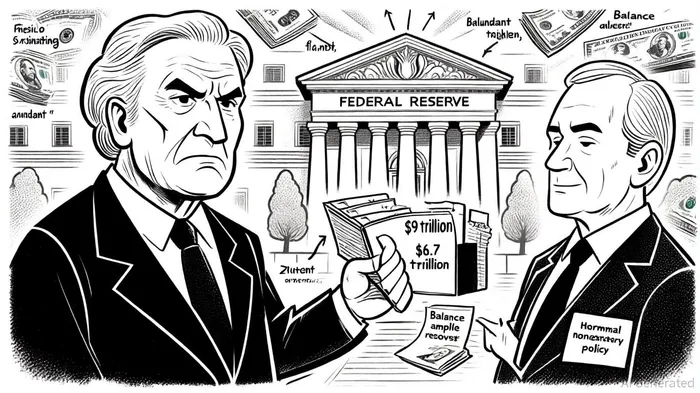







Comentarios
Aún no hay comentarios