
The Fed's 25-Basis-Point Rate Cut: Implications for Equity and Bond Markets
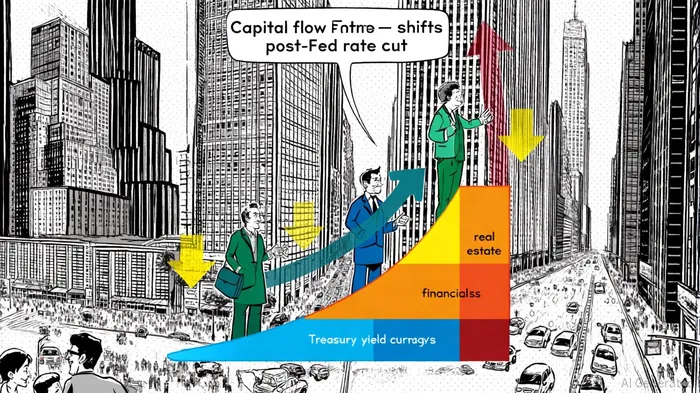
The U.S. Federal Reserve's 25-basis-point rate cut on September 17, 2025, marked a pivotal shift in monetary policy, signaling a recalibration to address a stalling labor market and slowing economic growth[1]. Lowering the federal funds rate to a range of 4% to 4.25%, the Fed's decision reflects a delicate balancing act between supporting employment and managing inflation, which remains stubbornly above its 2% target at 3.1%[2]. This move has triggered significant capital reallocation across equity and bond markets, with sectoral performance diverging sharply in response to the new interest rate environment.
Capital Flow Reallocation: Equity and Bond Market Shifts
The rate cut has accelerated a strategic reallocation of capital, with investors pivoting toward assets that benefit from lower borrowing costs. In equities, large-cap growth stocks—particularly in technology—have emerged as key beneficiaries. Reduced discount rates for future earnings have bolstered valuations, with the sector posting a year-to-date (YTD) return of 17.21% as of September 2025[3]. Similarly, real estate and consumer discretionary sectors have gained momentum, driven by expectations of lower mortgage rates and increased consumer spending[4].
Conversely, the bond market has seen a surge in demand for intermediate-term Treasuries, with the “belly” of the yield curve (3- to 7-year maturities) becoming a focal point for investors seeking a balance between income and downside resiliency[5]. The 10-year Treasury yield fell to its lowest level since April 2025, reflecting heightened demand amid recessionary concerns[6]. This shift contrasts with long-dated bonds, which have underperformed due to weak investor appetite and a lack of significant inflationary risks[7].
The U.S. dollar, meanwhile, has weakened post-cut, enhancing the appeal of international equities and alternative assets like gold and bitcoin[8]. This dynamic underscores a broader trend of capital seeking higher returns outside traditional U.S. dollar-denominated assets.
Sectoral Performance: Winners and Losers
The impact of the rate cut on sectors has been uneven. Technology has outperformed, with AI-driven innovation and robust cash reserves at major firms driving gains[9]. Real estate has also seen a rebound, as falling mortgage rates are expected to stimulate housing demand, though the sector's YTD return of 4.86% lags behind broader market indices[10].
Financials, however, face headwinds. Banks such as JPMorgan ChaseJPM-- & Co. and Bank of AmericaBAC-- Corp. are grappling with compressed net interest margins (NIMs) as borrowing costs decline[11]. While the sector posted a YTD return of 15.68%, concerns over credit losses and a flattening yield curve persist[12].
Defensive sectors like utilities and consumer staples have gained traction as income-focused investors seek stability amid macroeconomic uncertainty[13]. Small-cap stocks have also outperformed large-cap counterparts, aligning with historical trends where smaller companies benefit more from economic stimulus[14].
Outlook and Strategic Implications
The Fed's forward guidance suggests two more rate cuts in 2025 and one in 2026, with the federal funds rate projected to reach 3% by year-end 2026[15]. Investors are advised to adjust portfolios by shifting from high-cash allocations to intermediate-duration bonds and maintaining an overweight in equities, particularly U.S. large caps[16].
For bond investors, active selection and risk-aware strategies are critical, as historically tight credit spreads and limited yield differentials complicate returns[17]. In equities, a focus on sectors with strong cash flow generation—such as technology and consumer non-cyclicals—remains prudent[18].
Conclusion
The September 2025 rate cut has reshaped capital flows, with equity and bond markets recalibrating to a lower-rate environment. While technology and real estate sectors have thrived, financials861076-- face margin pressures, and the bond market's focus on intermediate-term Treasuries highlights evolving risk preferences. As the Fed navigates the delicate balance between inflation control and economic growth, investors must remain agile, leveraging sectoral divergences and strategic asset allocation to capitalize on emerging opportunities.






Comentarios
Aún no hay comentarios