
The Feasibility and Risks of US Oil Investment in Post-Maduro Venezuela
The political upheaval in Venezuela following the removal of Nicolás Maduro has reignited discussions about the potential for U.S. energy companies to re-enter the country's oil sector. President Donald Trump's vision of a $100 billion investment to revitalize Venezuela's oil infrastructure and boost production to pre-sanction levels is ambitious, but its feasibility hinges on navigating a labyrinth of political, economic, and market barriers. This analysis evaluates the risks and opportunities for U.S. oil investments in post-Maduro Venezuela, focusing on the stability of the political transition, the state of the country's oil infrastructure, and the confidence-or skepticism-of key industry players.
Political Uncertainty and Governance Challenges
The U.S.-led political transition in Venezuela remains fraught with instability. While the Trump administration has positioned itself as the de facto overseer of the country's governance, the absence of a clear, inclusive transition plan has raised concerns about legitimacy. Opposition leader María Corina Machado, who won a decisive victory in the 2024 election, has been sidelined in favor of a U.S.-backed interim administration, creating a perception of foreign interference that could fuel domestic resistance and regional backlash according to SSGA analysis.
Sanctions, though selectively relaxed to allow the import of oilfield equipment, remain a critical constraint. The U.S. Treasury continues to block transactions with state-owned entities like Petróleos de Venezuela, S.A. (PDVSA), and full sanctions relief is contingent on Venezuela severing economic ties with China, Russia, and other adversaries as reported by Morgan Lewis. This conditional approach introduces uncertainty for investors, as the timeline for sanctions removal remains unclear. According to a report by the law firm Holland & Knight, companies are advised to proceed cautiously, as "real legal changes" are still pending according to Holland & Knight.
Economic and Infrastructure Realities
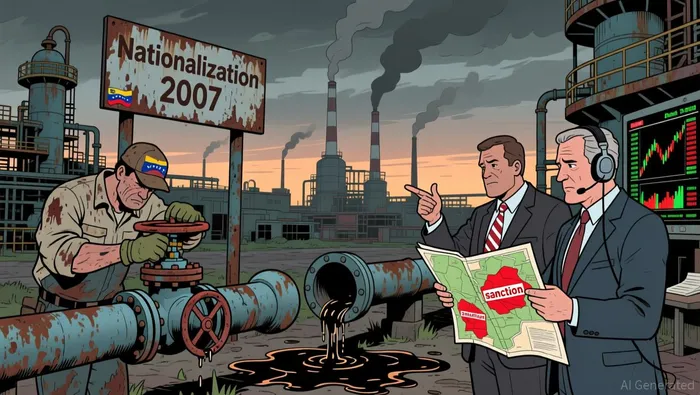
Venezuela's oil sector is in a state of severe decay. Production has plummeted to approximately 800,000 barrels per day, a fraction of its historical peak of 3.5 million barrels in the late 1990s according to CFR analysis. Decades of underinvestment, mismanagement, and U.S. sanctions have left infrastructure in disrepair, with estimates suggesting that restoring even basic production levels could require $10–$53 billion in upstream investment over the next 15 years according to industry analysts. Rebuilding to pre-sanction capacity would demand far more-potentially exceeding $100 billion-while navigating a global oil market characterized by oversupply and muted demand as noted by bipartisan policy analysis.
The economic risks are compounded by Venezuela's $200 billion external debt and unresolved arbitration claims against the government for expropriated assets. Companies like ExxonMobilXOM-- and ConocoPhillipsCOP--, which were forced out during Hugo Chávez's nationalization campaigns, have yet to see compensation for their losses according to ExxonMobil. While Trump has pledged to protect U.S. firms from future asset seizures, industry executives remain skeptical. ExxonMobil CEO Darren Woods, for instance, has described Venezuela as "uninvestable" without "serious guarantees" according to Yahoo Finance.
Market Dynamics and Geopolitical Competition
Even if political and economic hurdles are overcome, market realities pose significant challenges. Venezuela's heavy, high-sulfur crude oil is costly to refine and less competitive than lighter grades, limiting its appeal to global buyers according to Reuters. Meanwhile, China has maintained a dominant role in Venezuela's oil trade through discounted crude shipments and shadow fleet operations, a position the U.S. seeks to disrupt according to Columbia University analysis. Redirecting Venezuela's oil exports to the U.S. Gulf Coast, as Trump has proposed, would require not only infrastructure upgrades but also a shift in global market dynamics that favor American refiners over Canadian and Middle Eastern competitors according to Spectrum Local News.
Low oil prices further complicate the equation. With prices projected to remain below $60 per barrel through 2026, the economic incentives for large-scale investment are limited as reported by bipartisan policy analysis. Historical precedents, such as the post-conflict recovery in Iraq and Libya, suggest that foreign investment in politically unstable environments often yields uneven results, with progress marked by delays and setbacks according to National Bank analysis.
Investor Confidence and Legal Protections
U.S. oil companies are demanding robust legal protections before committing to Venezuela. ChevronCVX--, the only major U.S. firm currently operating in the country, is in a stronger position to expand production but still faces logistical and political challenges according to Congress.gov. Other firms, including ConocoPhillips and ExxonMobil, have signaled a need for "clear legal and commercial frameworks" to mitigate risks according to Janus Henderson. The Trump administration's promise of "total safety" for investors according to Al Jazeera must be backed by enforceable contracts and transparent governance reforms to rebuild trust.
Conclusion: A Vision at Odds with Reality
Trump's $100 billion investment vision for Venezuela's oil sector is theoretically aligned with the country's vast reserves and strategic importance to U.S. energy security. However, the practical barriers-political instability, infrastructure decay, unresolved debt, and a weak global oil market-make this goal highly uncertain. While selective sanctions relief and U.S. government guarantees could attract limited participation from firms like Chevron, broader investment will depend on sustained political stability, legal reforms, and a favorable fiscal environment.
For now, the feasibility of a U.S.-led oil revival in Venezuela remains a work in progress. As one industry analyst noted, "The path to recovery is long, and the risks are enormous. Success will require not just capital, but a commitment to stability and transparency that has been absent for decades" according to Atlantic Council analysis.





Comentarios
Aún no hay comentarios