
FB Financial's Earnings Outperformance and Revenue Growth: A Deep Dive into Operational Efficiency and Earnings Resilience
FB Financial Corporation (FBK) has emerged as a standout performer in the regional banking sector in 2025, driven by a combination of strategic acquisitions, disciplined cost management, and a resilient earnings model. While the company's Q3 2025 results-adjusted earnings per share (EPS) of $1.07, up 22% from Q2-have drawn attention, according to a BusinessWire report, the story beneath the numbers reveals a more nuanced picture of operational efficiency and underappreciated earnings resilience.
Operational Efficiency: A Path to Sustainable Profitability
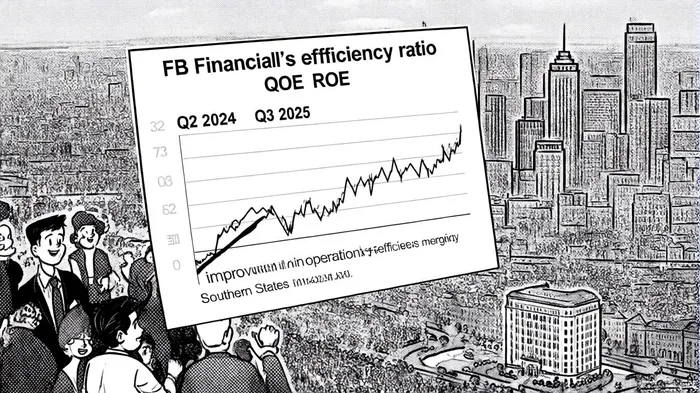
FB Financial's operational efficiency metrics tell a tale of transformation. In Q2 2025, the company reported an efficiency ratio of 56.9%, according to the Q2 earnings report, a modest improvement from the 58.4% recorded in Q3 2024, per Macrotrends ROE. However, the Q3 2025 core efficiency ratio-a non-GAAP metric excluding one-time costs-fell to 53.3%, a significant drop from 56.9% in Q2, the BusinessWire report noted. This improvement, coupled with full-year guidance targeting a low-50s efficiency ratio by Q4 2025 reported in the Q2 earnings report, suggests management's ability to scale operations without sacrificing cost discipline.
The company's focus on automation and digital transformation has been pivotal. For instance, the integration of Southern States Bancshares, which closed in July 2025, was executed with minimal incremental overhead. The merger added $2.87 billion in assets while enabling FB FinancialFBK-- to leverage shared infrastructure, reducing per-unit costs, according to the BusinessWire release. The BusinessWire release also stated, "The core efficiency ratio reflects the company's ability to optimize expenses post-merger, even as balance sheet growth accelerates."
Earnings Resilience: Navigating Headwinds with Adjusted Metrics
FB Financial's earnings resilience is perhaps best illustrated by its adjusted net income figures. In Q3 2025, adjusted net income surged to $57.6 million ($1.07 per share), a 26% increase from Q2's $0.88 per share, the BusinessWire release reported. This outperformance, even amid a $60 million pre-tax loss from a securities transaction noted in the Q2 earnings report, underscores the company's ability to isolate non-recurring items and maintain focus on core profitability.
The securities sale, while dilutive to GAAP net income, was strategically executed to redeem high-cost debt and pre-fund loan growth. As noted in the Q2 earnings report, "The proceeds from the transaction were redeployed into higher-yielding assets, directly supporting the company's net interest margin (NIM) expansion." Indeed, FB Financial's NIM rose to 3.95% in Q3 2025, up from 3.68% in Q2, as shown in the BusinessWire release, driven by accretive loan growth and favorable purchase accounting adjustments.
Merger-Driven Growth: A Catalyst for Long-Term Value
The Southern States merger has been a linchpin of FB Financial's growth strategy. By adding $2.32 billion in loans and $2.47 billion in deposits, the acquisition not only boosted scale but also diversified the company's geographic footprint, the BusinessWire release noted. This diversification has proven critical in stabilizing deposit costs and enhancing loan yields. For example, noninterest-bearing deposits grew to $2.69 billion in Q3 2025, up from $2.19 billion in Q2, reducing funding costs and amplifying NIM, as reported in the BusinessWire release.
Moreover, the merger's accretive impact is evident in tangible book value per share, which has grown at a 12.2% compound annual growth rate (CAGR) since the company's IPO, per the Q2 earnings report. This metric, often overlooked by short-term investors, highlights the compounding power of disciplined M&A and capital allocation.
Conclusion: A Model for Regional Bank Resilience
FB Financial's 2025 performance demonstrates that regional banks can compete with larger peers by prioritizing operational efficiency and strategic scale. While the company's GAAP metrics may occasionally be clouded by one-time events, its adjusted earnings and core efficiency ratios reveal a business that is both agile and resilient. With a clear path to a low-50s efficiency ratio and a balance sheet fortified by the Southern States merger, FB Financial is well-positioned to outperform in a challenging interest rate environment.
For investors, the key takeaway is that FB Financial's earnings resilience is not a flash in the pan but a product of disciplined execution and long-term strategic vision. As the company approaches its Q4 2025 efficiency targets, the focus should shift from quarterly volatility to the compounding effects of its operational and balance sheet strengths.





Comentarios
Aún no hay comentarios