
Fathom's Equity Offering: Strategic Opportunity or Short-Term Distraction?
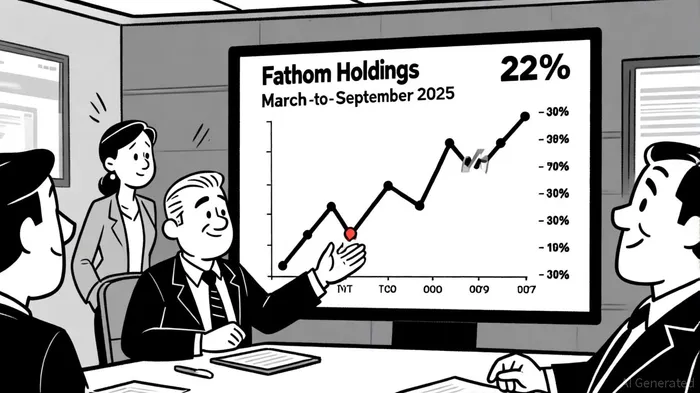
Fathom Holdings' recent $5.4 million equity offering has sparked debate among investors about its strategic value versus its potential to divert attention from deeper financial challenges. The company's capital structure and market positioning provide critical context for evaluating whether this move aligns with long-term growth or exacerbates short-term volatility.
Capital Structure Efficiency: A Mixed Picture
Fathom's debt-to-equity ratio of 0.57 as of September 2025[1] suggests a relatively conservative approach to leverage compared to the Services sector's industry benchmark of 1.14[2]. This positions the company as less reliant on debt financing than peers, which could buffer it against interest rate risks. However, the ratio has risen sharply from 0.32 in 2023[3], reflecting a growing dependence on equity to fund operations.
The September offering—priced at $2 per share, nearly three times the March 2025 offering's 68–72 cents per share[4]—highlights Fathom's attempt to stabilize its balance sheet. Yet, this comes amid a history of financial strain. For instance, the company's interest coverage ratio for June 2024 was -55.83[5], indicating that operating income failed to cover interest expenses. While Q2 2025 results showed a 36% year-over-year revenue increase[6], the GAAP net loss of $3.6 million and a $0.13 per share loss[7] underscore persistent profitability challenges.
Market Positioning: Growth Amid Volatility
Fathom's equity offering must also be viewed through the lens of its market positioning. As a technology-driven real estate services platform, the company reported $335 million in revenue for 2025[8], with a forecasted 14% annual growth rate over the next two years[9], outpacing the 10% industry average. This growth is driven by a 39.6% increase in brokerage revenue and a 22.6% expansion in its agent network[10].
However, the offering's immediate market reaction raises concerns. Following the September announcement, Fathom's share price fell 22%, closing at $1.88[11], despite the offering being priced at $2 per share. This disconnect suggests investor skepticism about the company's ability to allocate capital effectively. The funds raised will be used for “general corporate purposes,” including strategic acquisitions[12], but the lack of specificity in these plans could fuel doubts about long-term value creation.
Strategic Opportunity or Short-Term Distraction?
The offering's pricing—nearly three times higher than March's delisting-risk-driven raise[13]—signals improved investor confidence. Yet, the 22% post-announcement price drop[14] indicates lingering uncertainty. For FathomFTHM--, the key will be whether the proceeds are deployed to accelerate high-margin growth initiatives, such as expanding its digital platform or acquiring complementary technologies.
From a capital structure perspective, the offering reduces immediate liquidity risks but does not address underlying profitability issues. With a debt-to-equity ratio still below industry peers[15], Fathom retains flexibility to pursue debt financing if needed. However, the negative interest coverage ratio[16] and recurring net losses[17] suggest that equity raises may remain a primary funding source, potentially diluting shareholder value over time.
Conclusion
Fathom's September 2025 equity offering appears to be a calculated move to stabilize its balance sheet and fund strategic growth. While the company's low leverage and strong revenue growth position it favorably in the real estate services sector, the offering's mixed market reception and historical financial challenges highlight the need for disciplined capital allocation. Investors should monitor how effectively Fathom uses the proceeds to address profitability gaps and capitalize on its 14% annual growth forecast[18]. For now, the offering seems to straddle both strategic opportunity and short-term distraction, with its ultimate success hinging on execution.





Comentarios
Aún no hay comentarios