
Fastenal's Q3 2025 Earnings: Operational Resilience and Margin Expansion Amid Macroeconomic Headwinds
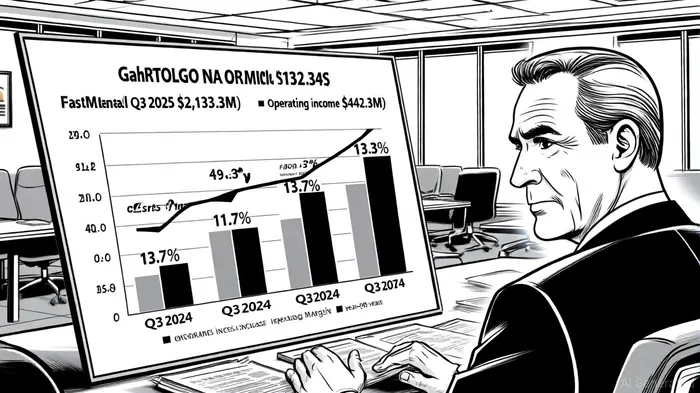
In Q3 2025, FastenalFAST-- Co. (NASDAQ: FAST) demonstrated remarkable operational resilience amid a challenging macroeconomic landscape, delivering 11.7% year-over-year net sales growth to $2,133.3 million and expanding operating margins to 20.7% from 20.3% in the prior-year period, according to Fastenal's Q3 earnings release. This performance underscores the company's ability to navigate headwinds such as sluggish industrial production and rising import duties while maintaining profitability. For investors, the results highlight Fastenal's strategic agility in leveraging pricing actions, digital transformation, and disciplined cost management to fortify its market position.
Financial Performance: Sales Growth and Margin Expansion
Fastenal's Q3 2025 earnings report revealed a 13.7% increase in operating income, driven by an 11.7% rise in daily sales rate (DSR) and improved product availability in distribution centers, as noted in the release. The fastener category, which constitutes a significant portion of the company's revenue, outperformed non-fastener segments, while heavy manufacturing and other manufacturing end markets saw robust DSR growth. Notably, the company's gross margin expanded to 45.3% in Q3 2025 from 44.9% in Q3 2024, attributed to better fastener inventory management and pricing strategies, as illustrated in the Fastenal Q3 slides.
Operating cash flow also remained strong at $386.9 million, representing 115.3% of net income, a testament to Fastenal's efficient working capital management and pricing discipline reported in the earnings release. However, the company faced challenges in translating earnings into cash, as net cash from operating activities fell to 86% of net income for the first six months of 2025, down from 100.5% in the prior year, according to a Fastenal earnings analysis. This weakening conversion rate raises questions about the sustainability of cash flow generation amid macroeconomic pressures.
Margin Expansion Strategies: Cost Control and Digital Transformation
Fastenal's margin expansion was underpinned by disciplined SG&A cost control, with expenses remaining flat at 24.6% of net sales compared to the prior year, as shown in the slides. The company also leveraged automation in warehouses and delivery efficiency improvements via its trucking network to reduce operational costs, a point highlighted in the Fastenal Q3 preview. Additionally, strategic shifts toward higher-margin private-label products and supply chain optimizations helped offset rising import duties and unfavorable customer mix, as the preview noted.
The FMI Technology program, a cornerstone of Fastenal's digital transformation, contributed to operational efficiency and customer retention. Sales through FMI Technology grew 14.4% year-over-year to $928.5 million, representing 44.1% of total sales, according to a Fastenal FMI update. However, the program faced headwinds as FMI device signings declined 10.2% year-over-year in Q2 2025, prompting management to revise its full-year 2025 FMI signing goal downward in that update. This slowdown highlights the challenges of scaling embedded customer relationships in a slowing industrial economy.
Macroeconomic Headwinds and Strategic Responses
Fastenal's Q3 2025 results were not without challenges. The company reported a 65-basis-point contraction in operating margins year-over-year, driven by uneven performance across customer segments and weak demand in non-residential construction and reseller channels, according to the earnings analysis. Fastener sales, a critical component of the business, declined due to sluggish industrial production, though non-fastener sales in maintenance and safety-related products grew 4.7%, partially offsetting the decline, the analysis noted.
To address these headwinds, Fastenal prioritized contract-based sales, where the DSR for contract customers increased 11% year-over-year, significantly outpacing non-contract sales growth of 2.6%, per the analysis. The company also expanded its Onsite program, adding 93 new customers in Q3 2025 and maintaining a presence in 1,980 active locations, the article reported. This service, which provides on-site inventory management and supply solutions, remains a key differentiator in retaining customers and reducing reliance on competitors.
Assessing Long-Term Resilience
While Fastenal's Q3 2025 results reflect short-term resilience, long-term success will depend on its ability to scale FMI Technology adoption and navigate macroeconomic uncertainties. The company's revised FMI signing targets and working capital challenges signal potential bottlenecks in growth. However, its focus on pricing actions, digital transformation, and high-margin product lines positions it to weather ongoing economic pressures.
For investors, Fastenal's 11.7% sales growth and 40-basis-point operating margin expansion demonstrate its capacity to adapt to a volatile environment. Yet, the weakening cash flow conversion and FMI adoption slowdown warrant caution. As the company anticipates improved fastener demand with easing interest rates, its ability to balance innovation with cost discipline will be critical to sustaining profitability.
Historical performance analysis of FAST following earnings-beat events (2022–2025) shows the average excess return reached +3.1% by day 5, +6.0% by day 15, and +8–10% by day 20–30, with a 100% win rate from day 14 onward in the sample period. These findings suggest that a simple buy-and-hold strategy following positive earnings surprises has historically yielded favorable returns, reinforcing the case for patience and strategic positioning in Fastenal's stock.





Comentarios
Aún no hay comentarios