
Farmland as a Strategic Alternative: WisdomTree's $750M AUM Target and the Rise of a Resilient Asset Class
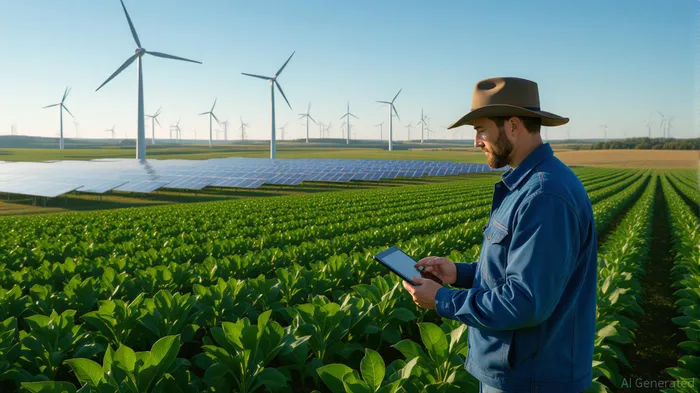
The acquisition of Ceres Partners by WisdomTreeWT--, Inc. (NYSE: WT) marks a pivotal moment in the evolution of farmlandFPI-- as a strategic alternative asset class. With a $275 million upfront cash payment and an earn-out tied to 12–22% annual revenue growth, WisdomTree is betting on the $3.5 trillion U.S. farmland market's potential to deliver inflation-hedged returns, diversification, and structural growth. By 2030, the company aims to amass over $750 million in farmland AUM under its new platform, leveraging Ceres's $1.85 billion AUM base and a fee structure of 1% base / 20% performance. This move is not just a strategic expansion—it's a calculated alignment with macroeconomic and technological trends reshaping global investing.
The Case for Farmland: Scarcity, Resilience, and ESG Alignment
Farmland's appeal lies in its unique characteristics: it is a finite resource, inherently resilient to market volatility, and increasingly aligned with ESG (Environmental, Social, and Governance) priorities. Since 2007, Ceres's farmland portfolio has delivered a 10.3% net annual total return, outperforming benchmarks and demonstrating the asset class's capacity to generate income and capital appreciation. U.S. farmland values have risen in all but nine years since World War II, with 2023–2025 seeing an 8% increase in 2023, 5% in 2024, and a projected 3.5% in 2025. Cropland, in particular, commands a premium—$5,570 per acre in 2024—due to its productivity and demand for food security in a climate-uncertain world.
The integration of ESG principles into farmland investments is accelerating demand. Regenerative agriculture, carbon sequestration, and water conservation practices are not only environmentally beneficial but also enhance asset value. For instance, Ceres's portfolio includes properties that leverage regenerative techniques, boosting soil health and yield resilience. Investors are increasingly drawn to these models, which align with global climate goals and offer dual returns from agricultural output and carbon credits.
Digital Asset Growth and Technological Synergy
WisdomTree's acquisition also taps into the broader trend of digital assetDAAQ-- growth, including tokenization and blockchain-based tracking. Farmland's physical nature might seem at odds with digital finance, but platforms like Farmonaut and Ceres's own infrastructure are bridging this gap. Real-time crop health monitoring, AI-driven advisory systems, and blockchain traceability are transforming farmland into a high-tech, data-rich asset. These tools reduce operational risks, optimize resource use, and provide investors with transparent, real-time performance metrics.
Moreover, WisdomTree's existing strengths in ETPs (Exchange-Traded Products) and tokenization position it to democratize access to farmland. By packaging farmland into tradable instruments, the company can attract a broader investor base, from institutional players to retail clients seeking uncorrelated returns. The projected $4,500 per acre value for managed farmland funds in 2025 underscores the sector's readiness for scalable innovation.
Record Inflows and Market Dynamics
Global agricultural land investments are set to exceed $50 billion by 2025, driven by rising food demand, climate resilience, and ESG-driven capital flows. U.S. farmland real estate alone reached $3.52 trillion in 2024, with cropland accounting for 78% of the value. Rental rates for cropland and pastureland have also risen steadily, reflecting the growing scarcity of arable land and the economic value of productivity.
While 2024 saw a -1.0% total return for the NCREIF Total Farmland Index, the Annual Cropland Index delivered a 5.7% return, highlighting the importance of crop type and management strategies. WisdomTree's focus on annual row crops, which benefit from higher rental income and capital appreciation, positions it to capitalize on these dynamics. The company's target of 12–22% annual revenue growth is ambitious but achievable in a sector where demand for income-generating, inflation-protected assets is surging.
Risk Mitigation and Long-Term Positioning
Farmland is not without risks—climate volatility, regulatory shifts, and liquidity constraints. However, WisdomTree's acquisition strategy mitigates these through diversification. Ceres's portfolio spans 12 U.S. states, with a concentration in the Midwest's fertile Corn Belt, while also exploring adjacent verticals like solar and water infrastructure. This multi-asset approach spreads risk and taps into cross-sector synergies.
For investors, the key takeaway is to view farmland as a cornerstone of a diversified portfolio. Its low correlation with equities and bonds (historically around 0.2–0.4) makes it an effective hedge against market downturns. With WisdomTree's institutional-grade platform and Ceres's operational expertise, the asset class is now more accessible than ever.
Investment Advice: Positioning for 2030 and Beyond
The $750 million AUM target by 2030 is not just a number—it's a signal of farmland's maturation as a mainstream alternative. Investors should consider allocations to farmland through managed funds, REITs, or WisdomTree's ETPs, which offer liquidity and professional management. For those seeking direct exposure, Ceres's 174,000-acre portfolio of prime farmland provides a tangible, high-quality entry point.
As the world grapples with food security, climate resilience, and digital transformation, farmland stands out as a rare asset class that combines scarcity, utility, and innovation. WisdomTree's bold move into private assets is a testament to farmland's enduring value—and a call to action for investors to rethink their portfolios.
In the end, the future of capital appreciation may lie not in silicon or oil, but in the soil—and the systems that steward it.





Comentarios
Aún no hay comentarios