
Faraday Future's Strategic Move into the Middle East and the FX Super One Launch: Assessing High-Growth EV Opportunities in Emerging Green Mobility Markets
The Middle East is emerging as a pivotal frontier for electric vehicle (EV) innovation, driven by ambitious sustainability goals and a rapidly expanding charging infrastructure. Faraday FutureFFAI--, the American EV startup, has positioned itself at the center of this transformation with its FX Super One, a luxury electric MPV unveiled as part of its "Third Pole" strategy to establish the region as a global hub for smart green mobility. As the company prepares for its Middle East launch on October 28, 2025, investors must weigh the risks and rewards of this high-stakes bet in a market poised for explosive growth.
A Strategic Pivot to the Middle East
Faraday Future's entry into the Middle East is not accidental but calculated. The company's Third Pole Strategy aims to leverage the region's wealth of capital, political will, and climate-driven demand for sustainable mobility. As detailed in a Business Insider press release, by securing a facility in Ras Al Khaimah's economic zone and showcasing the FX Super One at WETEX 2025-a major clean energy exhibition-FF has aligned itself with the UAE's Net Zero 2050 and Clean Energy 2050 initiatives. A Zawya press release noted that the vehicle's debut at WETEX, where UAE royal family members and officials praised its "contributions to sustainable mobility," underscores the political capital FF has secured.
The FX Super One, marketed as the world's first "First-Class EAI MPV," is designed to disrupt the luxury EV segment. With features like the F.A.C.E. (Front AI Communication Ecosystem)-an interactive LED grille-and a dual-motor, all-wheel-drive system, the vehicle blends AI-driven innovation with premium comfort, as shown in a MotorTrend review. Its hybrid AIHER (AI Hybrid Extended Range) variant, which uses a gasoline generator to extend range, addresses range anxiety in a region where charging infrastructure remains uneven, according to a Forbes article.
Market Opportunity: A $16 Billion EV Frontier
The Middle East EV market is projected to grow at a 20% CAGR, reaching $16.11 billion by 2030, per a Mordor Intelligence report. The UAE alone aims for 50% of its vehicle fleet to be electric by 2050, supported by incentives like free parking, toll exemptions, and reduced registration fees, as described in a Rest of World feature. Saudi Arabia and Qatar are similarly advancing local EV manufacturing and charging networks, creating a fertile ground for companies like FF.
However, challenges persist. Extreme heat and sandstorms threaten battery performance, and while FF has conducted baseline testing of the FX Super One's air conditioning system in the UAE, specifics on climate-resilient battery cooling remain undisclosed, according to a GlobeNewswire release. Competitors like Tesla, BYD, and Nio-which offer battery-swap technology and aggressive pricing-pose a significant threat, per a Dubai Business article. FF's niche as a luxury MPV may struggle in a market dominated by SUVs, but its focus on AI-driven differentiation could carve out a unique value proposition.
Financial Realities and Execution Risks
Faraday Future's financial health remains precarious. In Q2 2025, the company reported a net loss of $43.8 million but secured $61 million in funding, including $41 million from new investors, as reported in a TMCNet report. While the FX Super One's projected "affordable mass-market" pricing (under $100,000) aims to balance luxury and accessibility, noted in a Yanko Design piece, FF's ability to achieve positive gross margins hinges on scaling production at its Hanford, California, factory and leveraging local sourcing in the UAE, according to a QuiverQuant release.
The company's reliance on external financing and its history of operational losses raise questions about long-term sustainability. For instance, FF's 2024 net loss of $355.8 million-58% from non-operating expenses-was highlighted in a StockTitan article. Yet, the Middle East's regulatory support and FF's strategic partnerships, including dealer agreements in Dubai and Abu Dhabi, suggest a calculated effort to mitigate these risks, per a Stockhouse press release.
Investment Implications
For investors, Faraday Future's Middle East venture represents a high-risk, high-reward opportunity. The region's EV market is undeniably on an upward trajectory, and FF's alignment with UAE policymakers could provide a critical tailwind. However, the company's technical readiness for extreme climates, competitive positioning against entrenched rivals, and financial discipline will determine its success.
The FX Super One's launch in November 2025 will be a litmus test. If FF can deliver on its promises of climate resilience, AI-driven innovation, and cost efficiency, it may capture a slice of the $16 billion market. But if execution falters-whether due to battery performance issues, pricing missteps, or regulatory headwinds-the risks could outweigh the rewards.
In the end, the Middle East's green mobility revolution is not just about vehicles; it's about redefining energy systems, urban infrastructure, and economic diversification. Faraday Future's bet is bold, but in a race where the finish line is 2050, patience and adaptability may matter as much as innovation.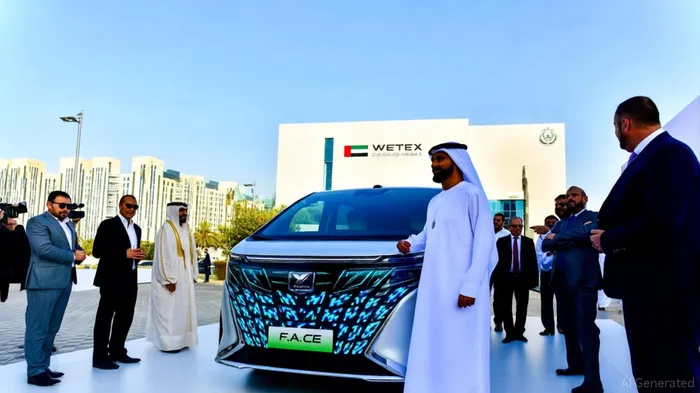





Comentarios
Aún no hay comentarios