
Faraday Future's Shareholder Vote: A Make-or-Break Moment for EV and AI Ambitions
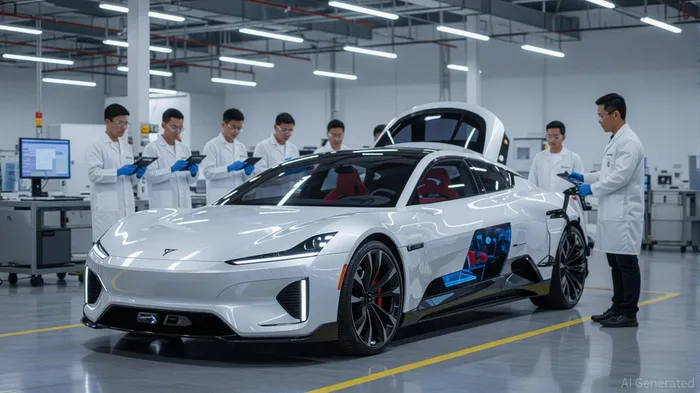
The stakes couldn't be higher for Faraday FutureFFAI-- (NASDAQ: FFAI) as it prepares for its September 19, 2025, shareholder vote. This isn't just another round of dilution—it's a pivotal inflection pointIPCX-- that could either accelerate the company's ascent as a leader in AI-driven electric vehicles or deepen the skepticism that has long shadowed its ambitious roadmap. Let's dissect the strategic calculus here: a 39% increase in authorized common and preferred shares, a $105 million financing agreement, and a pivot toward mass-market EVs. But with every step forward, the question lingers: Is this the right price to pay for growth?
The Strategic Playbook: Capital, Production, and AI
Faraday's “Second Chapter of the Bridge Strategy” hinges on securing the capital to transition from prototype to production. The proposed 39% share increase—adding 65 million common shares and 5 million preferred shares—is not a one-time dilution but a buffer for future financing needs. The company is betting that this flexibility will allow it to fund the trial production of the FX Super One, a mass-market EV with over 10,000 paid pre-orders, and to meet obligations under its recent $105 million financing.
What's compelling here is the alignment of capital with tangible milestones. The FX Super One's trial production at the Hanford factory, with a first vehicle roll-off expected by year-end, is a critical test of execution. Unlike many EV startups that chase hype over substance, Faraday has tied its capital raise to operational progress. The company's 300% market cap surge since April 2025—when founder YT Jia returned as Co-CEO—suggests investors are starting to buy into this narrative.
But let's not ignore the elephant in the room: dilution. A 39% increase in authorized shares is aggressive, even by EV industry standards. For context, TeslaTSLA-- (TSLA) has navigated its growth with far less dilution, relying on revenue and profitability to fund expansion. shows how a disciplined capital structure can reward shareholders. Faraday's approach, however, is more akin to a startup in its “burn phase,” where survival depends on constant fundraising.
Industry-Wide Risks: The Dilution Dilemma
The broader EV and climate tech sector is no stranger to dilution. In 2025, venture capital funding for EV startups has become more selective, with investors demanding stronger revenue traction and clearer paths to profitability. The median time between funding rounds has stretched to 24+ months, and the median revenue requirement for Series A rounds has jumped 75% since 2021. This means startups must raise capital more frequently—and at higher valuations—to stay afloat, often at the expense of early shareholders.
Faraday's 39% share increase is a calculated risk. While it's lower than the 50%+ dilution seen in some peers, it still represents a significant shift in ownership. The company's opposition to a reverse stock split—despite the dilutive impact—signals a preference for long-term flexibility over short-term pain. But investors must ask: Will this capital be enough to reach profitability, or will it merely delay the next round of dilution?
The answer lies in execution. Faraday's dual-brand strategy—luxury FF 91 and mass-market FX—could differentiate it from rivals. The FX Super One's 10,000 pre-orders and B2B deals with East and West Coast companies are promising, but scaling production to 30,000 units annually at Hanford is a massive operational challenge. If the company falters, the dilution will feel even more acutely.
The AI Angle: A Differentiator or a Distraction?
Faraday's rebrand to “Faraday Future AI Electric Vehicle Inc.” isn't just semantics—it's a strategic pivot. The company is positioning itself as a leader in AI-integrated mobility, with autonomous driving systems and smart transportation ecosystems. This could attract tech-savvy investors and partners, but it also raises the bar for innovation.
The AI sector is a double-edged sword. While it's a growth engine, it's also capital-intensive. Faraday's $41 million in new funding (subject to closing) will need to cover R&D, talent retention, and regulatory hurdles. The proposed 9.5 million share increase under the 2021 Stock Incentive Plan is a smart move to retain top talent, but it adds to the dilution equation.
Investment Takeaways: Weighing the Risks and Rewards
For investors, the key is to balance optimism with caution. Faraday's shareholder vote is a make-or-break moment because it determines whether the company can fund its production timeline and AI ambitions without collapsing under the weight of dilution. Here's how to approach it:
- Monitor the Vote Outcome: If the proposals pass, watch for follow-through on production milestones and revenue growth. A failed vote could trigger a liquidity crisis.
- Assess Execution Risk: The Hanford factory's ability to scale to 30,000 units annually is critical. Delays or cost overruns will test investor patience.
- Compare to Peers: to gauge how the market values its AI and EV strategy.
- Dilution Tolerance: If you're invested, ask: Can you stomach a 39% share increase? If not, consider hedging with short-term options or reducing exposure.
Faraday Future's story is one of ambition and resilience. The shareholder vote is a test of whether the company can balance its audacious vision with the realities of capital markets. For those willing to take the plunge, the rewards could be substantial—but the risks are equally real. As the EV and AI sectors evolve, the winners will be those who can execute without losing their shareholders along the way.





Comentarios
Aún no hay comentarios