
Faraday Future's Crypto Pivot: Assessing the Long-Term Viability of EVs in the Blockchain Era
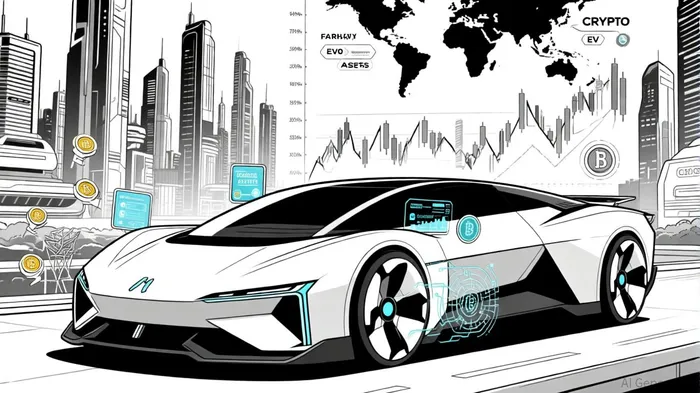
In 2025, Faraday FutureFFAI-- (FF) has emerged as a bold pioneer in the convergence of electric vehicles (EVs) and blockchain technology. The company's “EAI + Crypto” Dual-Flywheel & Dual-Bridge Ecosystem Strategy[1] represents a radical departure from traditional EV business models, positioning FF as one of the first U.S.-listed companies to directly link real-world operations with on-chain assets. This strategic pivot raises critical questions for investors: Can EV firms like FF sustain profitability in a volatile crypto market? How do regulatory shifts and industry trends shape the long-term viability of blockchain integration?
Strategic Initiatives: Bridging Web2 and Web3
FF's core crypto initiative, the C10 (Crypto 10) Treasury, allocates 80% of its portfolio to a passive holding of the top 10 cryptocurrencies (excluding stablecoins) and 20% to active management[1]. With an initial $30 million investment and ambitions to scale to “tens of billions” in assets[1], the C10 Treasury aims to fund innovation, stock buybacks, and asset growth. This approach mirrors strategies adopted by digital assetDAAQ-- treasuries (DATs) like MicroStrategy, which have leveraged crypto as a high-yield alternative to traditional cash reserves[4].
To operationalize its Web3 ambitions, FF partnered with HabitTrade, a digital asset infrastructure platform, to enable tokenized vehicle sales and crypto-based deposits via its EAI Vehicle Chain[3]. This collaboration, supported by RWA Group, marks FF's first major step into tokenizing physical assets, a trend gaining traction as blockchain firms seek to bridge real-world value with decentralized ecosystems[3]. Additionally, FF established a wholly owned subsidiary, FFAI Crypto Treasury and Bridging Holdings Inc., to manage its crypto operations independently[1], a move that enhances transparency but also introduces corporate complexity.
Industry Trends: EVs and Blockchain Synergies
FF's pivot aligns with broader industry trends. TeslaTSLA--, FerrariRACE--, and BYD have already integrated crypto payments for EVs[5], while blockchain's role in supply chain transparency and energy trading is expanding. For instance, FordF-- and IBM's blockchain-based cobalt sourcing initiative improved traceability by 46% in one year[6], highlighting the technology's potential to address EV industry pain points like mineral sourcing and battery lifecycle management.
Moreover, blockchain's decentralized architecture supports peer-to-peer (P2P) energy trading, enabling EV owners to monetize idle charging infrastructure[7]. This aligns with FF's Embodied AI (EAI) mobility ecosystem, which emphasizes AI-driven energy optimization[1]. By merging EAI with crypto, FF aims to create a circular growth engine where on-chain assets fund innovation, and real-world EV operations generate data and value for Web3 applications[1].
Financial and Regulatory Risks
Despite these synergies, FF's strategy carries significant risks. The crypto market's volatility—exemplified by Bitcoin's 50% surge in July 2025[4]—poses challenges for long-term planning. Unlike Tesla, which benefited from a 2024 accounting rule change that boosted profits by $600 million through crypto mark-to-market gains[8], FF's C10 Treasury lacks similar financial tailwinds. If crypto prices decline, FF's treasury could become a drag on its balance sheet, exacerbating its already precarious financial position[5].
Regulatory uncertainty further complicates the outlook. The U.S. has adopted a pro-crypto stance under President Trump, with the GENIUS Act clarifying stablecoin regulations[4], but the EU's Markets in Crypto-Assets (MiCA) framework imposes stringent compliance requirements[9]. FF's global ambitions will require navigating this fragmented landscape, particularly as countries like China maintain restrictive crypto policies[9].
Comparative Analysis: EVs and Crypto Investment Viability
To assess FF's strategy, it's instructive to compare it with peers. Tesla's Q3 2025 financial report revealed $29 billion in revenue, driven by energy solutions and FSD subscriptions[2], but its crypto-related gains remain anecdotal. BYD, meanwhile, leverages its dominance in China's EV market to offset crypto volatility with consistent profitability[8]. In contrast, FF's reliance on crypto as a core funding mechanism exposes it to dual risks: EV industry headwinds (e.g., U.S.-China trade tensions[4]) and crypto market fluctuations.
A risk analysis of the EV sector using beta coefficients shows it is more volatile than the broader market[8], a trend amplified by crypto integration. For FF to succeed, it must balance innovation with risk mitigation—perhaps through hedging strategies or diversified crypto holdings.
Conclusion: A High-Stakes Bet on the Future
Faraday Future's crypto pivot is a high-risk, high-reward proposition. While its C10 Treasury and EAI + Crypto strategy could position it as a leader in the EV-Web3 convergence, the company must navigate regulatory hurdles, market volatility, and operational complexity. For investors, the key question is whether FF can transform its crypto assets into sustainable value or if the strategy will become a speculative albatross.





Comentarios
Aún no hay comentarios