
Faraday Future's $41M Strategic Investment in Qualigen: A Game-Changer for Crypto-Driven Biotech Synergy?
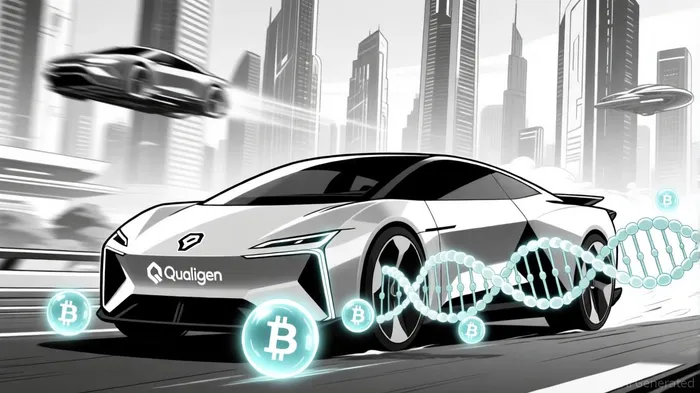
In September 2025, Faraday FutureFFAI-- (FF) made headlines with a $41 million strategic investment in QualigenQLGN-- Therapeutics (QLGN), rebranding the biotech861042-- firm as CXC10 and pivoting it toward crypto and Web3 ventures. This move, structured as a private investment in public equity (PIPE), sees FFFF-- acquiring 55% of Qualigen's common stock while its founder, YT Jia, personally invests $4 million for a 7% stake. The transaction raises critical questions: Can a biotech firm's pivot to crypto create sustainable value? Does FF's “Dual Flywheel” strategy—linking electric vehicles (EVs) with crypto—offer a viable path for cross-industry growth? And what regulatory and financial risks loom over this ambitious experiment?
Strategic Alignment: Bridging EVs, Biotech, and Crypto
Faraday Future's investment in Qualigen is notNOT-- merely a financial play but a strategic repositioning. By transforming Qualigen into a crypto-focused entity, FF aims to leverage blockchain technology to create a “bridge between Web2 and Web3” while maintaining its core EV business[1]. This aligns with broader trends in decentralized finance (DeFi) and tokenized assets, where companies like BlackRockBLK-- are tokenizing real-world assets to attract institutional investors[2].
The “Dual Flywheel” model—connecting FF's Electric AI (EAI) with crypto—could theoretically generate synergies. For instance, FF's AI-driven EV development could feed data into CXC10's crypto platforms, while blockchain-based stablecoins or tokens might fund biotech R&D. However, the success of this model hinges on execution. Unlike traditional biotech partnerships, which rely on incremental drug approvals, crypto ventures demand rapid scalability and market adoption. Qualigen's existing biotech pipeline, including its Phase 1a trial for QN-302 (a G-quadruplex-targeting drug for pancreatic cancer), remains a critical asset[3]. Yet, diverting resources to crypto could delay clinical milestones, risking both regulatory approval timelines and investor confidence.
Financial Implications: Risk and Reward in a Volatile Market
The $41 million investment is structured as unsecured convertible notes and warrants, with an additional $10 million in potential funding[4]. This approach allows FF to avoid immediate dilution of existing shareholders while securing liquidity for its FX vehicle launch by late 2025. However, the crypto component introduces volatility. As of 2025, over 100 public companies have adopted digital assetDAAQ-- treasuries (DATs) to hedge against traditional banking risks[5]. Yet, the same volatility that attracts investors to crypto—such as Bitcoin's 50% swings in a single quarter—could destabilize Qualigen's valuation if market conditions shift.
FF's financial history adds another layer of complexity. Despite securing over $100 million in total fundraising since September 2024, the company has faced repeated production delays and a debt-to-equity ratio of 0.36[6]. While the Qualigen investment may signal renewed focus, skeptics argue that FF's reliance on speculative ventures could exacerbate its liquidity challenges. For example, if CXC10's crypto initiatives fail to gain traction, the $41 million investment could become a drag on FF's balance sheet, particularly if the convertible notes are exercised at a discount.
Regulatory Challenges: Navigating a Fragmented Landscape
Qualigen's pivot to crypto is already entangled in regulatory hurdles. The company recently faced Nasdaq compliance issues due to an underqualified audit committee[7], a problem that could worsen as it transitions into a crypto entity. The U.S. Securities and Exchange Commission (SEC) has intensified scrutiny of crypto-linked biotech ventures, demanding clear ties between a company's core operations and its digital asset initiatives[8]. For instance, the SEC's recent enforcement actions against stablecoin projects highlight the risks of conflating biotech R&D with speculative token sales[9].
Globally, the regulatory environment remains fragmented. While the G20 endorsed a crypto framework in 2023, implementation varies by jurisdiction. In the U.S., the CFTC's oversight of crypto derivatives and the Federal Reserve's potential CBDC rollout could further complicate Qualigen's pivot[10]. Meanwhile, the biotech sector's stringent FDA approval processes—requiring years of clinical trials—contrast sharply with crypto's fast-paced innovation cycles. This misalignment could lead to operational bottlenecks, particularly if CXC10's crypto projects outpace its ability to meet biotech regulatory standards.
Growth Potential: A High-Stakes Bet on Convergence
Despite the risks, the FF-QLGN partnership taps into a growing trend: cross-industry innovation. Decentralized autonomous organizations (DAOs), such as VitaDAO, have already demonstrated the potential of blockchain-based biotech funding, with projects like Matrix Biosciences securing $285,000 for longevity research[11]. Similarly, FF's investment could attract blockchain-focused investors, including Binance Labs and Sequoia Capital, which have shown interest in CXC10's crypto index/ETF and Web3 gateway initiatives[12].
However, the path to growth is fraught. Megarounds—$100M+ biotech investments—have surged in 2025, but many are now underperforming due to regulatory delays and market volatility[13]. For CXC10 to succeed, it must balance the rigor of biotech development with the agility of crypto. This could involve tokenizing clinical trial data to attract decentralized investors or using AI to optimize drug discovery while maintaining compliance. Yet, such innovations require not only technical expertise but also regulatory foresight.
Conclusion: A Calculated Gamble or a Strategic Masterstroke?
Faraday Future's $41 million investment in Qualigen represents a bold bet on the future of cross-industry innovation. By merging EVs, biotech, and crypto, FF aims to create a “Dual Flywheel” that drives growth through interconnected markets. However, the venture's success depends on navigating three critical challenges:
1. Execution: Can CXC10's crypto initiatives scale without derailing Qualigen's biotech pipeline?
2. Regulation: Will the SEC and FDA provide clear frameworks for crypto-biotech convergence?
3. Market Volatility: Can FF withstand crypto's inherent instability while maintaining its EV ambitions?
For now, the answer remains uncertain. Yet, in a world where AI-driven drug discovery and blockchain-based funding are reshaping industries, FF's gamble underscores the high-stakes nature of innovation. As the 2025–2034 biotech boom unfolds, the FF-QLGN partnership may either become a blueprint for cross-industry synergy—or a cautionary tale of overambition.





Comentarios
Aún no hay comentarios