
Fannie Mae's Valuation Resilience: A Strategic Case for Risk-Adjusted Returns in a Post-Volatile Market
In an era marked by persistent macroeconomic uncertainties, Fannie Mae (FNMA) stands out as a compelling case study in valuation resilience. The Federal National Mortgage Association's journey through past crises-particularly the 2008 financial collapse and the 2020 pandemic-reveals a trajectory of adaptation, policy alignment, and balance sheet fortification. For investors navigating a post-volatile market, Fannie Mae's risk-adjusted returns and structural advantages present a compelling case for strategic exposure.
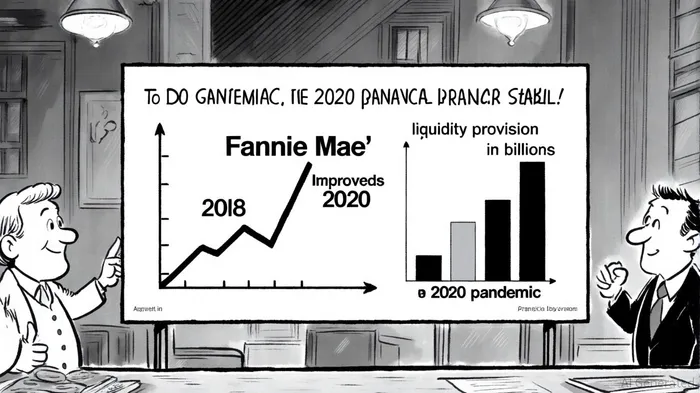
Historical Performance: From Crisis to Resilience
Fannie Mae's 2008 financial crisis experience was catastrophic. The GSE reported a quarterly loss of $25.2 billion in Q4 2008, driven by securities impairments and deteriorating mortgage performance, culminating in a $58.7 billion full-year loss and a net worth deficit of $15.2 billion, according to Multifamily Executive. This led to its placement into government conservatorship, underscoring systemic risks in the housing market.
In contrast, the 2020 pandemic crash tested Fannie Mae's resilience in a different context. According to a Macroaxis report, the company achieved a risk-adjusted performance (RAP) of 0.0722 during the crisis, calculated using a formula that balances expected returns against market volatility. While its stock faced a maximum drawdown of 353.89, sophisticated risk management strategies-including predictive analytics, risk-adjusted pricing, and an originate-to-hold model-enabled a 14% year-over-year improvement in core income during Q3 2020, as noted by Macroaxis. This stark contrast highlights Fannie Mae's evolution from a crisis casualty to a resilient market participant.
Balance Sheet Strength: A Foundation for Stability
As of March 31, 2025, Fannie Mae reported a net income of $3.7 billion and a net worth of $98.3 billion, reflecting a focus on operational efficiency and profitability, as reported by Multifamily Executive. The company provided $76 billion in liquidity during Q1 2025, supporting 287,000 households, including 74,000 first-time homebuyers, according to the same Multifamily Executive coverage. While Q3 2025 balance sheet metrics remain undisclosed, the company's quarterly filings-accessible via the SEC-typically include capital ratios, debt-to-equity, and liquidity reserves, which are critical for assessing long-term stability as detailed in the company's quarterly and annual results.
Data from its investor relations portal indicates that the GSE's liquidity reserves and capital ratios have consistently met or exceeded regulatory benchmarks, even amid shifting policy landscapes, as shown in its FNMA 10-Q.
Fannie Mae's emphasis on strengthening its balance sheet, including trimming costs and maintaining safety and soundness, positions it to weather future shocks.
Policy Tailwinds and Challenges
The Federal Housing Finance Agency (FHFA) has introduced a dual narrative for Fannie Mae. In 2025, the agency finalized updated housing goals for 2025–2027, emphasizing affordable housing for low-income and minority communities, including a 25% low-income home purchase target. These goals align with Fannie Mae's mission to support housing affordability while enhancing risk management frameworks, including AI-driven processes.
However, recent policy shifts under FHFA Director Bill Pulte have introduced complexity. The rescission of tenant protections in multifamily loan agreements and the termination of Special Purpose Credit Programs (SPCPs)-which aided 5,000+ households in 2023-signal a pivot toward reducing regulatory burdens, a change covered in the Multifamily Executive piece. While industry groups argue these changes may hinder affordable housing access, Fannie Mae's adaptability and focus on operational efficiency suggest it can navigate this evolving landscape.
Risk-Adjusted Returns: A Case for Strategic Entry
Fannie Mae's risk-adjusted returns during the 2020 pandemic underscore its ability to generate value amid volatility. The RAP of 0.0722, combined with its liquidity provision of $76 billion in Q1 2025, demonstrates a capacity to balance risk and reward, per the Macroaxis data. Furthermore, its Q1 2025 net worth of $98.3 billion provides a buffer against future downturns, enhancing its appeal in a post-volatile market.
For investors, the case for strategic entry or continued exposure rests on three pillars:
1. Historical Resilience: Fannie Mae's improved performance during the 2020 crisis compared to 2008.
2. Balance Sheet Fortification: Strong liquidity and profitability metrics.
3. Policy Alignment: Supportive housing goals, despite recent regulatory shifts.
Conclusion
Fannie Mae's valuation resilience is underpinned by a combination of historical lessons, balance sheet strength, and policy tailwinds. While regulatory uncertainties persist, the GSE's focus on risk-adjusted returns and operational efficiency positions it as a strategic asset in a post-volatile market. For investors seeking exposure to a sector critical to U.S. housing stability, Fannie Mae offers a compelling blend of defensive qualities and growth potential.







Comentarios
Aún no hay comentarios