
Falcon Finance's $FF Tokenomics Framework and Its Implications for DeFi Growth
In the volatile world of decentralized finance (DeFi), tokenomics frameworks are critical to ensuring protocol resilience during market downturns. Falcon Finance's $FF token, launched in 2025, presents a compelling case study in structuring incentives to align long-term value accrual with ecosystem growth. By dissecting its supply dynamics, governance mechanisms, and deflationary strategies, we uncover how Falcon FinanceBYFC-- aims to insulate its token from bear market pressures while fostering sustainable DeFi adoption.
Token Supply Dynamics: Balancing Liquidity and Scarcity
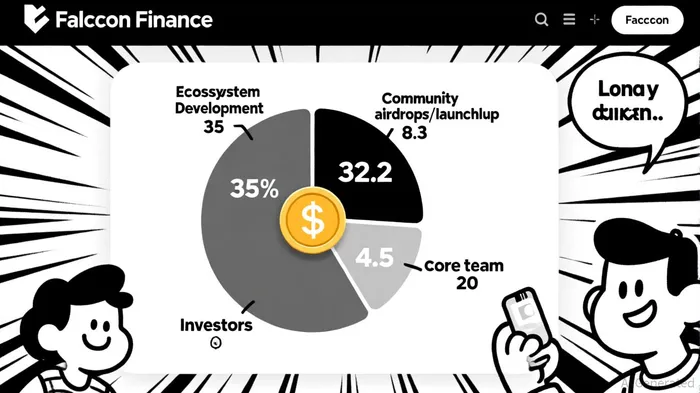
Falcon Finance's $FF token operates on a 10 billion supply model, with allocations designed to prioritize ecosystem development and institutional credibility. According to a report by PR Newswire, 35% of tokens are reserved for the ecosystem to fund initiatives like cross-chain integrations and future airdrops, while 32.2% are allocated to the FF Foundation for liquidity and risk management [2]. This structure ensures that the protocol retains flexibility to adapt to market conditions without relying on discretionary governance.
The core team and early contributors hold 20% of the supply, subject to a 1-year cliff and 3-year vesting schedule, mitigating short-term dumping risks [2]. Meanwhile, institutional backing from entities like DWF Labs and World Liberty FinancialWLFI-- (WLFI) adds liquidity depth, a factor highlighted in Bitget's presale analysis as critical for stabilizing token value during downturns [1].
Incentive Structures: Aligning Stakers and Long-Term Holders
Falcon Finance's tokenomics employ a dual pricing model to incentivize participation. As stated by Dropstab's research, stakers of USDf or sUSDf tokens benefit from a $350 million fully diluted valuation (FDV), while non-stakers face a higher $450 million FDV [2]. This creates a deflationary pressure by rewarding those who lock liquidity, aligning token holder interests with protocol stability.
Boosted Yield mechanics further amplify this effect. Users who stake USDf or sUSDf receive enhanced rewards, with minimum thresholds ensuring meaningful capital engagement [2]. Additionally, Falcon Miles—a loyalty program rewarding long-term participation—reinforces retention, a strategy akin to traditional finance's customer acquisition models.
Deflationary Mechanisms and Bear Market Resilience
During market downturns, Falcon Finance leverages token burns to create scarcity. Protocol revenue from staking and yield generation is systematically used to retire $FF tokens, a strategy detailed on its official website [2]. This contrasts with inflationary models that dilute value during crises.
The 100% token unlock at the Token Generation Event (TGE) also deserves scrutiny. While immediate liquidity could theoretically destabilize the token, Falcon Finance offsets this with structured airdrops and vesting schedules for core contributors [2]. The FF Foundation's independent governance further ensures transparency, reducing the risk of misaligned incentives.
Strategic Implications for DeFi Growth
Falcon Finance's approach addresses a key DeFi pain point: the lack of bear market-tested tokenomics. By prioritizing ecosystem development (35% allocation) and institutional partnerships, it creates a flywheel effect where liquidity providers, stakers, and developers are all incentivized to sustain the protocol. The FF Foundation's role as an independent arbiter of token distribution further enhances trust, a critical factor in attracting institutional capital.
However, risks remain. The 20% allocation to the core team, while vesting over three years, could still be perceived as concentrated. Additionally, the success of deflationary burns depends on consistent protocol revenue, which may falter in prolonged downturns.
Conclusion
Falcon Finance's $FF tokenomics framework represents a sophisticated blend of liquidity incentives, deflationary mechanics, and institutional credibility. By structuring rewards to favor long-term participation and embedding governance transparency, it positions itself as a potential benchmark for bear market resilience in DeFi. For investors, the key takeaway is clear: protocols that prioritize aligned incentives and adaptive tokenomics are better equipped to navigate the cyclical nature of crypto markets.







Comentarios
Aún no hay comentarios