
Falcon Finance's FF Token: A New Paradigm in DeFi Tokenomics and Governance
In the ever-evolving landscape of decentralized finance (DeFi), Falcon Finance's $FF token emerges as a compelling case study in redefining tokenomics and governance. With a fixed supply of 10 billion tokens and a meticulously designed distribution model, Falcon Finance aims to address long-standing challenges in DeFi—such as centralization risks, token inflation, and user engagement—while positioning itself at the forefront of real-world asset (RWA) integration.
Tokenomics: A Blueprint for Sustainable Growth
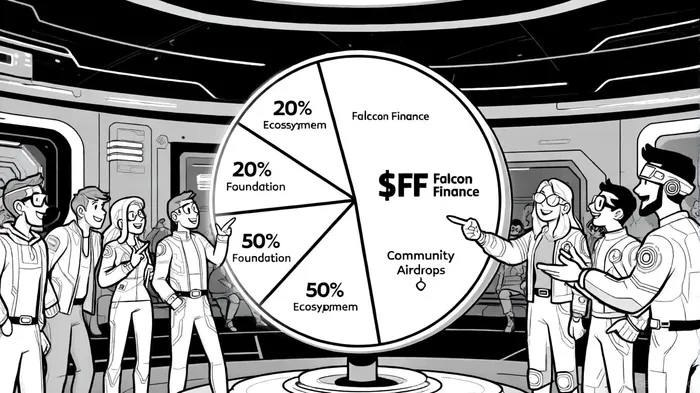
Falcon Finance's $FF token operates under a dual-token system alongside USDf and sUSDf, synthetic dollars that facilitate yield generation and liquidity provision. The token's fixed supply of 10 billion units is allocated to ensure long-term ecosystem sustainability. According to the project's whitepaper, 35% of tokens (3.5 billion) are reserved for ecosystem growth initiatives, including airdrops, RWA adoption, and cross-chain integrations [1]. This allocation mirrors the strategies of successful DeFi protocols like UniswapUNI--, which prioritize community-driven growth over centralized control.
The remaining supply is distributed as follows:
- 32.2% (3.22 billion) to the Foundation for liquidity management and exchange partnerships [2].
- 20% (2 billion) to the Core Team and Early Contributors, subject to a 1-year cliff and 3-year vesting schedule [3].
- 8.3% (830 million) to Community Airdrops and Launchpad Sales, incentivizing early adopters [4].
- 4.5% (450 million) to Investors, also under a vesting schedule [5].
This structure mitigates the risk of token dumping by aligning incentives between developers, investors, and users. For instance, the vesting schedules for team and investor allocations ensure that key stakeholders remain committed to the project's long-term success [6].
Governance: Decentralization with Institutional Rigor
A standout feature of $FF is its governance model, which delegates authority to an independent FF Foundation. As stated by Falcon Finance in its updated whitepaper, this entity ensures that token governance is decoupled from protocol development, enhancing transparency and trust [7]. Token holders can vote on protocol upgrades, while the Foundation oversees critical functions like liquidity management and RWA partnerships. This separation of roles is reminiscent of the DAO model but with added institutional safeguards, a critical differentiator in an industry plagued by governance exploits.
Moreover, $FF holders gain utility through staking mechanisms. Stakers earn rewards in USDf or $FF itself, with additional benefits like reduced fees and boosted APY on staking pools [8]. These incentives create a flywheel effect, where increased participation drives liquidity, which in turn enhances the token's utility and value.
RWA Integration: Bridging Onchain and Offchain Finance
Falcon Finance's roadmap includes a 2026 launch of an RWA engine to tokenize institutional assets, a move that could redefine DeFi's role in global finance. By integrating real-world assets—such as real estate, commodities, and corporate debt—into its onchain liquidity system, Falcon Finance aims to attract institutional capital while maintaining composability for developers [9]. This strategy aligns with broader industry trends, as platforms like MakerDAO and AaveAAVE-- have begun exploring RWA integrations to expand their use cases beyond crypto-native assets.
Risks and Considerations
While Falcon Finance's tokenomics and governance model are innovative, investors should remain cautious. The absence of disclosed emission rates for $FF in 2025 raises questions about inflationary pressures, though the fixed supply cap of 10 billion tokens provides a degree of predictability [10]. Additionally, the success of RWA adoption hinges on regulatory clarity and institutional buy-in, both of which are still evolving.
Conclusion: A Disruptive Force in DeFi?
Falcon Finance's $FF token represents a bold experiment in balancing decentralization, utility, and institutional-grade governance. Its token distribution prioritizes ecosystem growth and long-term alignment, while its RWA ambitions position it to capture a significant share of the $1.5 trillion DeFi market. For investors, the key question is whether Falcon Finance can execute its vision without compromising security or regulatory compliance. If successful, $FF could become a cornerstone of the next phase of DeFi—where onchain systems and real-world assets converge.







Comentarios
Aún no hay comentarios