
The Fading Santa Claus Rally: Is the December Effect Losing Its Magic?
The Santa Claus Rally, a storied seasonal phenomenon in financial markets, has long captivated investors with its promise of year-end gains. Historically, the S&P 500 has delivered an average return of 1.3% during the last five trading days of December and the first two of January, with positive outcomes occurring 79% of the time since 1950. Yet, recent years have cast doubt on this tradition. In 2023 and 2024, the rally failed to materialize, with the S&P 500 declining by 2.4% in December 2024 despite a robust annual gain of 23.3%. This raises a critical question: Is the December effect losing its magic?
Historical Reliability and the "Magic" of the Santa Claus Rally
The Santa Claus Rally's allure stems from its historical consistency. Since 1950, the pattern has served as a reliable barometer for market sentiment, with a rally often signaling a positive start to the new year. Studies show that years with a Santa Claus Rally have averaged 10.4% returns in the following 12 months, compared to just 5.0% when the rally fails. This correlation has made the period a focal point for investors seeking to capitalize on seasonal trends.
However, the rally's reliability is not absolute. The 2023 and 2024 anomalies highlight how macroeconomic forces can disrupt historical patterns. In 2024, persistent inflation concerns and hawkish Federal Reserve signals created a perfect storm of investor caution, leading to a rare four-day losing streak into year-end. These factors underscore the growing influence of real-time economic data and central bank policy on seasonal trends.
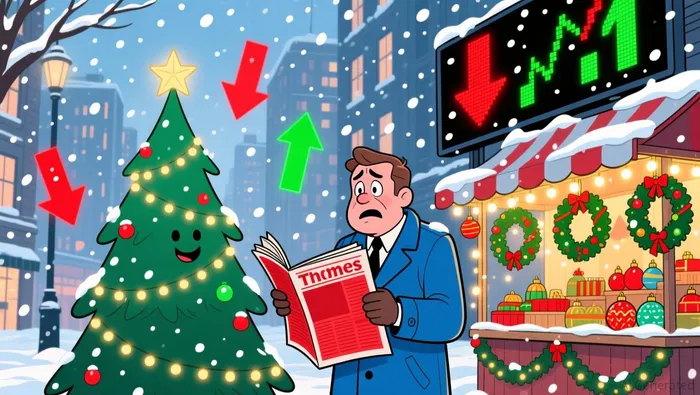
The 2023–2024 Failures: A New Normal?
The absence of a Santa Claus Rally in 2023 and 2024 reflects a shift in market dynamics. In 2023, the S&P 500 surged 24.2% annually but saw no late-year gains, while 2024's 23.3% annual return was similarly unaccompanied by a rally. Analysts attribute this to stretched bullish sentiment and macroeconomic headwinds, including inflationary pressures and uncertainty around Fed policy.
The 2024 decline was particularly striking. Despite a strong annual performance, the S&P 500's 2.4% drop in December marked only the third monthly decline of the year and the first failed rally since 2015. This deviation suggests that traditional seasonal patterns may be less predictive in an era of rapid macroeconomic shifts and heightened volatility.
2025 Outlook: Can the Magic Return?
As we approach December 2025, the question of whether the Santa Claus Rally will reemerge hinges on three key factors: Fed policy, inflation trends, and investor sentiment.
1. Federal Reserve Policy and Liquidity Conditions
The Fed's December 2024 rate cut of 0.25 percentage points signaled a pivot toward accommodative policy, and the likelihood of further cuts in December 2025 has risen above 90%. Rate cuts typically boost equity markets by lowering borrowing costs and improving liquidity, particularly for small-cap stocks as noted. However, the Fed's preferred inflation measure, core PCE, remains above the 2% target, complicating the path to sustained easing according to analysis.
2. Economic Data and Sector Rotation
November 2025 data revealed a cooling but resilient economy. The S&P 500's seven-month winning streak was driven by a shift from Growth to Value stocks, with Healthcare surging 9% while Technology declined 4%. This rotation reflects investor caution around AI-linked stocks, which face scrutiny over stretched valuations and circular funding risks as reported. Meanwhile, the Beige Book noted flat economic activity and weakness in consumer spending among lower-income households, adding to uncertainty according to data.
3. Investor Sentiment and Behavioral Shifts
Retail investor sentiment remains mixed. The AAII Investor Sentiment Survey shows bullishness ranging between 32% and 44.6%, while bearish sentiment hovers similarly according to the survey. However, the 2025 Natixis survey reveals deeper pessimism, with nearly 25% of investors considering exiting the market. Professional investors, conversely, remain fully invested, citing resilient earnings and economic data as noted. This divergence highlights the growing complexity of market psychology, where retail caution contrasts with institutional optimism.
Conclusion: A Cautious Optimism for 2025
The Santa Claus Rally's fading magic may reflect a broader transformation in market behavior. While historical patterns still hold some sway-evidenced by the 73% positive return rate since 1980-the interplay of macroeconomic forces, Fed policy, and shifting investor sentiment has introduced new variables. For 2025, the combination of anticipated rate cuts and sector rotation suggests a modest chance of a rally, but the risks remain significant.
Investors should approach the December 2025 window with caution, balancing historical optimism with a critical eye on real-time data. As the market navigates a post-AI euphoria landscape and recalibrates to a more nuanced economic reality, the Santa Claus Rally may evolve into a less predictable, yet still relevant, seasonal event.







Comentarios
Aún no hay comentarios