
The FAA's Newark Flight Restrictions: Navigating Airline Volatility and Infrastructure Opportunities in a Restructured Sky
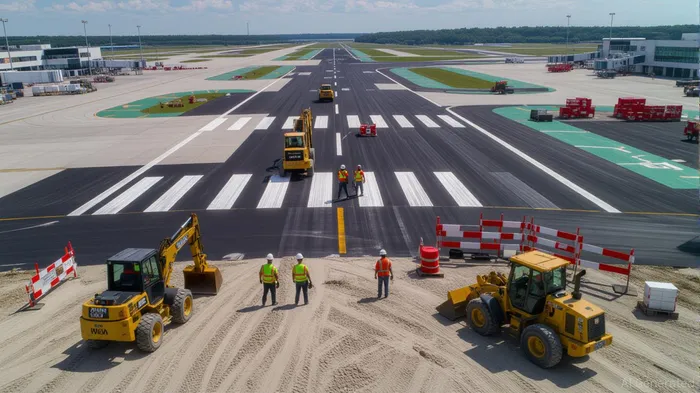
The Federal Aviation Administration's (FAA) flight restrictions at Newark Liberty International Airport (EWR) have created a seismic shift in the aviation landscape, exposing vulnerabilities in the U.S. air traffic system while simultaneously unlocking long-term investment opportunities. As airlines grapple with operational constraints and infrastructure firms accelerate modernization efforts, investors must weigh the risks and rewards of this evolving dynamic.
Airlines: Capacity Constraints and Financial Strain
The FAA's 2025 restrictions—capping arrivals and departures at 28 per hour during construction periods and 34 per hour otherwise—have disproportionately impacted United AirlinesUAL-- (UAL), which operates 70% of EWR's flights. United has slashed 35 daily roundtrips, leading to an estimated $200 million annual revenue loss and a 12% underperformance in its stock since March 2025. Analysts project a 5–7% hit to UAL's 2025 earnings, with recovery hinging on the FAA's ability to restore full runway capacity by mid-2026.
Delta Air Lines (DAL) and American AirlinesAAL-- (AAL), while less directly exposed, face indirect costs. Delta's recent waiver for EWR-affected customers and its 4.1% flight cancellation rate in the past week highlight operational fragility. American's proactive schedule cuts in October 2024—440 basis points—suggest a broader industry trend of capacity reductions to mitigate delays. These adjustments, combined with rising fuel and labor costs, could erode margins for all carriers until infrastructure upgrades stabilize operations.
Infrastructure: A $5 Billion Modernization Play
The FAA's $5 billion EWR modernization project, funded under the Infrastructure Investment and Jobs Act (IIJA), represents a critical long-term opportunity. Key components include:
- Runway and TRACON Upgrades: A new fiber-optic network between New York and Philadelphia TRACON, replacing copper lines to enhance redundancy and speed.
- Terminal A Expansion: A $2.7 billion, 1 million-square-foot terminal with LEED Gold certification, boosting passenger capacity and amenities.
- AirTrain Replacement: A 2.5-mile automated train system to handle 50% more riders by 2040, improving multimodal connectivity.
These projects are spearheaded by Parsons Corporation (PAR), the prime contractor under the FAA's $1.8 billion Technical Support Services Contract V (TSSC V). Parsons' expertise in radar systems, communications infrastructure, and environmental compliance positions it as a key beneficiary of the FAA's $12.5 billion national modernization plan. With over 450 TSSC employees and 300 subcontractors, the company is uniquely positioned to execute complex, nationwide projects.
Investment Implications: Balancing Risks and Rewards
For airlines, the path to recovery depends on the FAA's timeline for lifting restrictions. United's EWR operations could return to pre-crisis profitability by 2027 if infrastructure upgrades deliver a 20% efficiency gain. However, until then, investors should remain cautious, particularly for carriers with heavy EWR exposure. DeltaDAL-- and American, with more diversified networks, may fare better but still face elevated costs from rerouting and rebooking.
Infrastructure players like ParsonsPSN-- offer a compelling counterbalance. The company's TSSC V contract ensures steady revenue for a decade, with potential for additional work as the FAA accelerates modernization. Investors should monitor congressional approval of the $12.5 billion plan, which could unlock further contracts for firms specializing in air traffic control, radar, and communications.
Conclusion: A Sky in Transition
The FAA's EWR restrictions underscore the fragility of the U.S. aviation system but also highlight the transformative potential of infrastructure investment. While airlines face near-term headwinds, the long-term outlook for both carriers and infrastructure firms hinges on the success of modernization efforts. For investors, a diversified approach—hedging airline exposure with infrastructure plays—could offer resilience in an era of constrained skies.





Comentarios
Aún no hay comentarios