
FAA Certification and Starlink: A New Era in Aviation Connectivity
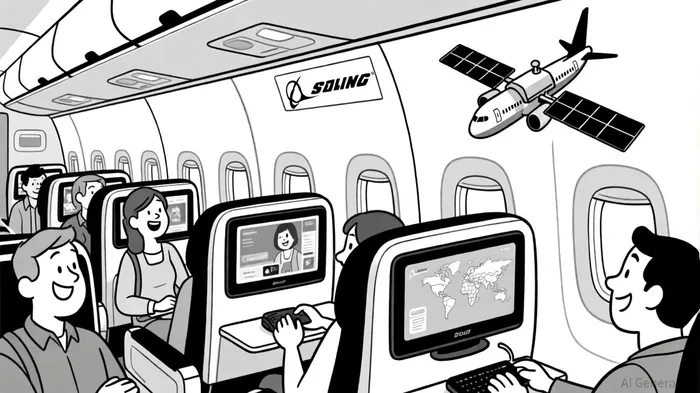
The Federal Aviation Administration's (FAA) recent certification of Starlink-equipped aircraft marks a pivotal moment in aviation technology. United AirlinesUAL--, the first major carrier to secure approval for Starlink's in-flight connectivity system on its Boeing 737-800 and Embraer 175 fleets, is now poised to redefine passenger expectations and operational efficiency. This development is not merely a technical upgrade but a structural shift in the aviation-technology value chain, driven by Starlink's disruptive capabilities and United's aggressive adoption strategy.
United's Certification: A Catalyst for Change
United's FAA certification for Starlink's in-flight connectivity system, finalized in late 2025, follows a rigorous process involving design approval, installation testing, and compliance with safety standards[3]. The airline's first commercial flight using Starlink-equipped aircraft is scheduled for October 15, 2025, with plans to retrofit over 300 regional aircraft by year-end[2]. This rapid deployment—installing 40 aircraft monthly—highlights Starlink's streamlined integration compared to traditional systems, which often require weeks of installation and extensive ground infrastructure[4].
The certification also underscores Starlink's technological edge. Unlike geostationary (GEO) satellite systems, which suffer from latency exceeding 700 milliseconds due to their 35,786 km orbital altitude, Starlink's low Earth orbit (LEO) satellites operate at 550 km, achieving round-trip latencies of 25–60 milliseconds[3]. This enables real-time applications like video streaming and online gaming, which United will offer free to MileagePlus members, differentiating its service in a competitive market[1].
Starlink's Structural Advantages
Starlink's superiority over traditional in-flight connectivity (IFC) systems lies in its performance, scalability, and cost efficiency. Traditional providers like Viasat and Hughes rely on GEO or medium Earth orbit (MEO) satellites, offering median download speeds of 50–85 Mbps[3]. In contrast, Starlink delivers up to 250 Mbps downlink and 25 Mbps uplink speeds, with latency low enough to rival terrestrial broadband[3]. This performance gap is critical for airlines seeking to monetize connectivity through premium services or enhance passenger satisfaction.
Moreover, Starlink's phased array antennas and lightweight design reduce installation costs and time. United's ability to retrofit 40 aircraft monthly—compared to the slower pace of traditional IFC installations—accelerates its competitive positioning[4]. The system's resilience is another asset: inter-satellite laser links ensure uninterrupted connectivity even if ground infrastructure fails, a vulnerability in traditional systems[1].
Industry-Wide Implications and Market Dynamics
United's adoption of Starlink is part of a broader industry shift toward LEO-based IFC. By 2025, Starlink has secured contracts with airlines including Qatar Airways, WestJet, and Air France, with over 10,000 aircraft projected to be connected by 2034[2]. This growth is reshaping the aviation-technology value chain, displacing legacy providers and creating new partnerships between aerospace firms and satellite operators.
Competitors are responding. Eutelsat OneWeb and Amazon's Kuiper project are accelerating satellite launches, with Kuiper expected to enter the market by 2028[2]. However, Starlink's first-mover advantage—7,000+ satellites in orbit as of March 2025—and its established aviation service model (hardware at $150,000 and monthly fees of $12,500–$25,000) position it to capture 39% of the IFC market by 2034[2]. Traditional players like Panasonic Avionics and Hughes are pivoting to multi-orbit solutions, but their reliance on ground infrastructure and slower deployment timelines hinder their competitiveness[3].
Investment Considerations
For investors, United's Starlink integration signals a paradigm shift in aviation's value chain. Airlines adopting LEO-based IFC gain operational efficiencies—real-time data for predictive maintenance and crew communication—while enhancing revenue through premium services[4]. Starlink's expanding global footprint, including recent availability in 20 African countries, further broadens its appeal[1].
However, challenges remain. LEO systems face weather-related disruptions and require frequent satellite handovers, though Starlink's performance still outpaces traditional systems[3]. Additionally, regulatory hurdles in emerging markets could slow adoption, though Starlink's direct certification model (e.g., Supplemental Type Certificates for Boeing and Embraer aircraft) streamlines approvals[3].
Conclusion
United's FAA certification for Starlink is more than a technical milestone—it is a harbinger of a new era in aviation connectivity. By leveraging Starlink's speed, scalability, and cost advantages, United is not only enhancing passenger experience but also redefining the economics of in-flight connectivity. As the industry shifts toward LEO-based systems, investors should monitor how traditional players adapt and how Starlink's dominance in the IFC market translates to long-term profitability for early adopters like United.





Comentarios
Aún no hay comentarios