
Exxon's Venezuela Standoff: A Test of U.S. Energy Dominance vs. Political Risk
The seizure of Venezuela's oil assets by the U.S. government is a direct attempt to rewire the global energy map. At its core is a staggering reserve: Venezuela holds the world's largest proven oil reserves, estimated at 303 billion barrels. By taking control of production, the administration aims to capture this strategic resource and assert a new form of energy dominance. The goal is clear and ambitious: attract over $100 billion in investment to rebuild the sector and ramp output from its current 750 thousand barrels per day to a target of 1.3 to 1.4 million barrels per day within two years. This isn't just about boosting U.S. supply; it's about reshaping the balance of power.
The macro question is one of realignment. Success would combine U.S. technological and financial muscle with Venezuela's colossal reserves, potentially giving the United States control of 55% of global oil reserves. This scale of influence could stabilize prices and keep them in historically lower ranges. Yet the path is fraught with operational and political hurdles. The administration's push to force Exxon's re-entry is a high-stakes gamble, but the company's stated stance that the assets are "uninvestable" highlights the immense challenges. The Orinoco Belt's extra-heavy crude requires advanced refining techniques, and the political risk of nationalization remains a persistent overhang. The U.S. now controls the production, but translating that control into reliable, large-scale output is the true test.
The Operational and Political Hurdles to Revival
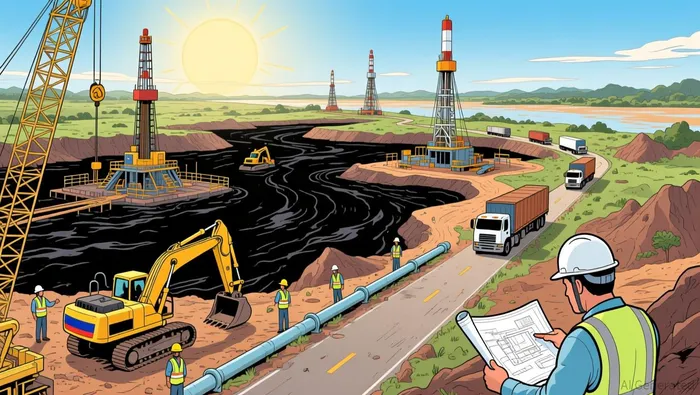
The ambition to double Venezuela's output is a structural challenge of immense scale. Current production stands at roughly 750 thousand barrels per day, a figure that must nearly double to meet the projected 1.3 to 1.4 million barrels per day target within two years. This isn't a simple matter of turning on taps; it requires rebuilding an entire industrial ecosystem from a state of severe decay. The technical hurdles are immediate and costly. The Orinoco Belt's extra-heavy crude cannot be transported or refined without blending it with lighter hydrocarbons-a process known as dilution. The U.S. has pledged to provide exports of light oil to Venezuela as needed for use as diluent, but this is a stopgap. A permanent solution demands massive new infrastructure for diluent production and transport, representing a significant capital outlay that will test investor appetite.
Beyond the physical rebuild, a critical human capital shortage looms. Decades of mismanagement and economic collapse have triggered a severe brain drain, leaving the country with a depleted pool of skilled engineers, geologists, and field operators. Scaling operations to a new plateau requires not just capital, but a workforce capable of managing complex extraction and refining processes. This shortage is a fundamental constraint on the timeline and cost of any revival, as training or importing talent adds another layer of friction and expense.
The political risk, as Exxon's CEO bluntly stated, remains the overriding deterrent. The company's assessment that the industry is "uninvestable" underscores the deep skepticism among major players. While the U.S. has seized control of production and is offering a path to profitability, the legacy of nationalization and the volatile political environment create an uncertainty that no financial incentive can fully offset. The administration's push for a $100 billion investment faces the reality that the industry's own leaders see the risk-reward calculus as tilted far too heavily toward the latter. For now, the operational and human capital hurdles are real and formidable, creating a gap between the ambitious production targets and the practicalities of execution.
Financial and Strategic Implications for Exxon
The standoff with the U.S. administration is forcing a reckoning for Exxon's financial strategy. On the surface, the company has shown remarkable resilience. Its stock has climbed 14.3% over the past 120 days, a move that suggests the market is viewing the Venezuela risk as contained and perhaps even a catalyst for a broader energy sector rally. This positive sentiment appears to outweigh the immediate political friction, at least for now.
Yet the forced participation scenario carries significant strategic costs. Forcing ExxonXOM-- to commit capital to Venezuela would divert billions from its core projects, which are already under pressure to deliver returns. The company's own assessment that the industry is "uninvestable" in its current state underscores the high risk and likely low returns of such a venture. Channeling capital into a politically volatile, infrastructure-starved environment could slow the execution of more profitable, lower-risk initiatives, potentially impacting long-term shareholder returns. The administration's push for a $100 billion investment is a direct challenge to Exxon's capital allocation discipline.
This standoff, however, creates a clear strategic opening for a competitor. Chevron is the only major U.S. oil firm currently operating in Venezuela, giving it a unique foothold and a potential path to leadership in any revived sector. While Chevron has not publicly committed to the $100 billion target, its existing presence means it would be in a far stronger position to negotiate favorable terms and secure a dominant role. For Exxon, the choice is becoming binary: either accept a high-risk, potentially capital-inefficient role in Venezuela, or risk being sidelined entirely in a market the U.S. now controls. The financial and strategic implications are now inextricably linked to a political decision that may not align with the company's commercial calculus.
Catalysts, Scenarios, and What to Watch
The standoff has entered a critical phase where political leverage will be tested against corporate calculus. The immediate catalyst is the administration's push for a $100 billion investment to rebuild Venezuela's shattered industry. The key question is whether political pressure can compel Exxon's participation, or if the company's "uninvestable" assessment will hold. President Trump's recent comments signal a hardening stance, with the White House threatening to keep Exxon Mobil out of Venezuela if it doesn't comply. This is a direct challenge to Exxon's capital allocation autonomy and could set a precedent for how the U.S. leverages control over strategic assets.
The path to any investment, however, hinges on a foundational shift in Venezuela's political and legal framework. The company's CEO cited the need for some pretty significant changes from what has been historically seen, referencing the 2007 seizure of its and ConocoPhillips's assets and billions in outstanding arbitration claims. For Exxon to re-enter, the U.S. and Venezuelan governments must establish a new, stable legal and commercial construct that offers real protection against nationalization. The pace of political stabilization under interim leadership and the speed of negotiations for a new investment agreement will be the primary variables determining if the $100 billion target is realistic or remains a political aspiration.
The competitive landscape is also evolving, creating a new dynamic for the sector's revival. Chevron is the only major U.S. oil firm currently operating in Venezuela, giving it a unique foothold. While Chevron has not publicly committed to the $100 billion target, its existing presence means it would be in a far stronger position to negotiate favorable terms and secure a dominant role if the political risks are mitigated. The administration's push could accelerate Chevron's expansion or even draw ConocoPhillips back into the market, reshaping the competitive balance. The market will be watching for any shift in this landscape, as it will signal whether the sector's revival is gaining genuine commercial traction beyond political will.
The macro market implications are significant. A successful revival would combine U.S. financial and technological muscle with Venezuela's colossal reserves, potentially reshaping global supply and keeping prices in historically lower ranges. Yet the current setup creates a clear winner and loser. If Exxon is sidelined, Chevron stands to capture a disproportionate share of any future profits and influence. For the broader market, the outcome will test the limits of political leverage in forcing corporate behavior and will provide a real-world case study on the cost of political risk in energy investments. The coming weeks will reveal whether the U.S. can translate its control of production into a functioning, investable industry.







Comentarios
Aún no hay comentarios