
Exxon's Venezuela Stance: A Catalyst for a $100B Industry Bet or a Strategic Misstep?
The immediate catalyst is a stark clash of wills. On January 9, President Trump convened a White House meeting with major oil executives, framing a bold new opportunity: a plan to revive Venezuela's oil industry with a stated goal of securing at least $100bn in spending. The president claimed U.S. oil firms were ready to reenter the country. The response from the industry's top table was a resounding, if cautious, no.
The core conflict erupted when ExxonMobilXOM-- CEO Darren Woods delivered the starkest assessment. In a live-streamed exchange, he told the president that, today it's uninvestable under current conditions. His reasoning was direct: decades of asset seizures and a hostile legal framework make a commercial return impossible without significant changes to those commercial frameworks, the legal system and durable investment protections. Woods' verdict directly contradicted the White House's narrative of eager corporate partners.
This political clash creates a clear investment question. Does the stock's reaction to this pressure represent a temporary mispricing? The event itself is a pure catalyst-a high-profile disagreement between a sitting president and a major corporate chief. For now, it introduces significant uncertainty around a potential strategic pivot, but it does not alter the fundamental commercial case for Venezuela, which remains a vast, untapped reserve. The market's immediate overreaction to the political friction may create a tactical setup, but the real test will be whether the promised policy changes materialize to make the "uninvestable" math work.
The Commercial Reality: Why "Uninvestable" is a Valid, Not a Fatal, Assessment
Exxon's verdict is not a surrender; it's a commercial reality check. The company's assessment that Venezuela is "uninvestable" today is grounded in the absence of three non-negotiable conditions: physical security, legal certainty, and a competitive fiscal framework. Without these, even the promise of a $100bn industry bet is just political noise.
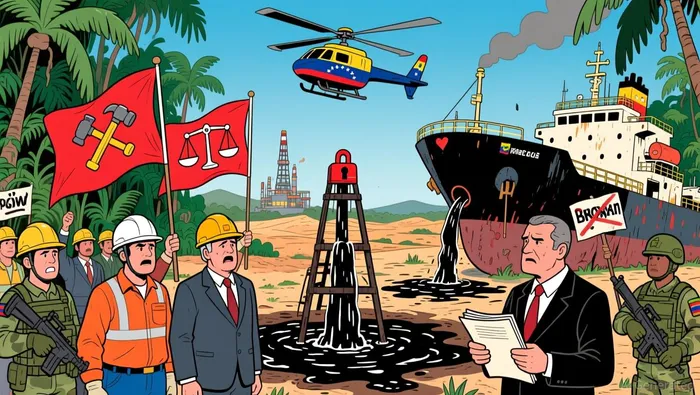
The physical and legal risks are immediate and severe. Exxon's CEO cited having had assets seized there twice, a stark reminder of the hostile environment. The White House's plan to control sales and hold revenue in U.S. accounts may secure political leverage, but it does nothing to address the core commercial problem: a company cannot operate without legal protection for its investments. The risk of another seizure, or of having its profits frozen, remains high, making a return on capital impossible to model.
Then there's the sheer scale and nature of the project. Venezuela's oil is heavy and tar-like, requiring significant infrastructure investment to produce. As experts note, restoring production will take years and many billions of dollars. The initial rehabilitation of existing fields might need $10-20 billion, but reaching meaningful output levels requires a far larger commitment. The claim of a $100bn industry bet is a long-term, decade-spanning capital expenditure, not a short-term project. No major oil company is committing to single-digit billions without ironclad guarantees.
The bottom line is that the commercial math is broken. The market may be reacting to the political catalyst, but the fundamental drivers are static. Until the U.S. government can credibly promise the physical security and legal protections that ExxonXOM-- demands, the "uninvestable" label stands. This isn't a strategic misstep; it's a rational calculation of risk. The event creates uncertainty, but the commercial reality remains unchanged.
The Immediate Risk/Reward Setup: Stock Reaction vs. Long-Term Asset
The political event creates a clear tactical setup, but it's one where the immediate risk is noise, not a fundamental threat. Exxon's stock may face short-term pressure from the fallout of the CEO's blunt "uninvestable" verdict, but the company's core business and balance sheet are not materially at risk. The real risk is political uncertainty, not a broken financial model.
Exxon's stated posture is one of tactical patience. The company is not ruling out Venezuela permanently. Instead, it aims to hit the ground running and evaluate the opportunity. This is a wait-and-see stance, not a strategic retreat. The goal is to get a technical team on the ground to assess the current state of the industry-a classic first step before any major commitment. This measured approach underscores that the company sees no immediate commercial case, but it also keeps the door open for a future decision if conditions change.
Contrast this with the long-term asset value. Venezuela's reserves remain a vast, untapped resource. The country produced 3 million barrels a day twenty years ago, and with sufficient investment, it could ramp up significantly again. The potential reward is real, but the timeline has been pushed further out. The political uncertainty introduced by the White House meeting and the ongoing transition in Caracas means any return to production is now a multi-year, high-stakes gamble, not a near-term catalyst.
The risk/reward here is asymmetric. The immediate risk is the political noise and potential stock volatility from the clash with the White House. The long-term reward is a potential asset, but only if the U.S. government can deliver the durable investment protections Exxon demands. For now, the event doesn't change the fundamental math. It simply delays the decision. The market's reaction may overstate the threat to the stock, creating a potential mispricing around the political friction, while the real story-the commercial viability of Venezuela-remains on hold.
Catalysts and Watchpoints: What Changes the Thesis
The current mispricing thesis hinges on political uncertainty. For the stock to re-rate, that uncertainty must resolve. Three near-term events will serve as the key triggers to validate or invalidate the setup.
First, the U.S. government must deliver its formal investment framework. President Trump has stated he will personally decide which US companies can enter Venezuela. The specifics of this framework-particularly the legal protections and security guarantees Exxon demands-will define the "investable" conditions. Until this is public, the thesis remains on hold. A framework that offers credible, durable protections could shift the narrative from "uninvestable" to "high-risk, long-term bet." One that does not will confirm the commercial reality and likely deepen the political friction.
Second, watch for any shift in Exxon's public posture or the release of findings from its technical assessment team. The company has committed to hit the ground running and get a technical team in place. The initial findings from that team will be a critical data point. If they confirm the industry's state is more degraded than expected, it could reinforce the "uninvestable" view. Conversely, if they identify a faster path to operational viability, it could signal a potential pivot. Any change in CEO Darren Woods' public stance from "uninvestable" to "evaluating" would be a major signal.
Third, track the release of political prisoners as a tangible signal of progress on U.S. demands. Venezuela has released at least nine political prisoners, a small but measurable step. The pace and scale of further releases will be a key indicator of the interim government's willingness to comply with U.S. conditions. This is a concrete, observable metric that could build momentum for the broader investment plan or, if stalled, highlight the deep political rifts that remain.
These are the watchpoints. The market's initial reaction to the political clash may have been overdone, but the thesis will only change when these specific catalysts provide clarity. Watch for the framework, the technical assessment, and the prisoner releases. They will determine whether the uncertainty resolves or deepens.





Comentarios
Aún no hay comentarios