
Exploiting Market Volatility in Trump's UFO Declassification Prediction Markets: Arbitrage Strategies and Political Signaling
The rise of prediction markets in 2025 has transformed speculative trading into a sophisticated arena where investors aggregate global sentiment into probabilistic outcomes. Among the most volatile and politically charged markets is the one centered on former President Donald Trump's pledge to declassify UFO-related files. As of late 2025, Polymarket traders price an 87% chance that the Trump administration will declassify such files by December 31, 2025, while Kalshi offers a separate market on whether the U.S. will confirm the existence of aliens in 2025(https://polymarket.com/event/will-the-us-confirm-that-aliens-exist-in-2025). These markets, driven by Trump's rhetoric and bipartisan calls for transparency, present unique opportunities for coordinated arbitrage strategies and political signal analysis.
Market Volatility and Key Metrics
The surge in trading activity reflects a confluence of factors: Trump's repeated emphasis on "radical transparency," bipartisan legislative pressure, and the growing mainstream acceptance of prediction markets. Polymarket's market on Trump declassifies UFO files within his first 100 days has attracted $349,367 in trading volume, while the broader 2025 deadline market has drawn $313,605(https://polymarket.com/event/trump-declassifies-ufo-files-in-2025). Kalshi, with its regulated CFTC license, offers a competing market on alien confirmation, highlighting structural differences in pricing dynamics between platforms(https://www.reuters.com/business/kalshi-valued-11-billion-latest-financing-round-2025-12-02/).
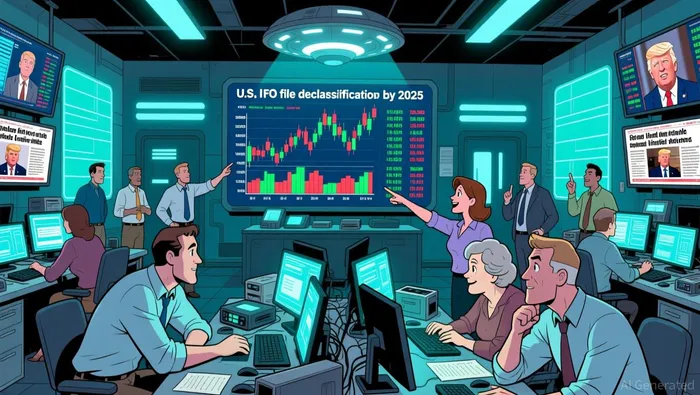
The volatility is further amplified by Trump's recent statements. For instance, his December 2024 pledge to release a report on mysterious drone sightings within a day of his second term triggered a spike in Polymarket odds from single digits to 81% within hours(https://www.ndtv.com/offbeat/polymarket-bets-spike-on-talk-of-trump-releasing-ufo-files-9769966). Such rapid price swings create fertile ground for arbitrage, particularly between decentralized (Polymarket) and regulated (Kalshi) platforms.
Arbitrage Strategies: Inter-Platform Opportunities
Arbitrage in prediction markets involves exploiting price discrepancies across platforms or within a single market. For example, if the "YES" bid for Trump's UFO declassification on Polymarket is 50.2¢ and the "YES" ask on Kalshi is 49.8¢, a trader could buy low and sell high, securing a 0.8¢ profit per share. This micro-arbitrage is most effective when liquidity is thin and spreads are wide, as seen in late 2025 when Polymarket's volume surged to $1.5 billion.
Technical execution requires real-time monitoring via APIs or WebSocket integrations, as opportunities often vanish within seconds. However, transaction costs-particularly Polygon gas fees on Polymarket can erode small profits. Additionally, oracle risks (differences in outcome resolution criteria) necessitate caution; for instance, Polymarket's market resolves on "official government declassification or credible reporting," while Kalshi's alien confirmation market depends on a narrower definition(https://kalshi.com/markets/kxaliens/aliens/kxaliens-26).
Triangular arbitrage, involving three correlated markets, also presents opportunities. For example, a trader could hedge positions across markets predicting Trump's declassification, the timing of such action (e.g., first 100 days vs. 2025), and broader UFO-related disclosures (e.g., alien confirmation). While complex, these strategies capitalize on logical dependencies between events.
Political Signaling and Market Impact
Trump's administration has issued mixed signals, complicating market analysis. While he has declassified historical documents (e.g., JFK assassination files), no formal executive order has targeted UFO files) as of late 2025. However, his emphasis on transparency and the Pentagon's accelerated release of unclassified UAP reports suggest a potential shift(https://abcnews.go.com/Politics/ufo-sleuths-fewer-secrets-trump-era-investigations/story?id=121811368).
Political actors, such as Senator Chuck Schumer, have amplified pressure for declassification, mirroring the legislative model used for historical files(https://www.newsweek.com/will-donald-trump-declassify-ufo-files-2020158). This bipartisan push increases the likelihood of executive action, which could trigger further volatility in prediction markets. For instance, a hypothetical executive order in early 2026 might cause Polymarket's 2025 deadline market to plummet, while the 2027 market (currently at 39.5% odds) could surge.
As prediction markets mature, their role in aggregating information and pricing uncertainty will only grow. However, the regulatory landscape remains murky, with New York's ORACLE Act and federal debates over market legitimacy posing risks. Savvy investors must navigate these challenges while leveraging the unique interplay between political signaling and speculative trading.







Comentarios
Aún no hay comentarios