
The Evolving Risks and Rewards of Crypto Regulation and Enforcement in 2026
The crypto asset landscape in 2026 is being reshaped by a confluence of legal reforms and political dynamics, creating both opportunities and challenges for institutional participants. As global regulators pivot from enforcement-driven ambiguity to structured frameworks, the interplay between compliance innovation and systemic risk mitigation is redefining the asset security paradigm. This analysis examines how 2025's regulatory milestones and enforcement actions are influencing 2026's compliance priorities, while balancing the rewards of institutional adoption against emerging geopolitical and operational risks.
U.S. and EU: Pioneering Structured Regulatory Frameworks
The U.S. GENIUS Act, enacted in 2025, has set a precedent for stablecoin oversight by mandating 100% reserve backing and monthly transparency disclosures. This shift from reactive enforcement to proactive compliance has compelled firms like CircleCRCL-- and Paxos to overhaul their reserve management systems. Similarly, the EU's Markets in Crypto-Assets (MiCA) regulation, fully implemented in early 2025, has harmonized cross-border rules but faces challenges in reconciling divergent national interpretations of stablecoin requirements. These frameworks are not merely compliance burdens; they are catalysts for institutional-grade infrastructure, such as tokenization platforms and DeFi integration, which Grayscale projects will drive mainstream adoption by 2026.
However, the U.S. and EU are also grappling with jurisdictional overlaps. According to analysis, the SEC's proposed "innovation exemption" for crypto startups, expected in 2026, aims to reduce compliance friction while maintaining investor protections. Meanwhile, the CLARITY Act's anticipated reintroduction in January 2026 seeks to clarify the SEC and CFTC's overlapping jurisdictions, a move that could resolve lingering legal uncertainties for token issuers as per industry reports. These legislative efforts underscore a broader trend: regulators are prioritizing market structure clarity over punitive enforcement, a shift exemplified by the SEC's dismissal of high-profile cases.
Global Competition and Geopolitical Influence
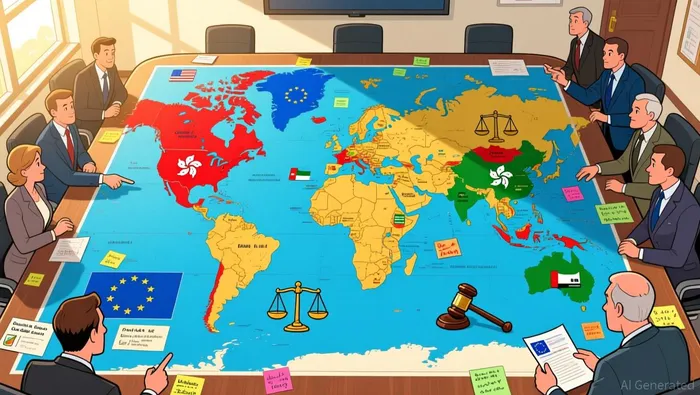
Beyond the U.S. and EU, jurisdictions like Hong Kong and the UAE are leveraging selective regulatory clarity to attract institutional liquidity. Hong Kong's Stablecoins Ordinance, for instance, has drawn TetherUSDT-- to seek local licensing, while the UAE's programmable CBDC initiatives aim to position the region as a hub for tokenized assets according to industry analysis. These developments highlight a growing "regulatory arbitrage" dynamic, where jurisdictions compete to offer structured frameworks without compromising compliance standards.
Yet this competition introduces risks. The 2026 National Defense Authorization Act expands the Outbound Investment Security Program (OISP) to include high-performance computing and hypersonic systems, signaling heightened scrutiny of cross-border capital flows. For crypto firms, this means navigating dual reporting requirements under the Corporate Transparency Act and state-level laws like New York's LLC Transparency Act as reported by legal experts. Such overlapping mandates complicate compliance programs, particularly for firms operating in multiple jurisdictions.
Enforcement Shifts: Systemic Risks and Institutional Accountability
2026 enforcement priorities are increasingly focused on systemic risk nodes rather than isolated market abuses. The U.S. federal framework, for example, is expected to target stablecoin issuers, exchanges, and custody providers-entities deemed critical to financial stability according to regulatory analysis. This aligns with the SEC's Project Crypto initiative, which seeks to distinguish between investment contracts and non-security tokens to reduce regulatory ambiguity as detailed in industry reports.
Europe's Digital Operational Resilience Act (DORA) further reinforces this trend by mandating robust ICT disruption protocols for financial entities. For crypto firms, this means investing in advanced custody solutions and governance frameworks to mitigate risks like theft or insolvency. While these measures enhance asset security, they also raise operational costs, particularly for smaller players unable to scale compliance infrastructure.
Balancing Risks and Rewards
The rewards of 2026's regulatory evolution are evident in rising institutional participation. According to Grayscale research, bipartisan crypto market structure legislation in the U.S. is projected to enable regulated trading of digital asset securities, cementing blockchain-based finance in the capital markets. Grayscale's research suggests this could end the cyclical price volatility historically tied to four-year regulatory cycles as noted in their analysis.
However, risks persist. The Basel Committee's potential reassessment of prudential rules for crypto exposures may encourage traditional banks to enter the space, but it also raises concerns about systemic contagion. Similarly, the EU's passporting rights under MiCA could accelerate cross-border operations but may strain enforcement capacity if national regulators lack alignment.
Conclusion
2026 marks a pivotal year for crypto regulation, where structured frameworks and enforcement clarity are unlocking institutional adoption while introducing new compliance complexities. For investors, the key lies in balancing the rewards of innovation-such as tokenization and DeFi integration-with the risks of geopolitical fragmentation and operational resilience demands. As regulators continue to refine their approaches, the crypto ecosystem's ability to adapt to these dual pressures will determine its long-term viability.







Comentarios
Aún no hay comentarios