
The Evolving Risks in Crypto Wallet Security and Their Impact on Institutional and Retail Investors
The cryptocurrency ecosystem has matured significantly in 2025, with over 100 million active users relying on digital wallets to manage their assets. Yet, as adoption grows, so do the systemic vulnerabilities inherent in wallet infrastructure. From signature verification flaws to multi-party computation (MPC) implementation gaps, the risks facing both institutional and retail investors have become increasingly complex. This analysis examines the technical and operational weaknesses in popular crypto wallets, their real-world consequences, and the urgent need for infrastructure upgrades to safeguard digital assets.
Systemic Vulnerabilities in Popular Crypto Wallets
The top wallets of 2025-Trust Wallet, MetaMask, CoinbaseCOIN-- Wallet, and others-dominate the market but face persistent security challenges. Trust Wallet, with 60 million monthly active users and support for 100+ blockchains, remains a prime target for attackers. Similarly, MetaMask's 30 million users and broad blockchain compatibility expose it to phishing and malware threats. While hardware wallets like Ledger and Trezor offer robust security via EAL6+ secure elements according to security research, their offline nature paradoxically enables misuse by bad actors. For instance, hardware wallet recovery seeds have been exploited for illicit transfers, such as drug cartel money laundering, where funds are moved without leaving a blockchain footprint.
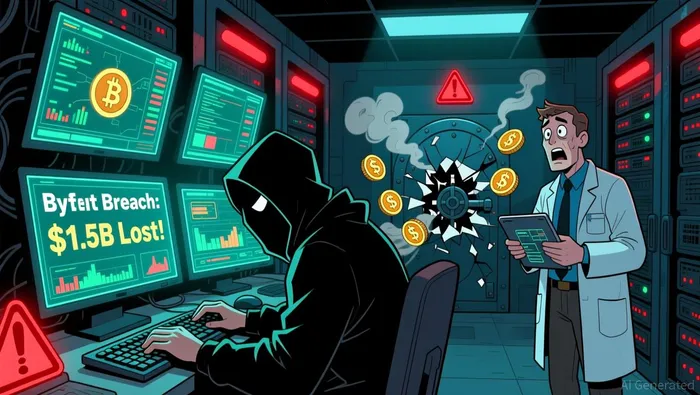
Centralized custodial wallets, including Coinbase and Crypto.com, face unique risks. The ByBit hack in February 2025-a $1.5 billion breach attributed to North Korean actors-exemplifies how institutional-grade vulnerabilities can destabilize entire markets. This incident accounted for 69% of all funds stolen in 2025, underscoring the concentration of risk in large-scale custodial platforms. Meanwhile, retail investors are increasingly targeted through phishing campaigns, with fake exchange sites stealing $8.5 billion in on-chain assets by mid-2025.
Technical Flaws: Signature Verification and MPC Gaps
Technical vulnerabilities in wallet architecture exacerbate these risks. Signature verification flaws, which account for 19% of reported wallet vulnerabilities, can compromise transaction integrity across hardware, smart contract, and MPC wallets. For example, MetaMask's integration of Web3Auth aims to streamline key management via social logins, but signature verification issues persist, leaving room for exploitation.
MPC wallets, designed to distribute private key shares across multiple parties, are not immune to flaws. Fireblocks' MPC-lib, for instance, has been criticized for nonce reuse vulnerabilities and side-channel attacks. A non-constant time operation in its codebase could allow attackers to infer private keys by measuring execution times. Similarly, protocol abort vulnerabilities in Fireblocks' implementation expose cryptographic material during termination, creating opportunities for malicious actors to extract key data. These technical shortcomings highlight the fragility of even advanced cryptographic solutions.
Diverging Impacts on Institutional and Retail Investors
The consequences of these vulnerabilities diverge sharply between institutional and retail investors. Institutions, which hold large sums in custodial wallets, face catastrophic losses from breaches like the ByBit incident. Such events not only erode trust but also trigger regulatory scrutiny, as seen in the U.S. SEC's new custody guidance for institutional investors. Conversely, retail investors suffer from a deluge of smaller-scale attacks. Phishing scams and fake platforms have cost individuals $8.5 billion in 2025 alone, with opportunistic "wrench attacks" spiking during BitcoinBTC-- price surges.
Regulatory responses are beginning to address these disparities. The EU's Markets in Crypto-Assets (MiCA) Regulation, fully implemented in 2025, mandates threat-led penetration testing for crypto-asset service providers. In the U.S., the GENIUS Act has established stablecoin reserves and redemption standards, indirectly bolstering retail investor protections. However, enforcement remains inconsistent, particularly in cross-border cases where hardware wallet misuse persists.
To mitigate these risks, the industry must prioritize infrastructure upgrades. First, cryptographic protocols must evolve beyond legacy systems. The GG18 to CGGMP21 MPC protocol transition, for example, reduces signing rounds and enhances efficiency, but older implementations remain vulnerable. Second, proactive detection mechanisms-such as real-time anomaly monitoring and secure memory handling-are critical to addressing side-channel and protocol abort vulnerabilities.
Regulators and developers must also collaborate to standardize security practices. The EU's Digital Operational Resilience Act (DORA) and U.S. bipartisan initiatives like the SAFE Crypto Act represent progress, but global harmonization is lacking. For instance, hardware wallet recovery seeds, which enable illicit transfers, require stricter controls under frameworks like MiCA.
Conclusion
The crypto wallet landscape in 2025 is defined by a paradox: as digital assets grow in value and adoption, their security infrastructure lags behind. Institutions and retail investors alike face escalating threats, from large-scale custodial breaches to personal wallet compromises. While regulatory frameworks and technical innovations like MPC wallets offer hope, systemic risks persist. For the industry to mature, stakeholders must invest in robust cryptographic upgrades, enforce stringent compliance, and foster a culture of proactive risk management. The cost of inaction-measured in billions of stolen assets and eroded trust-is too high to ignore.







Comentarios
Aún no hay comentarios