
Evolving Media Access to Defense Operations: Geopolitical Risks and Sector Valuation Implications
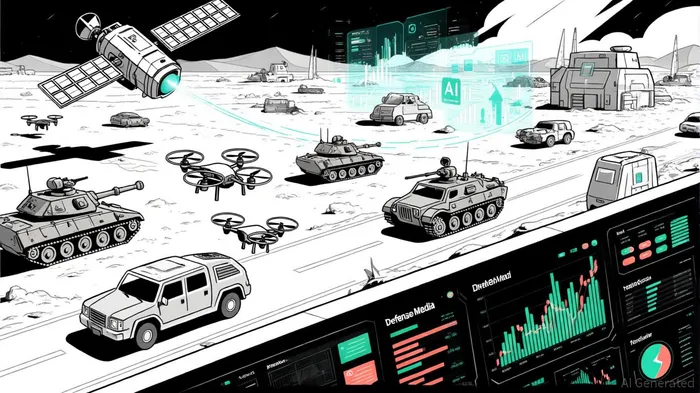
In 2025, the intersection of geopolitical risk and technological innovation has reshaped the defense landscape, with cascading effects on media access to military operations and sector valuations. As global tensions persist-from the protracted Russia-Ukraine conflict to Middle East volatility-defense budgets are surging, and media coverage of these operations is evolving through digital platforms, real-time data, and AI-driven analysis. This transformation is not merely operational but financial, with defense and media sectors experiencing divergent yet interconnected valuation dynamics.
Geopolitical Pressures and Defense Sector Resilience
The defense industry is in the midst of a spending supercycle, driven by urgent modernization needs and strategic competition. According to a Morningstar report, global defense spending reached $2.718 trillion in 2024, with Europe's defense budgets projected to grow at an annual rate of 6.8% through 2035. This surge is evident in companies like Rheinmetall AG, whose stock price surged 130% in 2025 due to increased demand for armored vehicles and ammunition, according to a defense market review. Similarly, U.S. contractors such as Kratos Defense & Security Solutions (KTOS) and PalantirPLTR-- Technologies (PLTR) have secured multi-billion-dollar contracts for hypersonic systems and AI-powered intelligence platforms, with Kratos' hypersonic pipeline alone exceeding $12.6 billion, per a LevelFields analysis.
The integration of digital technologies-ranging from cloud computing to digital twins-is central to this growth. The U.S. Department of Defense's $4.3 billion AI contract portfolio by 2023, as detailed in a defense trends piece, underscores a shift toward data-centric warfare, where real-time analytics and autonomous systems redefine operational efficiency. These advancements are not only enhancing military capabilities but also creating new revenue streams for defense firms, as governments prioritize resilience against hybrid threats and cyberattacks.
Media Access: From Transparency to Strategic Control
Media access to defense operations has become increasingly fragmented and technologically mediated. In the Russia-Ukraine conflict, for instance, Ukraine's use of cloud-based infrastructure (e.g., Microsoft Azure, Amazon Web Services) to protect critical data has redefined how information is disseminated and secured, as shown in a study on digital conflict. While this has enabled real-time reporting on battlefield developments, it has also introduced layers of encryption and access controls that limit traditional media's ability to verify and report on military actions.
Conversely, defense contractors are leveraging digital platforms to shape narratives. As noted in an industry survey, 72% of defense firms now allocate budgets to digital marketing, with 46% of 2023 marketing spend directed toward AI-driven outreach. This shift has implications for media companies specializing in defense coverage. While platforms like CNBC and Reuters face declining ad revenue from traditional defense firms, niche outlets and tech-focused media are capitalizing on the demand for AI and cybersecurity content. For example, defense-focused ETFs managing $35 billion in assets, according to Defense News, have created new audiences for in-depth analysis of emerging technologies, indirectly boosting subscription models for specialized media.
Valuation Divergence: Defense Stocks Outperform, Media Struggles
The financial performance of defense and media sectors in 2025 reflects stark contrasts. Defense stocks, buoyed by sustained demand and geopolitical uncertainty, have outperformed broader markets. The SPADE Defense Index, for instance, rose 90% since the start of the Russia-Ukraine conflict in 2023, far outpacing the S&P 500, according to Forecast International. Companies like L3HarrisLHX-- Technologies - which raised its 2025 revenue forecast due to global defense demand, according to the Rochester Business Journal - and AeroVironment (AVAV), which posted a 24% year-over-year revenue increase per a FinanceCharts screener, exemplify this trend.
In contrast, the media sector faces headwinds. Traditional outlets covering defense operations are grappling with declining ad revenue and fragmented audiences, as social platforms and hyperscalers dominate content distribution. A Deloitte report highlights that rising production costs and the need for AI-driven analytics are squeezing margins for media firms. However, there are exceptions: defense-related content producers that adapt to digital trends-such as those offering immersive virtual reality briefings or real-time data visualizations-have seen niche growth.
Strategic Implications for Investors
For investors, the evolving dynamics of media access and defense spending present both opportunities and risks. The defense sector's resilience is likely to persist as long as geopolitical tensions remain elevated, with AI, cybersecurity, and hypersonic systems offering high-growth subsectors. However, media companies must innovate to remain relevant, leveraging their expertise in defense analysis to capture audiences in an era of information overload.
The key takeaway is that media access to defense operations is no longer a static metric but a dynamic interplay of technology, strategy, and market forces. As governments and corporations increasingly weaponize digital tools, the ability to navigate this landscape will determine not only operational success but also financial performance.





Comentarios
Aún no hay comentarios