
The Evolving Crypto Derivatives Landscape: Evaluating CME's New Solana and XRP Options Amid Shifting Market Dynamics
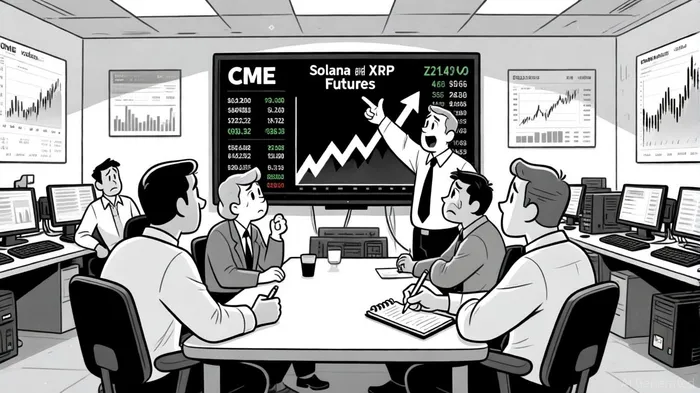
The crypto derivatives market is undergoing a seismic shift as CME GroupCME--, the world's largest derivatives exchange, expands its product suite to include options on SolanaSOL-- (SOL) and XRPXRP-- futures. Scheduled for launch on October 13, 2025, these options represent a pivotal step in institutionalizing altcoin markets and democratizing access to advanced risk management tools for both retail and institutional investors. With over $22.3 billion in notional value traded in Solana futures and $16.2 billion in XRP futures since their March and May 2025 launches, respectively, the demand for these products has already proven robust [1]. This analysis evaluates how CME's new offerings position investors to navigate the next phase of crypto adoption, balancing opportunity with the inherent risks of a rapidly evolving regulatory and market landscape.
Strategic Positioning for Institutional Investors
For institutional players, CME's Solana and XRP options fill a critical gap in the crypto derivatives ecosystem. These contracts, available in both standard and micro sizes with daily, monthly, and quarterly expirations, provide sophisticated hedging capabilities for portfolios increasingly allocating to altcoins. As noted by FalconX, a leading digital assetDAAQ-- execution platform, “The introduction of options on high-liquidity altcoins like Solana and XRP is a game-changer for institutional treasuries, enabling precise risk mitigation in a market where volatility is the norm” [1].
The data underscores this demand: August 2025 saw record average daily volumes of $437.4 million for Solana futures and $385 million for XRP futures [1]. These figures suggest that institutions are already treating Solana and XRP as core assets, not speculative outliers. By offering options, CMECME-- allows these investors to lock in price targets, hedge against downside risks, and capitalize on volatility without liquidating positions. For example, a fund holding large Solana exposures could use put options to protect against a potential selloff, while simultaneously using call options to amplify gains in an upward trend.
Retail Investors: Diversification and Speculation in a New Era
Retail investors, too, stand to benefit from CME's expansion. The micro contracts (e.g., 2,500 XRP per contract) lower the barrier to entry for options trading, enabling retail traders to diversify beyond BitcoinBTC-- and EthereumETH--. According to a report by Coin Tribune, XRP and Solana have exhibited distinct risk-return profiles compared to BTC and ETH, with XRP delivering an average daily return of 0.52% and Solana 0.32%, albeit with higher volatility [2]. This makes them attractive for investors seeking uncorrelated assets to hedge against Bitcoin's dominance in the market narrative.
Moreover, CME's margin credits for offsetting positions between options and futures enhance capital efficiency. A retail trader holding Solana futures could, for instance, use options to generate income via covered calls or protect against a sudden drop in price. As retail adoption of crypto treasuries accelerates—driven by platforms like PayPalPYPL-- and Fidelity's digital asset services—these tools will become essential for managing exposure in a fragmented market [2].
Regulatory Considerations and Market Dynamics
The regulatory environment remains a wildcard. While CME's entry into Solana and XRP options signals growing institutional confidence, the ongoing SEC vs. Ripple litigation and the CFTC's oversight of crypto derivatives create a dual-layered regulatory framework. CME's use of the CME CF XRP-Dollar Reference Rate for cash-settled futures demonstrates a commitment to transparency, but investors must remain vigilant about potential legal headwinds [1].
Market dynamics also pose challenges. The introduction of options could amplify volatility, as increased leverage and speculative activity often do. For instance, the $1.8 billion open interest in Solana futures and $1.2 billion in XRP indicates significant positioning, which may lead to sharp price swings if liquidity tightens [2]. However, CME's deep liquidity pools and robust clearing mechanisms mitigate counterparty risks, making these options a safer alternative to over-the-counter (OTC) derivatives.
Conclusion: A New Chapter in Crypto Derivatives
CME's Solana and XRP options mark a turning point in the maturation of crypto derivatives. For institutions, they offer the tools to treat altcoins as core portfolio components, while retail investors gain access to sophisticated strategies previously reserved for traditional markets. However, success hinges on prudent risk management. As CumberlandCPIX--, a major crypto market maker, aptly stated, “These options aren't just about speculation—they're about building infrastructure for a future where crypto treasuries are as common as corporate bonds” [1].
In the next phase of crypto adoption, investors who strategically position themselves with CME's new products will likely outperform those clinging to legacy benchmarks. The key lies in balancing innovation with caution—a principle as timeless in crypto as it is in traditional finance.





Comentarios
Aún no hay comentarios