
The Evolution of EV ETFs Beyond Tesla: Assessing Resilience and Diversification Amid Delivery Slowdown
The electric vehicle (EV) sector has long been synonymous with TeslaTSLA--, Inc. (TSLA), whose market dominance and innovation have driven much of the sector's growth. However, as Tesla's Q4 2025 delivery numbers revealed, a 15% year-over-year decline to 418,227 vehicles, investors are increasingly scrutinizing the resilience of EV thematic exposure beyond the automaker's performance. This analysis explores how EV exchange-traded funds (ETFs) have evolved to diversify risk and capitalize on broader industry trends, even as Tesla faces headwinds from expiring tax incentives and intensifying global competition.
Tesla's Q4 2025 Slowdown: A Catalyst for Reevaluation
Tesla's Q4 2025 delivery slowdown was precipitated by the expiration of the U.S. federal $7,500 EV tax credit in September 2025, which pulled forward demand into Q3. Analysts attribute the 16% year-over-year drop in deliveries to this policy shift, compounded by rising competition from Chinese EV manufacturers like BYD and European automakers such as Volkswagen. Despite these challenges, Tesla's stock rose 14% in 2025, driven by optimism around its AI-driven robotaxi initiatives and energy storage deployments, which hit a record 14.2 GWh in Q4.
This duality-declining deliveries paired with a strong stock price-has prompted investors to question whether Tesla's long-term growth narrative remains untethered to its EV sales performance. For those seeking to mitigate exposure to Tesla's volatility, EV ETFs offer a compelling alternative.
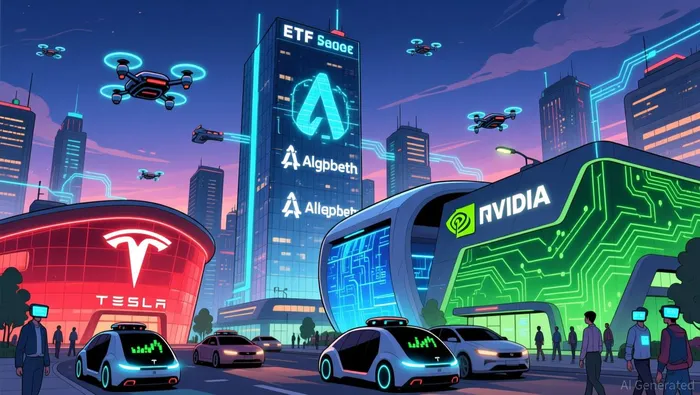
Diversification in Action: The Rise of Broadly Structured EV ETFs
EV ETFs have evolved beyond single-stock bets, with many now emphasizing diversification across the EV value chain. The Global X Autonomous & Electric Vehicles ETF (DRIV), for instance, allocates just 3.55% to Tesla, while including heavyweights like Alphabet (4.19%), NVIDIA (2.66%), and Toyota. Similarly, the KraneShares Electric Vehicles & Future Mobility ETF (KARS) holds Tesla at 4.26% but extends exposure to companies like Rivian and NIO according to holdings data. These structures reduce reliance on Tesla's performance while capturing growth in adjacent sectors such as battery technology, semiconductors, and autonomous driving.
In contrast, ETFs like the Simplify Volt TSLA Revolution ETF (TESL) remain heavily concentrated in Tesla (53.32% exposure), amplifying their vulnerability to the automaker's delivery trends. This divergence underscores a critical choice for investors: balancing Tesla's growth potential with the stability of a diversified portfolio.
Q4 2025 Performance: Resilience Amid Turbulence
The Q4 2025 delivery slowdown tested the resilience of EV ETFs. While Tesla's stock ended 2025 with a 14% gain, the broader EV sector saw mixed results. The KraneShares KARS ETF surged 44.19% year-to-date (YTD) as of November 28, 2025 according to ETF data, outperforming the Global X DRIV ETF (28.5% YTD) as reported by market analysis and the iShares Self-Driving EV and Tech ETF (IDRV) (30.74% YTD) according to financial reporting. These gains were fueled by strong performances from non-Tesla EVs like Rivian and NIO, which saw significant share price appreciation during the quarter.
The SPDR S&P Kensho Smart Mobility ETF (HAIL), with a more balanced approach to mobility technologies, posted a 19% YTD return, reflecting its exposure to both EVs and traditional automakers adapting to electrification trends. These results highlight how diversified ETFs can buffer against Tesla-specific risks while capitalizing on sector-wide innovation.
Strategic Implications for Investors
The Q4 2025 slowdown underscores the importance of diversification in EV investing. While Tesla remains a cornerstone of the sector, its declining delivery growth and valuation concerns-evidenced by Morgan Stanley's Equal-Weight downgrade-necessitate a more nuanced approach. ETFs like KARS and DRIV, with their broad exposure to EV manufacturers, battery producers, and AI-driven mobility solutions, offer a hedge against Tesla's volatility.
Moreover, the rise of non-Tesla EVs demonstrates the sector's maturation. Companies like Rivian and NIO, which outperformed Tesla in Q4 2025, signal a shift toward a more competitive and diversified EV landscape. For investors, this means opportunities extend beyond vehicle production to include advancements in energy storage, autonomous systems, and supply chain innovations.
Conclusion
Tesla's Q4 2025 delivery slowdown serves as a pivotal moment for EV investing. While the automaker's long-term prospects remain tied to AI and robotics, the sector's broader ecosystem is gaining traction. EV ETFs with diversified holdings-spanning EVs, battery tech, and autonomous systems-have demonstrated resilience during periods of Tesla-specific uncertainty. As the EV market evolves, investors are well-positioned to capitalize on thematic growth while mitigating risks through strategic diversification.





Comentarios
Aún no hay comentarios