
EVgo's Strategic Shift in Response to Fading Tax Incentives
The Inflation Reduction Act (IRA) of 2022 initially catalyzed a surge in electric vehicle (EV) infrastructure investment through generous tax credits for consumers and businesses. However, as the Clean Vehicle Tax Credit's expiration looms at year-end 2025, companies like EVgoEVGO-- are recalibrating their strategies. For EVgo, the fading incentives have accelerated a pivot toward mergers and acquisitions (M&A) and strategic partnerships to sustain growth in a post-subsidy era.
The Tax Credit Countdown and Strategic Reorientation
The Clean Vehicle Tax Credit, which offers up to $7,500 for new EVs and $4,000 for used models, has been a linchpin for EVgo's early expansion. But with its expiration date set for September 30, 2025, the company has shifted focus to capitalizing on IRA provisions for infrastructure developers. According to a report by BDO, the IRA's streamlined tax credit transferability—allowing businesses to sell credits at a discount or receive direct refunds—has spurred a $1.5 billion market in credit transfers since late 2023[1]. EVgo has leveraged this by securing a $1.25 billion loan from the U.S. Department of Energy (DOE) in December 2024, explicitly tied to deploying 7,500 fast chargers at 1,100 stations[2]. This financing, combined with $225 million in commercial bank facilities, underscores a strategic pivot from relying on consumer tax credits to monetizing infrastructure incentives through scalable capital structures[3].
M&A as a Catalyst for Network Dominance
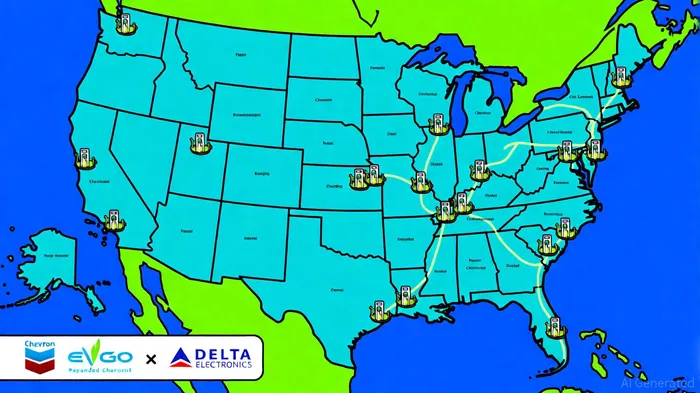
While EVgo has not pursued traditional acquisitions, its partnerships with Delta Electronics and Chevron exemplify a modern M&A-like strategy: integrating complementary assets to accelerate deployment. In January 2025, EVgo and Delta Electronics announced a co-development agreement to produce next-generation 350 kW chargers, reducing costs and enhancing reliability[4]. This collaboration mirrors the logic of M&A by aligning R&D resources without full acquisition risks. Similarly, EVgo's expanded agreement with Chevron to power 500+ stations nationwide[5] reflects a strategic acquisition of retail real estate, bypassing the need for organic site acquisition.
The broader EV charging sector has seen aggressive M&A activity post-2023, with over $4.8 billion in global deals between 2022 and 2024[6]. For instance, Blink Charging's $200 million acquisition of SemaConnect in 2022[7] highlights how consolidating networks and software platforms can create scale. EVgo's approach, while less transactional, mirrors this logic through partnerships that consolidate infrastructure, technology, and customer access.
Navigating the Post-Credit Landscape
EVgo's strategic emphasis on public-private partnerships further illustrates its adaptation to the post-IRA environment. By securing $12.7 million in NEVI grants and $4.3 million from California's FAST program[8], the company has diversified its funding sources beyond tax credits. These grants, coupled with its sale-leaseback transactions with institutional investors—generating $27 million for urban charging hubs[9]—demonstrate a shift toward asset-light models. Such strategies reduce reliance on volatile tax incentives while aligning with IRA-mandated domestic content requirements, which can boost credit values by up to 10%[1].
Risks and Opportunities
Despite these moves, challenges persist. EVgo's 2023 net loss of $77.1 million[10] highlights the sector's capital intensity, and the expiration of tax credits could dampen consumer demand. However, the company's focus on commercial fleets—onboarding 500+ fleet customers by 2025[11]—positions it to capture recurring revenue streams less sensitive to retail market fluctuations. Additionally, its AI-driven dynamic pricing and AI-driven utilization rate improvements (from 15% to 25%)[11] suggest operational efficiency gains that could offset margin pressures.
Conclusion
EVgo's strategic shift—from tax credit dependency to M&A-driven partnerships and diversified capital structures—positions it as a resilient player in the post-2025 landscape. By leveraging IRA-era infrastructure financing, co-development agreements, and public-private grants, the company is building a scalable model that transcends the volatility of consumer incentives. As the EV charging sector consolidates, EVgo's hybrid approach—combining strategic alliances with operational innovation—could serve as a blueprint for sustainable growth in an era of fiscal realism.





Comentarios
Aún no hay comentarios