
Everest Metals' Zero-Cost Mining Play at Mt Dimer Taipan: A Strategic Blueprint for Capital-Efficient Junior Producers
In the high-stakes world of junior gold producers, capital efficiency is not merely an advantage-it is a survival imperative. Everest Metals Corporation (ASX: EMC) has emerged as a compelling case study in this arena, leveraging a novel Right to Mine Agreement and a low-cost operational structure to transform its Mt Dimer Taipan Gold and Silver Project into a near-term cash-generating asset. For investors seeking exposure to high-grade gold without the typical capital burdens of exploration-stage ventures, Everest's model offers a rare alignment of strategic innovation, resource potential, and financial prudence.
A Capital-Efficient Partnership Model
At the heart of Everest's strategy is a non-dilutive funding structure orchestrated through a Right to Mine Agreement with MEGA Resources, signed in October 2025. This arrangement allows Everest to bypass the traditional equity-raising cycle, a critical differentiator for junior producers often constrained by volatile market conditions. Under the terms, MEGA Resources provides up to A$18.6 million in funding for development and working capital, while Everest retains operational control and a 50% share of net cash flow from the project.
This partnership is further bolstered by a division of labor: MEGA handles mining, haulage, and technical operations, while Everest focuses on project execution and resource expansion. By outsourcing capital-intensive activities to a partner with operational expertise, Everest avoids upfront expenditures on equipment or infrastructure. 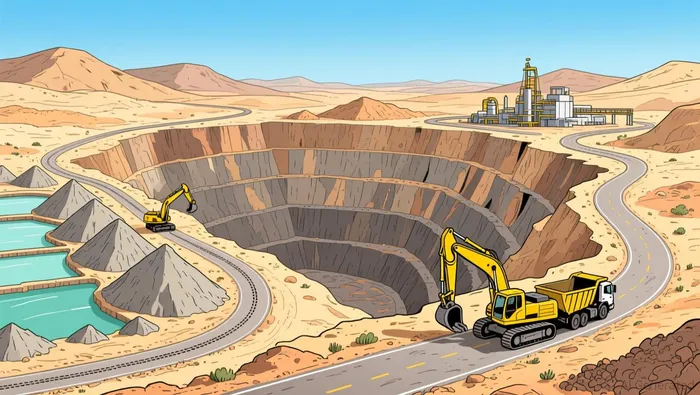 The ore will be processed via toll treatment at a third-party facility in Kalgoorlie, eliminating the need for costly on-site processing plants. Such a structure not only reduces financial risk but also accelerates time-to-revenue-a critical edge in a sector where liquidity constraints often derail projects.
Near-Term Cash Flow: The Heap Leach Pad as a Catalyst
Everest's path to cash flow hinges on two pillars: the heap leach pad and the inferred resource base at Mt Dimer Taipan. The heap leach pad, located 140 meters southeast of the main pit, contains 6,750 cubic meters of previously mined and crushed material with gold grades averaging 0.9 g/t and peaks of 15.5 g/t. Metallurgical testing is underway to assess recoverability, but preliminary results suggest this low-cost, near-surface inventory could generate early revenue.
Simultaneously, the project's inferred resource of 722,000 tonnes at 2.1 g/t gold (48,545 ounces) and 3.84 g/t silver (89,011 ounces) provides a robust foundation for sustained operations. While inferred resources carry lower confidence than measured or indicated categories under JORC standards, the resource remains open to expansion along strike and down dip, offering upside potential. Crucially, the project's small-scale open-pit design-requiring only a fleet of articulated dump trucks and an excavator- limits capital outlays while maintaining flexibility to scale as resources are upgraded.
Strategic Implications for Junior Producers
Everest's model exemplifies how junior producers can navigate the "valley of death" between exploration and production. By externalizing capital and operational risks, the company has created a zero-cost mining play: MEGA's funding covers upfront costs, toll treatment avoids processing CAPEX, and the heap leach pad offers a near-term revenue stream. This structure is particularly advantageous in a rising-interest-rate environment, where debt financing becomes prohibitively expensive for smaller firms.
Moreover, the project's proximity to Kalgoorlie-a major mining hub-reduces logistical costs and ensures access to skilled labor and infrastructure. Regulatory approvals, including the Mining Proposal and Mine Closure Plan, are already in place, further de-risking the timeline for production. For Everest, this means a transition from exploration-focused entity to a cash-generating producer within months, a feat that typically takes years for peers relying on traditional funding models.
Risks and Considerations
While Everest's approach is innovative, investors must remain cognizant of inherent risks. The inferred resource classification means there is no assurance that the 722,000-tonne resource can be upgraded to a higher category or economically mined. Additionally, metallurgical results from the heap leach pad will determine whether the low-cost feed material delivers the expected returns. However, these risks are mitigated by the project's small scale and the absence of capital commitments from Everest, which limits downside exposure.
Conclusion: A Blueprint for the Future
Everest Metals' Mt Dimer Taipan project represents more than a single asset-it is a blueprint for how junior producers can thrive in a capital-constrained environment. By combining strategic partnerships, non-dilutive funding, and operational simplicity, Everest has created a model that prioritizes liquidity, de-risks exploration, and accelerates value creation. For investors seeking a high-conviction play on gold, this is a rare opportunity to back a company that is not just discovering resources but building a business.







Comentarios
Aún no hay comentarios