
Re-evaluating Zoom Communications Inc. (ZM): Competitive Resilience and Long-Term Growth in a Post-Pandemic Era
In the post-pandemic era, the demand for unified communications-as-a-service (UCaaS) has evolved from a crisis-driven necessity to a strategic business tool. Zoom CommunicationsZM-- Inc. (ZM), once synonymous with remote work during the pandemic, now faces a recalibrated competitive landscape. This article re-evaluates Zoom's positioning, leveraging recent financial data, analyst insights, and market dynamics to assess its long-term investment potential.
Market Share and Competitive Positioning: A Modest but Profitable Player
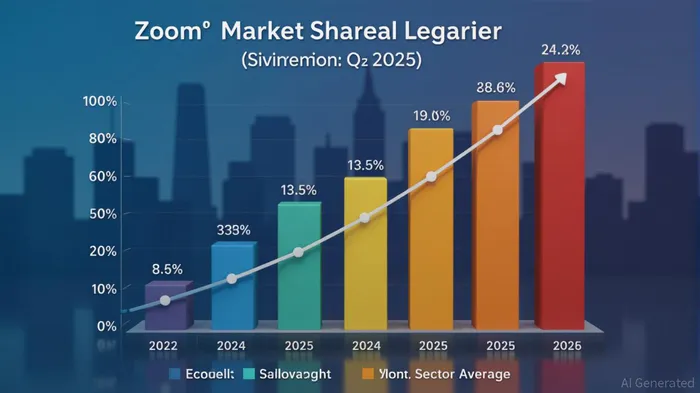
Zoom's market share in the Internet Services & Social Media industry stood at 0.82% in Q2 2025, a figure that pales in comparison to industry giants like Alphabet Inc. and Meta PlatformsMETA-- Inc. However, this modest share masks a critical strength: profitability. According to a report by csimarket.com, ZoomZM-- achieved a 20.6% income from operations margin in Q2 2025, outpacing the sector average of 12.1%[1]. This efficiency is underpinned by disciplined cost management, with operating expenses declining 1.5% year-over-year[1].
Zoom's competitive edge lies in its AI-driven innovation. Forrester's Wave report highlights Zoom as a leader in UCaaS, citing its AI-powered tools for meeting automation, real-time transcription, and virtual agents[3]. These features differentiate Zoom from rivals like MicrosoftMSFT-- Teams, which dominates enterprise adoption through its integration with Microsoft 365, and CiscoCSCO-- Webex, which emphasizes hybrid deployment flexibility[3]. While Teams boasts 320 million daily active users in 2024[4], Zoom's platform excels in workstream persistence and LTE/satellite failover capabilities—critical for businesses in volatile environments[3].
Strategic Expansion and AI Integration: Fueling Diversification
Zoom's long-term growth strategy hinges on AI and international expansion. The company has launched AI Companion, a tool that saw a 68% quarter-over-quarter surge in monthly active users[2], and Zoom Contact Center, which reported strong virtual agent adoption[3]. These innovations open new revenue streams beyond its core video conferencing business.
Geographically, Zoom is targeting untapped markets. Forrester notes that its hybrid deployment options and AI-driven features appeal to enterprises in Asia-Pacific and Latin America, where digital transformation is accelerating[3]. This diversification mitigates reliance on saturated North American markets and positions Zoom to capitalize on global remote work trends.
Financial Performance and Analyst Outlook: A Mixed but Optimistic Picture
Zoom's financials reflect a maturing business. Revenue in Q1 2026 grew 3% year-over-year to $1.175 billion, with enterprise revenue rising 6%[1]. The company raised its 2026 revenue guidance to $4.825–$4.835 billion, exceeding prior estimates[3]. Analysts remain cautiously optimistic, with a consensus “Hold” rating in recent months[2]. Price targets range from $69 to $115, averaging $90.30[2], suggesting a potential 16.7% upside from current levels[5].
However, growth is expected to moderate. Revenue is projected to increase to $5.14 billion in 2026, representing a 3.3% year-over-year growth rate[1], down from the 6.7% growth in 2025. Earnings per share (EPS) are forecasted to rise to $5.85 in 2026, a 1.7% increase from $5.75 in 2025[1]. These figures signal a shift from pandemic-era hypergrowth to sustainable, profit-driven expansion.
Risks and Mitigants: Navigating a Crowded Market
Zoom's primary risks include competition from Microsoft Teams, which leverages its ecosystem bundling strategy, and market saturation in core UCaaS offerings[1]. Additionally, macroeconomic headwinds, such as corporate cost-cutting in remote work tools, could pressure revenue. For instance, Zoom missed revenue estimates in Q1 2026 as companies scaled back remote work investments[2].
To counter these challenges, Zoom is doubling down on AI monetization. Its AI Companion and Contact Center solutions are designed to drive cross-selling opportunities, while its 98% net revenue retention rate underscores customer loyalty[4]. Furthermore, strategic partnerships, such as its collaboration with AWS for AI infrastructure, enhance scalability and innovation[3].
Conclusion: A Buy for the Long-Term, With Caution
Zoom's post-pandemic journey is a testament to its adaptability. While it no longer dominates the UCaaS market, its AI-driven product suite, profitability, and international expansion efforts position it as a resilient player. Analysts' mixed ratings reflect uncertainty about growth sustainability, but the company's focus on high-margin AI tools and enterprise diversification offers a compelling long-term thesis.
For investors, Zoom represents a “buy” for those with a 3–5 year horizon, provided they monitor macroeconomic risks and competitive dynamics. The stock's potential to outperform in AI-driven collaboration and enterprise AI adoption makes it a strategic play in the evolving digital workspace.





Comentarios
Aún no hay comentarios