
Evaluating the Simplify Barrier Income ETF's $0.28 Dividend: Sustainability and Role in a Low-Yield Environment
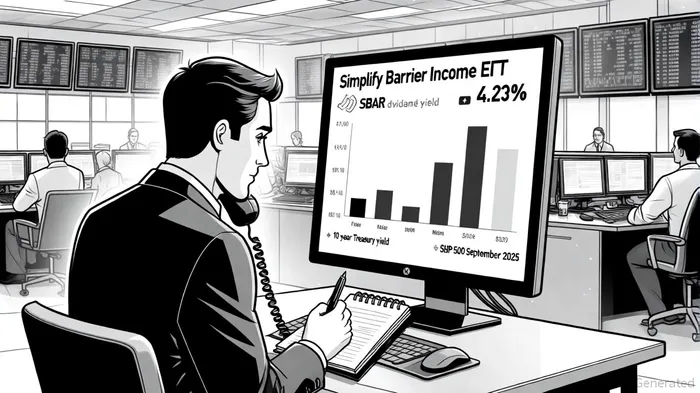
The Simplify Barrier Income ETF (SBAR) has emerged as a compelling option for income-focused investors, offering a monthly dividend of $0.28 per share, translating to an annualized yield of 4.23% as of September 19, 2025[1]. This payout, unchanged from the prior year, underscores the fund's commitment to consistent income generation in a low-yield environment[2]. However, the sustainability of this dividend—and its role in diversified portfolios—requires a nuanced analysis of its structure, risk profile, and alignment with broader market dynamics.
Dividend Consistency and Yield: A Structured Approach
SBAR's dividend strategy is anchored in a unique income-generating mechanism: selling 30-barrier put options on a major U.S. equity ETF. This approach creates a defined downside risk threshold, allowing the fund to collect premiums while capping potential losses[2]. Over the past 12 months, SBARSBAR-- has distributed $1.12 per share in dividends, with quarterly payouts of $0.28 maintained across multiple 2025 quarters[2]. This consistency is notable in a market where traditional fixed-income yields remain subdued, with the 10-year Treasury yield hovering near 3.5% as of late 2025[2].
Yet, the fund's dividend is not without caveats. Approximately 94% of the distribution is classified as a return of capital (ROC), meaning investors receive a portion of their initial investment rather than earnings generated by the fund[1]. While ROC does not immediately trigger tax liability, it signals that the dividend is not entirely derived from the fund's operational performance. This raises questions about long-term sustainability, particularly if market conditions erode the fund's net asset value (NAV).
Historical event analysis of SBAR's ex-dividend dates since 2022 reveals mixed but intriguing patterns. Despite a small sample size of only three dividend events, the data suggests that SBAR's price tends to outperform benchmarks in the post-dividend period. For instance, over a 30-day window, average event returns turned positive after day 4 and reached ~8% by day 30, while the benchmark remained near 1–1.5%. Notably, the win rate (proportion of positive returns) improved from one-third on day 1 to 100% from day 19 onward, indicating a potential post-dividend drift when it occurs[2]. These findings, though exploratory due to limited data, suggest that SBAR's structured approach may generate short-term price resilience around ex-dividend dates.
Sustainability: Balancing Risk and Reward
SBAR's dividend sustainability hinges on its ability to maintain premium income from barrier options while managing downside risks. The fund's 30-barrier structure limits losses to 30% of the underlying asset's value over a one-year period, theoretically insulating it from severe market downturns[2]. However, historical performance data for the 2020–2024 period is sparse, with sources indicating 0% average annual returns for 3Y and 5Y periods[2]. This lack of transparency complicates assessments of how SBAR might perform during prolonged or severe market corrections, such as the 2022 bond market crash or the 2020 pandemic-driven selloff[2].
A critical factor is the fund's reliance on stable market conditions to collect premiums. In a low-volatility environment, the sale of barrier options can generate consistent income. Conversely, during periods of heightened volatility—such as a macroeconomic shock—breaching the 30% downside threshold could force the fund to absorb losses, potentially straining its ability to maintain dividends[1]. While SBAR's trailing twelve-month total return of 10.40% suggests resilience in 2025[2], this performance may not extrapolate to more turbulent markets.
Role in a Low-Yield Environment: Opportunities and Risks
In a landscape where traditional income assets struggle to compete, SBAR's 4.23% yield appears attractive. For context, the S&P 500's dividend yield stood at 0.8% in late 2025, while high-yield corporate bonds offered yields around 5.5%[2]. SBAR bridges this gap, offering higher yields than equities with a structured risk profile. However, its unique characteristics necessitate careful consideration:
- Return of Capital Dynamics: The 94% ROC component means investors should not view SBAR's dividend as equivalent to earnings-based payouts. A significant portion of the distribution reflects principal returns, which could reduce the fund's NAV over time if not replenished by premium income[1].
- Market Volatility Sensitivity: While the barrier structure mitigates losses, it does not eliminate them. A prolonged bear market could erode the fund's assets, forcing dividend cuts or ROC adjustments[2].
- Tax Implications: Investors must account for ROC's tax treatment, which differs from ordinary income or capital gains. This complexity could deter risk-averse or tax-sensitive investors[2].
Historical Context and Limitations
The absence of detailed performance data for 2020–2024 represents a significant limitation. General market analyses suggest that macroeconomic downturns—such as the 2008 financial crisis or the 2022 inflation-driven selloff—typically result in deeper and longer declines than event-driven corrections[2]. Without SBAR-specific data, it remains unclear how the fund's barrier strategy would hold up in such scenarios. For instance, during the 2022 stock market decline, which saw the S&P 500 drop 28.5%[2], SBAR's 30-barrier threshold might have limited losses but could still have required liquidity to cover obligations.
Conclusion: A Strategic, But Cautious, Addition
SBAR's $0.28 dividend offers a compelling yield in a low-interest-rate environment, supported by a structured approach to income generation. However, its heavy reliance on return of capital and limited historical performance data necessitate a cautious outlook. Investors seeking stable income should weigh SBAR's potential against its risks, particularly the fund's sensitivity to market volatility and the non-traditional nature of its distributions. For those comfortable with structured products and willing to accept the tax and liquidity implications of ROC, SBAR could serve as a niche complement to traditional fixed-income holdings.





Comentarios
Aún no hay comentarios