
Evaluating the Risks and Rewards of Trump-Linked WLF’s Centralized Governance Model as WLFI Approaches Token Unlock
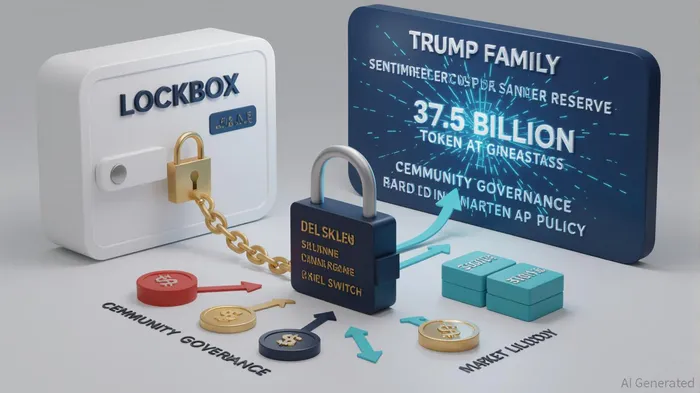
The World Liberty Financial (WLF) protocol’s governance model has become a focal point for investors assessing the WLFI token’s potential as it approaches its September 1, 2025, token unlock event. This hybrid structure—blending centralized authority with community-driven governance—raises critical questions about token value, liquidity stability, and long-term viability. While institutional backing and political influence offer strategic advantages, the risks of centralization, regulatory scrutiny, and speculative volatility cannot be ignored.
Centralized Control and Governance Risks
WLF’s governance model is defined by a dual-layered approach. The "Lockbox" mechanism restricts token transferability until specific conditions are met, aiming to balance decentralization with regulatory compliance [1]. However, the Trump family’s control of 37.5 billion tokens—nearly 38% of the total supply—introduces significant centralization risks. This concentration of power could override community governance votes, undermining the project’s decentralized ethos [3]. For instance, the core team retains a "kill switch" authority to veto proposals during crises, shifting governance to a centralized multisig wallet [5]. While this prioritizes stability, it also creates a paradox: a project marketed as decentralized may cede control to a small group during emergencies.
The September 1 token unlock event further amplifies these risks. On that date, 20% of WLFI tokens from early investment rounds will unlock, with 5% entering circulation immediately and the remaining 80% requiring community governance votes for release [1]. The Trump family’s majority stake could influence these votes, potentially accelerating token releases and overwhelming market demand. Analysts warn that a sudden influx of 3 billion tokens (3% of total supply) could destabilize liquidity, especially given the spot price of $0.000043 compared to futures prices of $0.40–$0.42 [1].
Institutional Backing and Market Dynamics
Despite governance concerns, WLFI’s institutional partnerships and political ties offer unique advantages. The Trump family’s stake and $1.5 billion in investments from entities like ALT5 SigmaALTS-- and DWF Labs lend partial legitimacy to the token [1]. DWF Labs, for example, invested $25 million at $0.10 per token and acts as a market maker for WLFI and its USD1 stablecoin [4]. These partnerships aim to bridge DeFi and traditional finance (TradFi), with USD1—pegged 1:1 to the U.S. dollar and backed by ETH and Treasury bills—playing a pivotal role in stabilizing the ecosystem [1].
However, speculative demand has already driven IOU prices to a 90% premium over the spot price, reflecting both optimism and risk [1]. Whale activity, such as a $70 million token unlock on August 31, 2025, further complicates market dynamics, potentially triggering short-term volatility [2]. The challenge lies in balancing liquidity with demand: if 5 billion tokens at TGE are fully unlocked, the market could face a $1.93 billion sell-off at current pricing [2].
Regulatory and Long-Term Viability
Regulatory scrutiny remains a wildcard. The SEC’s investigation into WLFI’s governance structure—particularly the Trump family’s 75% presale stake—could lead to delisting or restructuring if the token is classified as an investment contract under the Howey Test [1]. This uncertainty affects both institutional and retail investors, as compliance with the GENIUS Act and other regulations becomes critical for market acceptance [1].
Conclusion: A High-Risk, High-Reward Proposition
WLFI’s tokenomics prioritize governance over financial utility, distinguishing it from traditional DeFi protocols [1]. The September 1 unlock event will test the market’s ability to absorb liquidity while navigating governance disputes and regulatory hurdles. For investors, the key question is whether the project’s institutional-grade partnerships and political influence can outweigh the risks of centralization and speculative volatility.
While the Trump family’s stake and institutional backing offer strategic advantages, the centralized governance mechanisms and regulatory uncertainties create a high-stakes environment. Investors must weigh these factors carefully, recognizing that WLFI’s success hinges on its ability to balance decentralization ideals with the realities of market dynamics and compliance.
**Source:[1] WLFI Tokens Valuation: Exploring Governance, Risks, and ... [https://www.okx.com/en-us/learn/wlfi-tokens-valuation-governance-risks-market][2] Whale Unlocks $70M in WLFI Tokens as DeFi Platform ... [https://www.ainvest.com/news/whale-unlocks-70m-wlfi-tokens-defi-platform-gears-massive-tge-2508/][3] WLFI: A Politically Charged Token at the Crossroads of ... [https://www.ainvest.com/news/wlfi-politically-charged-token-crossroads-tradfi-defi-2508/][4] WLFI token: DWF Labs invests $25M at $0.10 for 250M WLFI, expected to serve as WLFI market maker alongside USD1 role [https://blockchain.news/flashnews/wlfi-token-dwf-labs-invests-25m-at-0-10-for-250m-wlfi-expected-to-serve-as-wlfi-market-maker-alongside-usd1-role][5] WLF Drops 'Kill Switch' Governance Before Sept 1 Token ... [https://www.mexc.co/en-IN/news/wlf-drops-kill-switch-governance-before-sept-1-token-unlock/79643]







Comentarios
Aún no hay comentarios