
Evaluating the Risks and Opportunities in the Shiba Inu Ecosystem Amid K9 Finance's Ultimatum
The Shiba InuSHIB-- (SHIB) ecosystem has faced a seismic shift in late 2025, marked by a $4.1 million Shibarium bridge hack and the subsequent ultimatum issued by K9 Finance, a key partner. As the project navigates the fallout, investors must weigh the risks of governance instability and security vulnerabilities against the potential for long-term growth driven by Shibarium's development and token utility.
The Immediate Fallout: A Security Crisis and Market Panic
In September 2025, attackers exploited a critical vulnerability in the Shibarium bridge by leveraging flash loans to gain control of validator signing keys, draining assets including $700,000 in K9 Finance's KNINE tokens, EthereumETH--, and SHIBSHIB-- itself. The incident triggered an 11.5% drop in SHIB's price and a 43.5% plunge in BONE, underscoring the fragility of the ecosystem's governance and security protocols. While the Shiba Inu team swiftly froze bridge operations and revoked attacker permissions, the damage to investor confidence was immediate and profound.
K9 Finance, a decentralized autonomous organization (DAO) and Shibarium's official partner, has since issued a January 6, 2026, deadline for full restitution of affected users' funds according to reports. Failure to meet this ultimatum could lead to a formal vote to sever ties with Shibarium, a move that would not only destabilize the network's credibility but also accelerate the exodus of liquidity providers and developers.
Security Upgrades and Governance Reforms: A Path to Recovery?
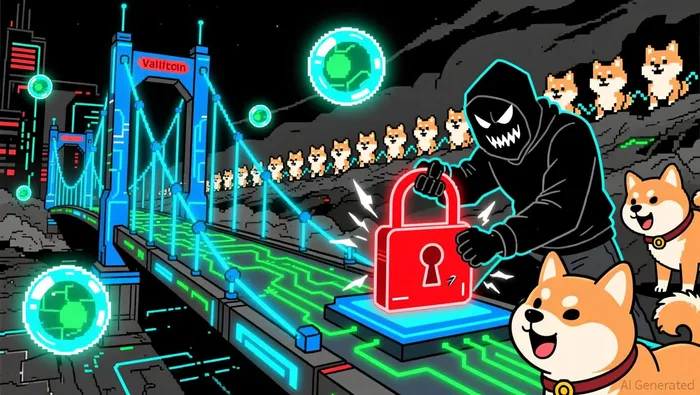
In response to the hack, the Shiba Inu team has implemented a series of security measures, including migrating over 100 critical contracts to multi-signature wallets and rotating all validator signing keys. A blacklist feature has also been introduced to block malicious addresses in staking operations, tested on Devnet and Puppynet before Mainnet deployment according to the Shiba Inu team. These steps signal a commitment to addressing vulnerabilities, but their effectiveness remains unproven in live conditions.
Longer-term, the project's roadmap includes the expansion of Shibarium through the Shib Alpha Layer, aiming to enhance transaction speed and cross-chain interoperability. Additionally, an AI technical paper slated for Q1 2026 promises to detail how artificial intelligence could optimize Shibarium's capabilities. While these initiatives are ambitious, their success hinges on attracting high-quality decentralized applications and institutional adoption-goals that remain aspirational given Shibarium's current Total Value Locked (TVL) of just $1 million.
Market Predictions: Bearish Sentiment vs. Ecosystem Potential
The immediate aftermath of the hack has been marked by extreme bearishness. The Fear & Greed Index for SHIB stands at 17 (Extreme Fear), with technical indicators suggesting a potential price floor of $0.00000744. However, some analysts project a gradual recovery if Shibarium gains traction. For instance, one forecast anticipates SHIB trading between $0.0000719928 and $0.0000859914 in 2026, rising to $0.0001039896–$0.0001229877 by 2027 according to market analysts. A more bullish scenario envisions SHIB reaching $0.00006–$0.0001 by 2030, contingent on sustained ecosystem development.
The token's burn mechanism, which has eliminated 40% of its total supply, adds a layer of scarcity but faces limitations due to SHIB's massive circulating supply of 589 trillion tokens according to market analysis. For burns to meaningfully impact value, they must be paired with increased transaction volume and real-world utility-a challenge given the current lack of compelling use cases for SHIB beyond speculative trading.
K9 Finance's Ultimatum: A Make-or-Break Moment
The ultimatum from K9 Finance represents a critical juncture for the Shiba Inu ecosystem. If the Shiba Inu team fails to meet the January 2026 deadline, the K9 DAO's potential withdrawal could trigger a cascade of consequences. Shibarium's TVL, already modest, might collapse further as liquidity providers flee to more secure networks. Moreover, the loss of K9 Finance's KNINE token-a key asset for yield farming and governance-could stifle innovation in Shibarium's DeFi and NFT sectors.
Conversely, a successful resolution could reinforce trust in the ecosystem's governance model. K9 Finance's ultimatum, while confrontational, also reflects a desire for accountability-a trait that could attract institutional investors seeking transparency in decentralized projects.
Conclusion: A High-Risk, High-Reward Proposition
Investing in SHIB and Shibarium post-hack remains a high-stakes bet. The ecosystem's long-term viability depends on three factors:
1. Security: Whether the implemented upgrades prevent future exploits.
2. Partnerships: The outcome of the K9 Finance ultimatum and its impact on Shibarium's credibility.
3. Adoption: The ability to attract dApps and users to justify SHIB's utility beyond speculative trading.
While the current bearish sentiment and governance uncertainties warrant caution, the project's aggressive roadmap and community-driven governance offer a glimmer of hope. For risk-tolerant investors, SHIB could represent a speculative opportunity if Shibarium's vision materializes. However, for those prioritizing stability, the ecosystem's unresolved vulnerabilities and partnership risks make it a less attractive proposition in the near term.






Comentarios
Aún no hay comentarios