
Evaluating Risk and Resilience in Established DeFi Projects: A 2025 Investment Analysis
The decentralized finance (DeFi) sector, once hailed as the future of open finance, has faced a sobering reality in recent years. Despite the maturation of protocols like UniswapUNI--, AaveAAVE--, and Compound, the cumulative losses from security breaches between 2023 and 2025 have reached $12 billion, according to a critical evaluation by the Oxford Journal of Cybersecurity[1]. These losses, driven by sophisticated attacks on smart contracts and governance mechanisms, underscore a persistent tension between innovation and risk. For investors, the challenge lies in discerning which projects have truly internalized these lessons-and which remain vulnerable to the next wave of exploits.
The Anatomy of DeFi's Security Failures
Even protocols with rigorous audit regimes have proven susceptible to systemic flaws. Uniswap v4, for instance, underwent four audits by firms like OpenZeppelin and Certora, yet vulnerabilities such as a double-counting exploit on the CELOCELO-- blockchain and a tick price invariant violation were identified[2]. These issues, though corrected, revealed the fragility of multi-chain logic and the limitations of static audits in dynamic environments.
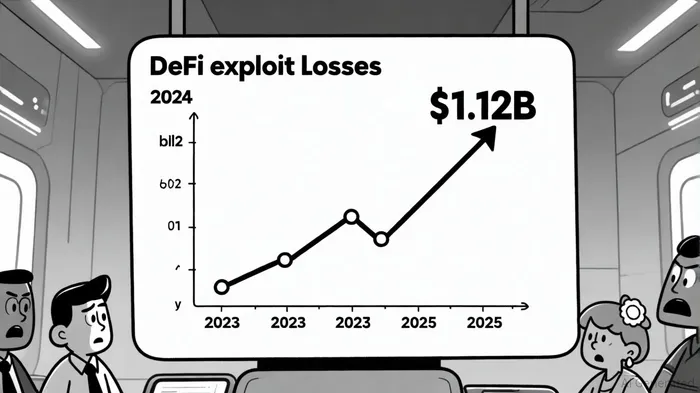
The scale of breaches has been staggering. In 2024 alone, DeFi platforms lost $1.12 billion across 79 exploits, with protocol logic flaws accounting for the majority of incidents[4]. The Bunni DEX exploit, where hackers manipulated liquidity distribution functions to siphon $2.4 million, and the Team Finance breach-despite audits by CertiK and Hacken-exposed gaps in input validation and post-deployment monitoring[3]. Reentrancy attacks, a classic vulnerability, resurfaced in July 2025 when GMXGMX-- lost $42 million after attackers exploited recursive withdrawal calls[3].
These cases highlight a paradox: as DeFi protocols grow in complexity, their attack surfaces expand exponentially. Smart contracts, once deployed, are immutableIMX--, making even minor logical errors costly. Oracle manipulation and governance attacks further compound risks, as attackers exploit price feeds or voting mechanisms to siphon funds[1].
Risk Mitigation: Innovation or Illusion?
In response, DeFi projects have adopted advanced risk management practices. Formal verification, once a niche tool, is now standard for protocols like Uniswap and Aave. Certora and ConsenSys's tools mathematically prove invariants, reducing the likelihood of logical errors[1]. Cross-chain risk aggregation platforms enable real-time monitoring of assets across blockchains, while AI-powered analytics detect anomalous transactions and governance votes[1].
Insurance protocols such as Nexus Mutual and Cover Protocol have also gained traction, offering parametric coverage against smart contract failures. These mechanisms, however, are not foolproof. The $14.5 million Team Finance exploit occurred despite insurance-like safeguards, suggesting that underwriting models may lag behind the pace of attacks[3].
Regulatory compliance is another frontier. RegTech integration now enforces AML/KYC rules pre-transaction, and decentralized identity (DID) systems aim to prevent Sybil attacks by creating risk-weighted access controls[1]. Yet, these measures remain fragmented. As one 2025 report notes, "Compliance layers are often bolted on rather than embedded in protocol design"[1].
Investor Implications: Navigating the New Normal
For investors, the key is to assess whether a project's risk management framework is proactive rather than reactive. Protocols that prioritize continuous monitoring, diversification across chains, and community-driven governance-such as those leveraging Nexus Mutual for insurance-demonstrate resilience[4]. Conversely, projects relying solely on periodic audits or opaque governance structures remain high-risk.
The data also suggests a declining trend in exploit losses post-2024, from $1.12 billion to $680 million in 2025, as formal verification adoption rose from 12% to 58% of protocols[4]. While this indicates progress, the total losses remain unacceptably high. Investors must weigh these metrics against a project's transparency, audit history, and willingness to adapt to emerging threats.
Conclusion: A Call for Prudent Optimism
The DeFi ecosystem is evolving, but its security trajectory remains uneven. While innovations like formal verification and cross-chain tools offer hope, they are not panaceas. Investors should favor projects that treat security as a continuous process-combining audits, insurance, and real-time analytics-rather than a checkbox. As the sector matures, resilience will be defined not by the absence of breaches, but by the speed and sophistication of responses to them.






Comentarios
Aún no hay comentarios