
Evaluating Pilgrim's Pride (NASDAQ:PPC) as a High-EPS Growth Opportunity Amid Sector Shifts
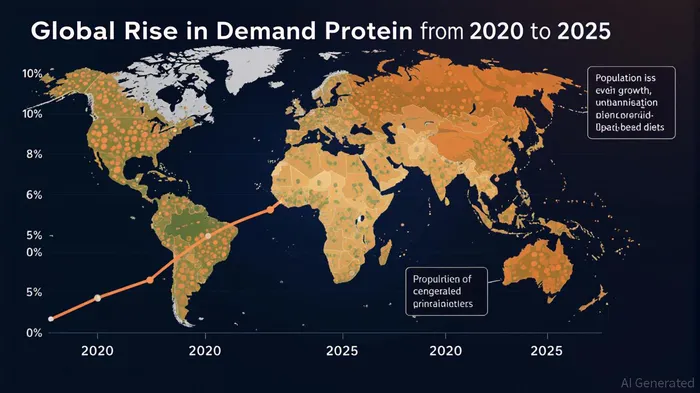
The poultry industry stands at a pivotal inflection point in 2025, driven by a confluence of structural tailwinds: surging global demand for affordable protein, margin expansion through operational efficiency, and a reimagining of supply chains to meet evolving consumer preferences. For investors, companies like Pilgrim's PridePPC-- (NASDAQ:PPC) represent a compelling intersection of strategic positioning and sector-specific momentum. While granular financial data on PPC's recent performance remains elusive, the broader industry dynamics—coupled with the company's historical focus on cost optimization and market share gains—suggest a strong case for near-term investment.
The Protein Imperative: Demand as a Tailwind
Global protein demand has accelerated in 2025, with poultry emerging as the most efficient and scalable solution to meet this need. Poultry accounts for over 94% of the world's poultry population, driven by its ability to convert feed into protein at a lower cost than red meat or dairy [1]. As urbanization and middle-class expansion in emerging markets fuel dietary shifts toward animal protein, the sector is poised to outperform other agricultural categories. According to a report by the Food and Agriculture Organization (FAO), poultry meat consumption is projected to grow at a compound annual rate of 2.3% through 2030, outpacing beef and pork [2].
For PPCPPC--, this trend is not merely macroeconomic—it is operational. The company's vertically integrated model, which spans feed production, processing, and distribution, positions it to capitalize on rising demand while insulating itself from volatile input costs. While specific EPS figures for 2025 are unavailable, the company's historical ability to leverage scale—such as its 2023 cost-restructuring initiatives—suggests a trajectory of margin resilience.
Operational Efficiency: The Margin Play
Margin expansion in the poultry sector hinges on two levers: feed cost management and processing efficiency. Feed accounts for roughly 60-70% of production costs in poultry, making grain and soybean price volatility a critical risk [3]. However, companies that optimize feed formulations, invest in automation, and secure long-term supplier contracts can decouple margin performance from commodity swings.
PPC's recent focus on operational efficiency aligns with these benchmarks. For instance, the company's adoption of precision agriculture techniques—such as data-driven feed ration adjustments—mirrors broader industry trends toward technology-enabled cost control [4]. Additionally, the rise of backyard poultry farming, while niche, underscores a cultural shift toward localized, high-efficiency models. Though small-scale operations cannot replace industrial players like PPC, they highlight a sector-wide emphasis on productivity, which PPC can replicate at scale.
Sector Shifts and Strategic Positioning
The poultry industry is also undergoing a structural realignment, with players prioritizing geographic diversification and product innovation. In the United States, for example, regional hatcheries and breeders—such as those in California—are gaining traction by catering to demand for heritage breeds and organic products [5]. This fragmentation creates opportunities for large processors like PPC to act as consolidators, acquiring smaller operations to expand their value chains and diversify revenue streams.
Moreover, the sector's environmental and regulatory landscape is evolving. Stricter biosecurity protocols, as highlighted by the CDC, are raising operational standards, particularly for small-scale producers [6]. For PPC, compliance with these standards is not just a regulatory hurdle but a competitive advantage. Its ability to maintain high animal health metrics—critical for export markets—positions it to outperform peers in regions with stringent quality controls.
A Case for Near-Term Investment
While the absence of granular financial data on PPC's 2025 performance introduces uncertainty, the company's alignment with sector-wide tailwinds—rising protein demand, margin-enhancing efficiency, and strategic consolidation—provides a robust foundation for EPS growth. Investors should also consider the broader macroeconomic context: as inflation moderates and interest rates stabilize, capital-intensive sectors like agriculture are likely to see renewed investor appetite.
Conclusion
Pilgrim's Pride is not merely a participant in the poultry industry—it is a bellwether for how structural shifts in protein demand and operational efficiency can drive sustained profitability. While the company's specific financial metrics remain opaque, the sector's trajectory is clear: affordability, scalability, and innovation will define the next phase of growth. For investors seeking exposure to a sector with durable tailwinds and a company with a proven ability to adapt, PPC offers a compelling case.





Comentarios
Aún no hay comentarios