
Evaluating Mounjaro's Phase 3 PEDS Trial as a Catalyst for Long-Term Growth in Eli Lilly's Diabetes Portfolio
Eli Lilly's Mounjaro (tirzepatide) has emerged as a transformative force in the diabetes and obesity therapeutics market, but its recent Phase 3 SURPASS-PEDS trial marks a pivotal inflection pointIPCX--. By demonstrating robust efficacy in pediatric type 2 diabetes—a previously underserved population—Mounjaro not only expands its therapeutic footprint but also cements Eli Lilly's leadership in the GLP-1 receptor agonist (RA) space. For investors, the trial's success raises critical questions: How does this pediatric expansion alter the competitive dynamics of the GLP-1 market? What are the long-term revenue implications for Eli Lilly? And how does Mounjaro's dual GIP/GLP-1 mechanism position it to outperform rivals like Novo Nordisk's Ozempic and Wegovy?
PEDS Trial: A New Frontier in Pediatric Diabetes Management
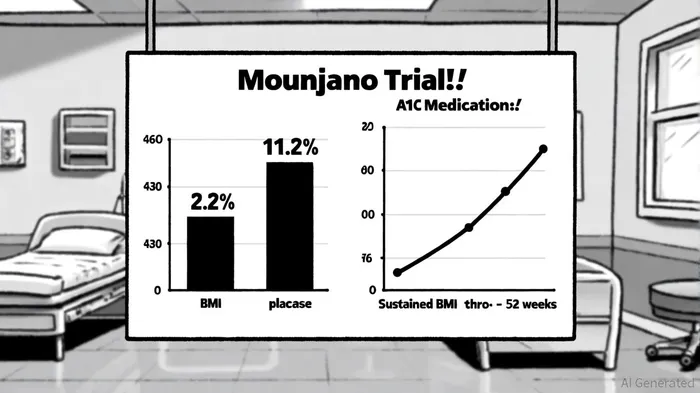
The SURPASS-PEDS trial, which evaluated Mounjaro in children and adolescents aged 10–17 with inadequately controlled type 2 diabetes, delivered headline results. At 30 weeks, the drug reduced A1C levels by an average of 2.2% from a baseline of 8.05%, compared to a 0.05% increase in the placebo group[1]. Notably, 86.1% of participants on the 10 mg dose achieved an A1C of ≤6.5%, a clinically meaningful threshold for glycemic control[1]. Concurrently, the 10 mg dose drove an 11.2% reduction in BMI, with sustained improvements observed through a 52-week open-label extension[1].
These outcomes are particularly significant given the rising prevalence of type 2 diabetes in pediatric populations. According to a report by Grand View Research, the global pediatric diabetes therapeutics market is projected to grow at a 7.89% CAGR, reaching $12.81 billion by 2034[2]. Mounjaro's ability to address both glycemic control and obesity—two interlinked challenges—positions it to capture a substantial share of this expanding market.
Strategic Implications: Expanding Indications and Market Share
Mounjaro's dual GIP/GLP-1 mechanism offers a key competitive edge. Unlike traditional GLP-1 RAs, which primarily target appetite regulation and insulin secretion, Mounjaro's dual action enhances glucose-dependent insulin release while promoting satiety and weight loss[3]. This has already translated into superior efficacy in adult trials, with head-to-head studies showing Mounjaro outperforming Ozempic in both HbA1c reduction and weight loss[3]. The PEDS trial now extends this advantage to a younger demographic, where obesity-linked type 2 diabetes is increasingly prevalent.
Financially, Mounjaro's pediatric expansion could unlock new revenue streams. Eli Lilly's Q2 2025 sales of Mounjaro reached $5.2 billion, capturing 57% of the U.S. branded obesity drug market[4]. With the global GLP-1 market forecasted to grow at a 17.46% CAGR through 2030, reaching $156.71 billion[2], Mounjaro's pediatric indication could accelerate this trajectory. Analysts at CoherentCOHR-- Market Insights project Mounjaro's market size to surge from $16.78 billion in 2025 to $55.48 billion by 2032, driven by its dominance in both diabetes and obesity[5].
Regulatory and Competitive Landscape
Eli LillyLLY-- has submitted PEDS trial data to global regulators for approval, though exact timelines remain undisclosed[6]. The European Medicines Agency (EMA) had already accepted a modified pediatric investigation plan in 2023, signaling regulatory alignment[6]. Assuming approval within 12–18 months, Mounjaro could rapidly gain traction in pediatric care, given its favorable safety profile. Adverse events in the trial were largely mild-to-moderate gastrointestinal issues, consistent with adult studies[1].
Competitively, Mounjaro's pediatric expansion complicates Novo Nordisk's dominance. While Ozempic and Wegovy remain top sellers, their pediatric approvals are limited to obesity management, not diabetes. Mounjaro's dual indication—addressing both conditions—creates a unique value proposition. Meanwhile, Eli Lilly's pipeline further strengthens its position: Orforglipron, an oral GLP-1 RA, recently outperformed Novo Nordisk's Rybelsus in key trials[4], diversifying Lilly's offerings in the GLP-1 space.
Risks and Considerations
Despite its strengths, challenges persist. Pediatric adoption may lag due to physician hesitancy or regulatory scrutiny, particularly given the long-term safety data gaps for GLP-1 RAs in children. Additionally, Novo Nordisk's pipeline includes oral semaglutide and dual GIP/GLP-1 candidates, which could erode Mounjaro's market share if approved[3]. However, Mounjaro's first-mover advantage in pediatric diabetes and its proven efficacy mitigate these risks.
Conclusion: A Catalyst for Sustained Growth
The SURPASS-PEDS trial is more than a scientific milestone—it is a strategic masterstroke for Eli LillyLLY--. By securing a foothold in pediatric type 2 diabetes, Mounjaro taps into a high-growth market while reinforcing its position as the GLP-1 class leader. For investors, the drug's dual mechanism, robust clinical data, and expanding indications justify optimism about its long-term revenue potential. As the GLP-1 market evolves, Eli Lilly's ability to innovate and adapt—evidenced by Mounjaro and Orforglipron—positions it to outpace rivals and deliver sustained value.





Comentarios
Aún no hay comentarios