
Evaluating Kyocera Corporation's Equity Buyback Plan: A Strategic Opportunity for Value Investors
Capital Allocation Efficiency: A Double-Edged Sword
Equity buybacks can be a powerful tool for capital allocation when executed at attractive valuations. By reducing the number of shares outstanding, companies can boost earnings per share (EPS) and signal confidence in their financial health. However, the effectiveness of such programs depends critically on the underlying cost of capital and the company's ability to generate returns exceeding its hurdle rates.
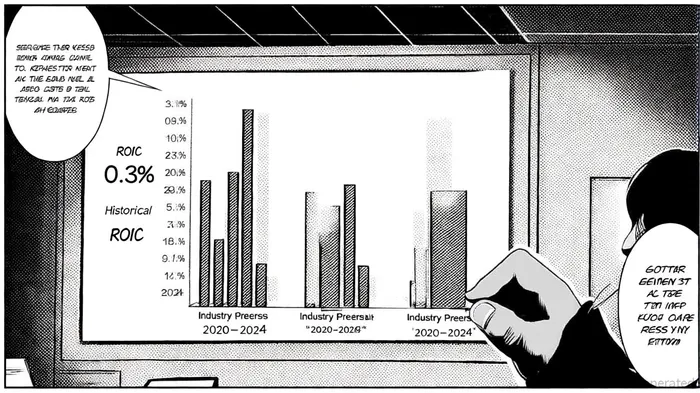
Kyocera's ROIC, a key metric for assessing capital efficiency, has deteriorated sharply. As of Q3 2025, its ROIC stood at a meager 0.3%, calculated using net operating profit after tax (NOPAT) of ¥11.4 billion and invested capital of ¥3.8 trillion [2]. This stark underperformance highlights the company's struggle to generate value from its investments, a challenge exacerbated by a one-time loss in its organic packaging business and weak demand in key markets [3]. A 2025 EY study on capital efficiency and total shareholder return (TSR) categorizes firms like Kyocera into the "Tortoise" quadrant-low ROIC but high TSR-suggesting that disciplined capital allocation, such as buybacks, may be the most viable path to restoring investor confidence [4].
Funding the Buyback: Risks and Uncertainties
While Kyocera has not explicitly disclosed the funding sources for its buyback program, its recent financial performance raises concerns. The company reported a 76.2% decline in profit attributable to owners of the parent in fiscal 2025, falling to ¥24.1 billion from ¥101.1 billion in the prior year [5]. Operating cash flow also showed mixed signals: Q4 2024 saw a 14.44% year-over-year increase to $0.395 billion, but the twelve-month trailing cash flow from operations declined by 58.36% to $1.249 billion [6]. This volatility underscores the risks of relying on operational cash flow to fund the buyback, particularly if market conditions deteriorate further.
Debt issuance is another potential funding source, though Kyocera's capital structure remains opaque. As of March 2025, the company held ¥200 billion in treasury shares and had 1,408,748,115 shares outstanding [1]. While its balance sheet details are accessible via investor relations filings, the absence of explicit guidance on debt leverage or cash reserves leaves room for speculation. For value investors, this ambiguity represents a critical risk: overleveraging to fund buybacks could exacerbate financial vulnerabilities, especially in a low-ROIC environment.
Strategic Implications for Shareholder Value
The buyback program's success ultimately depends on Kyocera's ability to deploy capital at a discount to intrinsic value. At the time of the July 2025 partial repurchase, the company acquired 2,407,600 shares at an average cost of ¥1,790 per share, totaling ¥4.31 billion [7]. If this price reflects a discount to Kyocera's long-term value, the buyback could enhance shareholder returns. However, with ROIC languishing near zero, the company must also address structural inefficiencies-such as its recent restructuring efforts, including reduced capital expenditures and a focus on high-margin products [3]-to ensure that buybacks complement, rather than substitute for, operational improvements.
From a strategic perspective, Kyocera's buyback aligns with the "Tortoise" framework outlined in the EY study: prioritizing capital efficiency and margin improvement before pursuing aggressive growth [4]. By reducing share count and signaling commitment to shareholder returns, the company may stabilize investor sentiment while it works to reverse its ROIC decline. However, the absence of clear funding transparency and the drag from recent profit drops mean that execution risks remain high.
Conclusion: A Calculated Bet for Value Investors
Kyocera's equity buyback plan presents a mixed opportunity for value investors. On one hand, the program reflects a strategic commitment to capital efficiency and shareholder returns, particularly in a low-ROIC environment where disciplined buybacks can outperform organic growth initiatives. On the other, the lack of clarity around funding sources and the company's recent profitability challenges necessitate caution. Investors should monitor Kyocera's capital structure disclosures, track its progress in structural reforms, and assess whether the buyback price reflects a meaningful discount to intrinsic value. For those willing to navigate these risks, the initiative could represent a calculated bet on a company seeking to rebalance its priorities in pursuit of long-term value creation.







Comentarios
Aún no hay comentarios