
Evaluating the Impact of Netflix Insider Sales on Market Confidence and Stock Valuation
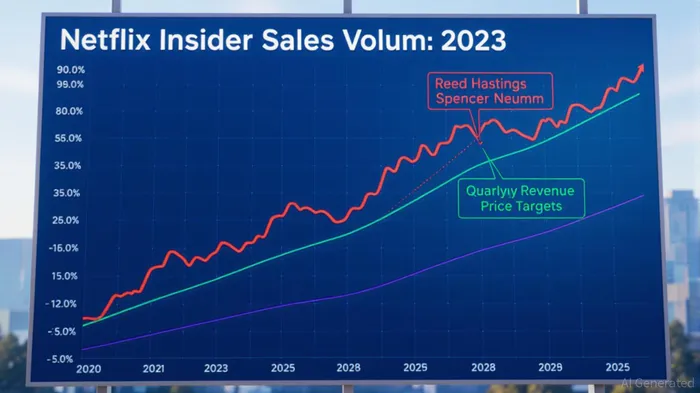
Netflix’s recent insider sales have sparked debate among investors, but the data tells a nuanced story. Let’s break it down.
1. Insider Sales: Routine Portfolio Management or Red Flag?
In Q3 2025, NetflixNFLX-- insiders—including CFO Spencer Neumann and director Anne M. Sweeney—executed transactions that totaled millions. Neumann sold 685 shares at $1,161.21, reducing his stake by 15.65% [3], while Hastings liquidated $26.5 million in shares via a Rule 10b5-1 plan [2]. These pre-arranged sales, designed to comply with insider trading laws, are part of standard wealth management strategies.
Critically, insiders still hold $2.4 billion in Netflix stock [4], a figure that dwards the $556 million in Q1 2025 sales. This retention signals alignment with long-term value creation. As stated by AINvest, “The pattern reflects liquidity needs, not a lack of confidence” [5].
2. Institutional Moves: A Mixed Signal
Institutional investors have taken divergent approaches. Adage Capital Partners cut its stake by 1.8%, while Fullcircle Wealth and Capital Analysts increased holdings by 2.5% and 0.3%, respectively [1]. With 80.93% of shares owned by institutions [1], these shifts highlight ongoing confidence in Netflix’s fundamentals.
The company’s Q2 2025 results—$11.08 billion in revenue, up 15.9% YoY—back this optimism. Analysts project $24.58 EPS for 2025, with a median price target of $1,394.44 [3].
3. Governance and Market Reactions
Governance concerns persist, including past GDPR violations and uneven board diversity [4]. However, Netflix’s strategic moves—expanding ad-supported tiers, leveraging AI for content curation, and doubling advertising revenue—offset these risks.
The stock’s 51.8% YTD gain [2] and 52-week high of $1,341.11 [3] suggest markets are prioritizing growth over governance quirks. Even after a 1.9% intraday drop in late August [3], the stock rebounded, reflecting resilience.
4. Valuation: Expensive or Justified?
Netflix trades at a P/E of 51.73 [4], above its five-year average of 22x. Critics argue this premium is unsustainable, but the company’s free cash flow is projected to hit $8 billion annually by 2026 [5]. With 80.93% institutional ownership and 26 “Buy” ratings from analysts [3], the valuation appears supported by fundamentals.
Conclusion: A Buy for the Long Haul
While insider sales may raise eyebrows, they’re part of a broader narrative of strategic liquidity and institutional confidence. Netflix’s robust subscriber growth, AI-driven innovation, and expanding ad revenue justify its premium valuation. For investors, the key takeaway is clear: This is a stock for the long game.
Source:
[1] Core Wealth Advisors Inc. Purchases Shares of Netflix [https://www.marketbeat.com/instant-alerts/filing-core-wealth-advisors-inc-buys-shares-of-237-netflix-inc-nflx-2025-09-01/]
[2] [Form 4] NetFlix Inc Insider Trading Activity [https://www.stocktitan.net/sec-filings/NFLX/form-4-net-flix-inc-insider-trading-activity-90991871f18a.html]
[3] NFLXNFLX-- Analyst Ratings & Price Target [https://www.tipranks.com/stocks/nflx/forecast]
[4] Netflix's Insider Selling: Governance Concerns or Strategic ... [https://www.ainvest.com/news/netflix-insider-selling-governance-concerns-strategic-moves-valuation-risks-investment-outlook-2506]
[5] Netflix Insider Sales: Strategic Liquidity or Red Flag? [https://www.ainvest.com/news/netflix-insider-sales-strategic-liquidity-red-flag-2506/]





Comentarios
Aún no hay comentarios