
Evaluating the Impact of DASH Aster's DEX Listing on Decentralized Finance Adoption
Market Infrastructure Innovations: Hybrid Models and Cross-Chain Scalability
Aster DEX's hybrid automated market maker (AMM)-centralized exchange (CEX) architecture has redefined DeFi's operational framework. By combining the speed and advanced features of centralized exchanges with the transparency of AMMs, Aster DEX achieved a total value locked (TVL) of $1.399 billion and daily trading volumes exceeding $27.7 billion in Q3 2025. This infrastructure supports high-leverage trading (up to 1001x via Shield Mode) and institutional-grade privacy through zero-knowledge proofs (ZKPs), which mask 77% of transactions.
The platform's multi-chain interoperability-spanning BNBBNB-- Chain, EthereumETH--, SolanaSOL--, and Arbitrum-has further enhanced liquidity consolidation for tokens like DASH, which previously faced fragmentation across networks. For instance, DASH's Q4 2025 trading volume surged 114.5% to $781.43 million, driven by 5x leverage perpetual futures.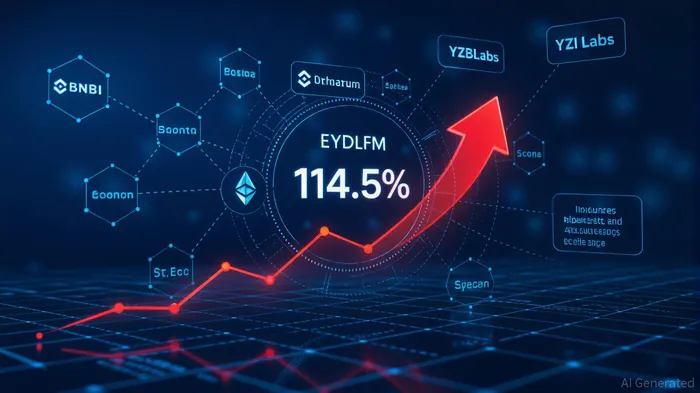 Such innovations position Aster DEX as a bridge between traditional finance and DeFi, offering scalable solutions for both retail and institutional participants.
Institutional Adoption and Investor Behavior: Liquidity, Leverage, and Tokenomics
The DASH listing has attracted institutional capital through strategic upgrades and tokenomics. Aster DEX's hybrid model, supported by partnerships with Binance and YZi Labs, has drawn institutional liquidity, with Binance's ASTER listing in October 2025 boosting the token's visibility. On-chain data reveals that 53.5% of ASTER's token supply is allocated to community rewards, while annual token burns of 5–7% create deflationary pressure. These mechanics have driven a 1,650% surge in ASTER's price post-token generation event (TGE), contributing to a $660 million TVL increase.
Institutional adoption is further evidenced by Aster DEX's expansion into real-world assets (RWAs), including blue-chip stock perpetuals and tokenized U.S. Treasuries. By Q3 2025, the platform's TVL and volume outperformed competitors like Hyperliquid, with 330,000 new wallets onboarding. Regulatory clarity, such as the EU's MiCA and the U.S. CLARITY Act, has also bolstered institutional confidence in DeFi protocols.
On-Chain Analytics and Capital Inflows: Q4 2025 Trends
On-chain analytics highlight the DASH listing's impact on capital flows. In Q4 2025, Aster DEX's daily trading volume spiked to $70 billion, with DASH contributing $36 billion. The platform's Shield Mode, introduced in December 2025, enabled gas-free, high-leverage trading while concealing strategies, attracting advanced traders. Despite a 50% TVL drop to $1.32 billion in December 2025, the platform's cumulative trading volume surpassed $2 trillion in 2025, signaling resilience amid market volatility.
The ASTER token's performance underscores this trend. Post-TGE, its price surged 1,650%, while DASH's Q4 2025 volume rose 114.5% to $781.43 million. These metrics reflect a shift in capital allocation toward hybrid DeFi models that blend CEX efficiency with AMM composability.
Challenges and Risks: Regulatory and Market Volatility
Despite its momentum, Aster DEX faces challenges. High leverage options and concentrated ownership of ASTER pose risks to market stability. Regulatory scrutiny, particularly around RWA tokenization and cross-chain compliance, remains a hurdle for institutional adoption. Additionally, the 5% ASTER price drop in December 2025 highlights the platform's susceptibility to broader market downturns.
Conclusion: A Catalyst for DeFi's Next Era
The DASH Aster DEX listing has undeniably accelerated DeFi's institutional adoption. By integrating hybrid infrastructure, cross-chain scalability, and privacy-preserving technologies, Aster DEX has addressed key pain points for institutional investors. While challenges persist, the platform's on-chain growth, strategic partnerships, and tokenomics position it as a leader in the DeFi 2.0 era. For investors, the DASH listing exemplifies how innovative market infrastructure can drive behavioral shifts, signaling a broader reallocation of capital toward decentralized ecosystems.





Comentarios
Aún no hay comentarios