
Evaluating Hooker Furnishings' Dividend Sustainability Amid Earnings Volatility
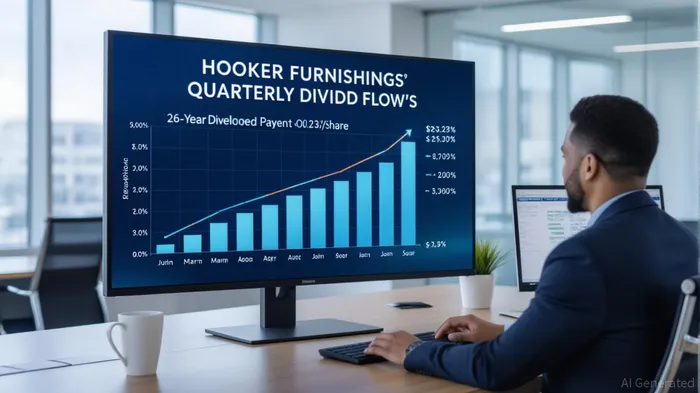
For dividend investors, few metrics are as critical as sustainability—especially when a company's earnings are under pressure. Hooker FurnishingsHOFT-- (HOFT), a furniture manufacturer with a 26-year streak of uninterrupted dividend payments, presents a compelling case study in balancing yield with financial resilience. As of June 2025, the company's annualized dividend yield of 8.88% dwarfs both its sector and industry averages, making it a tempting target for income-focused investors. However, recent earnings volatility and negative operating cash flow raise urgent questions about whether this high yield can endure.
The Dividend's Double-Edged Sword
Hooker's quarterly dividend of $0.23 per share translates to an annual payout of $0.92, a figure that appears robust on the surface. Yet, the company's fiscal 2026 first-quarter results reveal a stark reality: a net loss of $3.1 million and an EPS of -$0.29, despite a 31% reduction in operating losses driven by cost-cutting measures[1]. This paradox—improving operational efficiency amid declining sales—highlights the fragility of Hooker'sHOFT-- current financial model.
The payout ratio, listed as “N/A” or a negative 86.3% in some reports[5], suggests the dividend exceeds reported earnings. While this is not uncommon for companies with strong cash reserves, Hooker's negative operating cash flow complicates the picture. According to a report by SimplyWall St, the company's cash and equivalents stood at $18 million as of Q1 2026, up from $6.3 million year-over-year[1]. However, $2.5 million of this cash was allocated to dividend payments during the same quarter, leaving limited flexibility for reinvestment or unexpected shocks.
Financial Resilience: Debt, Liquidity, and Cost-Saving Initiatives
Hooker's balance sheet offers some reassurance. With a debt-to-equity ratio of 11.2% and a current ratio of 3.53, the company appears to have manageable leverage and ample liquidity to cover short-term obligations[3]. Additionally, it maintains $40.7 million in available borrowing capacity under its Amended and Restated Loan Agreement[1]. These figures suggest the company could weather short-term cash flow challenges without immediately threatening dividend payments.
Cost-saving initiatives further bolster this resilience. HookerHOFT-- has already achieved $10 million in annualized savings by fiscal 2025 and aims for $25 million by 2027[4]. A new warehouse in Vietnam, reducing lead times from six months to six weeks, is expected to enhance supply chain efficiency and margins[1]. Earl Armstrong, the CFO, noted that the company paid down all outstanding borrowings on its revolving credit facility post-Q1 2026, leaving only $3 million in cash on hand[1]. This aggressive debt management underscores a commitment to preserving liquidity.
Earnings Volatility and Analyst Skepticism
Despite these positives, earnings volatility remains a significant risk. Hooker's Q1 2026 sales dropped 8.8% year-over-year to $85.3 million, driven by tariffs impacting its mid-price segment[1]. Analysts project continued near-term struggles, with a consensus EPS of -$0.12 for the next quarter (range: -$0.16 to -$0.08)[3]. While long-term forecasts predict 162.2% annualized earnings growth, these are speculative and hinge on assumptions about market recovery and tariff relief[2].
The investment community reflects this caution. A single Wall Street analyst maintains a “Hold” rating with a $10.00 price target, implying an 8.42% downside from the current stock price of $10.92[3]. This skepticism is warranted given Hooker's reliance on cost-cutting rather than organic growth to improve margins.
The Sustainability Verdict: A High-Yield Gamble?
For dividend investors, Hooker Furnishings embodies both opportunity and risk. Its 26-year dividend streak and 8.88% yield are undeniably attractive, particularly in a low-interest-rate environment. However, the company's earnings volatility, negative operating cash flow, and reliance on cost savings rather than revenue growth create a precarious foundation.
The key to sustainability lies in two factors:
1. Execution of Cost-Saving Plans: Achieving $25 million in annualized savings by 2027 could offset declining sales and stabilize cash flow[4].
2. Tariff and Market Dynamics: Relief from import tariffs or a rebound in mid-price segment demand would alleviate pressure on sales[1].
Until these uncertainties resolve, Hooker's dividend appears to be a high-yield gamble rather than a guaranteed income stream. Investors seeking stability may find the risks outweigh the rewards, while those comfortable with volatility might view the current yield as a compelling entry point—if they're prepared to monitor the company's progress closely.





Comentarios
Aún no hay comentarios