
Evaluating High-Risk, High-Reward Crypto Presales: The Case of Pepe Dollar and Ethereum Synergy
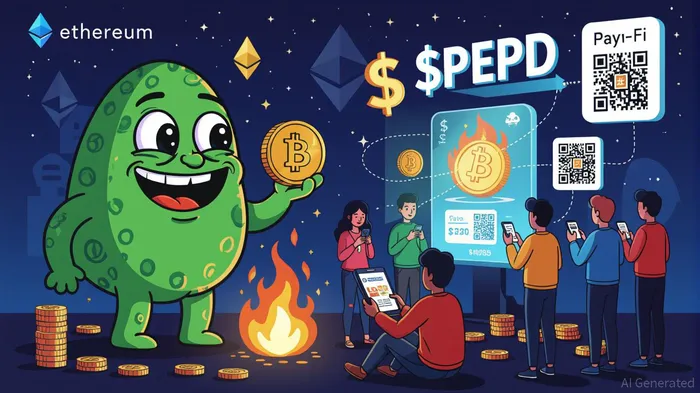
The cryptocurrency market's fascination with meme coins has created a unique niche for projects blending humor, community engagement, and speculative potential. Among these, Pepe Dollar ($PEPD) and the PEPE memecoin stand out as distinct yet Ethereum-centric experiments. While both leverage the Pepe the Frog meme, their approaches to token utility, community-driven growth, and EthereumETH-- integration diverge significantly. This analysis evaluates their high-risk, high-reward profiles, focusing on how Ethereum's infrastructure shapes their trajectories.
Token Utility: Meme-Driven vs. Functional Innovation
The PEPE memecoin, launched in 2023, operates as a deflationary token with no inherent utility beyond its cultural appeal. Its value proposition relies on scarcity mechanisms—such as token burns and redistribution to long-term holders—and the broader meme coin trend[2]. In contrast, $PEPD introduces Pay-Fi, a decentralized payments ecosystem enabling QR code checkouts, merchant integrations, and user-friendly wallets[2]. This functional layer differentiates $PEPD from pure meme coins, offering real-world utility while retaining the viral appeal of Pepe the Frog.
Ethereum's ERC-20 standard and Proof-of-Stake (PoS) security underpin both projects, but $PEPD's integration of no-code minting platforms for community-created meme tokens adds a layer of innovation[1]. By empowering users to generate their own tokens, $PEPD fosters a self-sustaining ecosystem, whereas PEPE's utility remains confined to speculative trading.
Community-Driven Growth: Viral Marketing vs. Strategic Partnerships
PEPE's rise to a $1.6 billion market cap in 2023 was fueled by social media virality, particularly on platforms like Twitter and Telegram[2]. Anonymous founders leveraged meme culture to build a community, but this approach lacks long-term governance structures. Conversely, $PEPD's roadmap emphasizes strategic partnerships with influencers and merchants, alongside influencer-driven campaigns to expand its user base[2]. The project's “Federal Burn” of 29% of its total supply further incentivizes holders by reinforcing scarcity[1].
Data from CoinMarketCap highlights PEPE's liquidity pool allocation: 93.1% of its 420.69 trillion tokens reside on UniswapUNI--, while 6.9% are reserved for centralized exchange listings[2]. $PEPD, however, has not disclosed similar liquidity metrics, suggesting a more opaque approach to capital distribution. This contrast underscores the risks of relying on unproven community strategies versus established DeFi mechanisms.
Ethereum Synergy: DeFi Integration and Scalability
Both projects benefit from Ethereum's DeFi ecosystem, but their integration depths vary. PEPE's liquidity on Uniswap and listings on Binance/KuCoin[2] position it as a tradable asset, while $PEPD's Pay-Fi infrastructure aims to bridge crypto and everyday commerce[2]. Ethereum's low transaction fees post-merge and smart contract flexibility are critical for these use cases, though neither project has announced NFT partnerships or cross-chain capabilities.
A key advantage for both is Ethereum's security and developer ecosystem, which mitigates risks of hacks or fraud. However, $PEPD's focus on merchant adoption could yield higher long-term value if it gains traction in retail payments—a use case PEPE does not address[1].
Risk Assessment: Speculation vs. Sustainable Growth
Meme coins inherently carry high volatility, but Ethereum's infrastructure offers a degree of stability. PEPE's lack of utility and reliance on social media trends make it a speculative bet, while $PEPD's Pay-Fi ecosystem and token burning mechanisms aim to create intrinsic value[1]. However, $PEPD's success hinges on executing its roadmap—particularly merchant integrations—which remain unproven.
Ethereum's upcoming upgrades (e.g., Proto-Danksharding) could enhance scalability for both projects, but competition from established DeFi protocols remains a hurdle. Investors must weigh the potential of meme-driven virality against the risks of overhyped, under-delivered projects.
Conclusion
The PEPE and $PEPD cases illustrate the duality of Ethereum-based meme coins: one prioritizes cultural virality, the other functional innovation. While PEPE's $1.6 billion peak demonstrates the power of community-driven speculation[2], $PEPD's Pay-Fi ecosystem and deflationary model aim to build a sustainable use case[2]. For investors, the key lies in assessing whether these projects can transcend their meme origins to become meaningful components of Ethereum's broader financial ecosystem.






Comentarios
Aún no hay comentarios