
Evaluating Edison International's Dividend Sustainability: A Balancing Act Between Growth and Risk
For income-focused investors, few sectors promise stability like utilities. Yet, even in this defensive space, sustainability hinges on a delicate balance of earnings, debt, and payout discipline. Edison InternationalEIX-- (EIX), a cornerstone of the U.S. power grid, offers a compelling case study in navigating these dynamics.
Dividend Payout Ratios: From Overpayment to Prudence
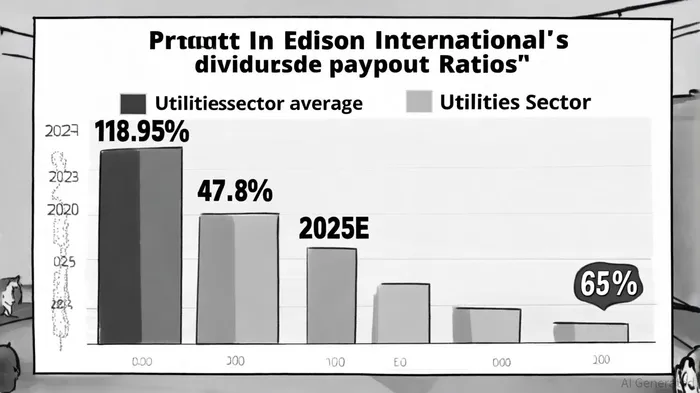
Edison's dividend strategy has undergone a notable recalibration. In 2023, the company reported a trailing payout ratio of 118.95%, distributing more in dividends than it earned—a red flag for sustainability[1]. However, forward-looking estimates paint a different picture. For 2025 and 2026, the payout ratio is projected at 62.50% and 58.30%, respectively[1], while the current ratio of 47.8% sits below the Utilities sector average of 65%[2]. This shift suggests a strategic pivot toward retaining earnings for reinvestment or debt management.
The annualized dividend of $3.26 (yield: 6.12%)[2] reflects a growing commitment to shareholders, with the most recent per-share payment rising to $0.828 from July 2024 to July 2025[2]. Such increases, coupled with a lower payout ratio, could signal long-term reliability—if earnings stabilize.
Earnings Trends: A Cloud Over Growth
Despite the improved payout ratio, earnings trends remain a concern. Edison's 3-year EPS growth rate stands at -24.90% as of June 30, 2025[4], with Q2 2025 results showing a 21% year-over-year decline in core EPS to $0.97 (adjusted)[3]. The drag comes from higher operations and maintenance expenses, regulatory headwinds at Southern California EdisonEIX-- (SCE), and elevated interest costs[3]. While the company reaffirmed its 2025 core EPS guidance of $5.94–$6.34[3], the path to meeting these targets appears fraught with operational pressures.
Debt Metrics: Leverage as a Double-Edged Sword
Edison's debt-to-equity ratio of 2.03 for Q2 2025[1] underscores its heavy reliance on borrowed capital. Though consistent with historical averages (2.10)[4], this level of leverage amplifies risk in a rising interest rate environment. Yet, cash flow from operations of $5.75 billion in 2025[4] provides a buffer, with the payout ratio based on cash flow at 23.92%[1]. This suggests the company can sustain dividends without overreliance on earnings, though debt servicing remains a critical watchpoint.
Investor Confidence: A Calculated Bet
The interplay of these factors defines investor sentiment. On one hand, Edison's low current payout ratio and robust cash flow offer reassurance. On the other, declining earnings and high leverage introduce volatility. For long-term holders, the key question is whether management can execute cost controls and regulatory negotiations to restore EPS growth. Southern California Edison's performance, in particular, will be pivotal given its role in the parent company's financial health[3].
Conclusion: A Dividend Stock in Transition
Edison International's dividend sustainability rests on its ability to balance aggressive payouts with earnings resilience. While the recent reduction in the payout ratio and strong cash flow generation are positives, the earnings slump and debt burden cannot be ignored. Investors seeking stable, growing dividends may find EIXEIX-- appealing, but they must weigh the risks of a sector increasingly exposed to regulatory and operational volatility. For now, Edison appears to be in a transitional phase—neither a sure bet nor a clear risk, but a stock demanding close scrutiny.





Comentarios
Aún no hay comentarios