
Evaluating DeFi Security Risks in Light of the Fusion PlasmaVault Exploit
The decentralized finance (DeFi) ecosystem has grown exponentially, offering innovative financial tools and democratizing access to global markets. However, this rapid expansion has also exposed systemic vulnerabilities, particularly in smart contract design. The hypothetical Fusion PlasmaVault exploit-while not a documented event-serves as a cautionary tale for investors, reflecting real-world risks such as reentrancy attacks, integer overflow errors, and economic invariant violations. These vulnerabilities, as highlighted by recent high-profile breaches, underscore the fragility of DeFi protocols and the urgent need for robust security frameworks.
The Fusion PlasmaVault Case Study: A Hypothetical but Instructive Scenario
Though the Fusion PlasmaVault exploit lacks direct documentation, its conceptual framework aligns with patterns observed in 2025 exploits. For instance, the Yearn FinanceYFI-- breach revealed how legacy contracts and economic invariant violations enabled attackers to mint near-infinite yETH tokens, resulting in $9.3 million in losses. Similarly, the Balancer exploit demonstrated how rounding errors in stable pool calculations could be weaponized through high-frequency batch swaps, amplifying financial risks. These incidents illustrate how even audited protocols can harbor hidden flaws, eroding investor trust and capital.
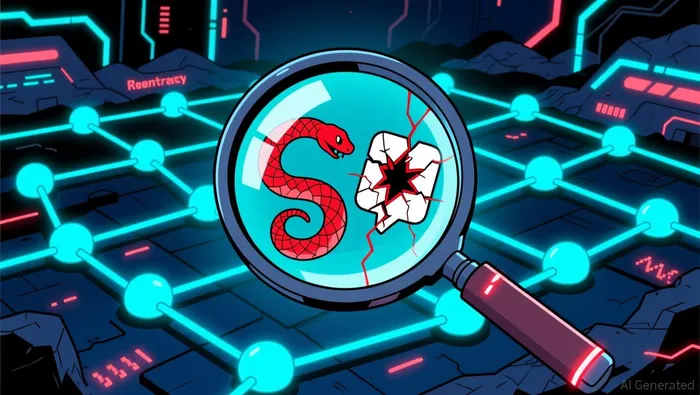
Reentrancy attacks, another recurring vulnerability, have caused catastrophic losses. The Rari Capital hack ($80 million in 2022) and Orion Protocol breach ($3 million in 2023) exploited unchecked external calls and poor state management. Such attacks thrive when contracts fail to follow the Checks-Effects-Interactions pattern, a foundational best practice in Solidity development.
The Role of Privacy Tools and Post-Exploit Challenges
Tools like Tornado CashTORN--, designed to anonymize blockchain transactions, complicate post-exploit recovery. While privacy is a legitimate user need, these tools can obscure the movement of stolen assets, making it harder to trace and recover funds. For example, attackers in the Poly Network heist (2021) leveraged cross-chain vulnerabilities and privacy mechanisms to siphon $600 million before returning most funds under pressure. This duality-privacy as both a shield and a weapon-highlights the need for protocols to balance transparency with user anonymity.
Mitigating Risks: The Rise of Advanced Security Tools
CertiK's SkyTrace and similar tools represent a critical advancement in smart contract security. By employing formal verification and differential fuzzing, these platforms identify vulnerabilities before deployment. For instance, the GMXGMX-- exploit ($42 million in 2025) revealed system boundary failures at the intersection of oracles and margin calculations. Tools like SkyTrace could have flagged such integration risks through adversarial modeling, a practice that simulates attacks to test protocol resilience.
Academic research further supports the efficacy of multimodal decision fusion methods, which use deep learning to detect vulnerabilities with high accuracy. These innovations, combined with rigorous audits and bug bounty programs, form a layered defense against exploits.
Strategic Recommendations for Investors
To safeguard capital in high-risk DeFi protocols, investors should adopt a multi-pronged approach: 1. Prioritize Audited Protocols: Favor projects with transparent audit histories and active bug bounty programs. The Yearn Finance and GMX exploits emphasize the dangers of legacy contracts and untested integrations. 2. Leverage Formal Verification: Support protocols that use formal verification tools to mathematically prove code correctness. This mitigates risks like integer overflow and reentrancy. 3. Monitor System Boundaries: Pay close attention to oracles, bridges, and cross-chain interactions, which are frequent attack vectors. 4. Engage in Community Governance: Advocate for security-focused upgrades and sunset mechanisms for outdated contracts, as seen in the Yearn Finance case.
Conclusion
The hypothetical Fusion PlasmaVault exploit, while unverified, encapsulates the real-world challenges facing DeFi. As the ecosystem matures, investors must remain vigilant, balancing innovation with security. By adopting advanced tools, demanding transparency, and learning from past breaches, the DeFi community can build a more resilient financial infrastructure-one that protects capital and fosters trust in the decentralized future.







Comentarios
Aún no hay comentarios